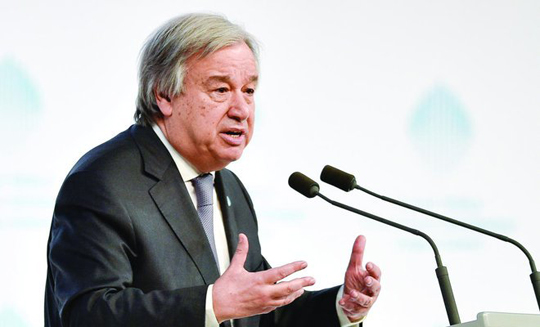
UN chief ‘deeply' regrets veto of Palestinian ex-PM as envoy

February 14, 2017

Dubai, Feb 14: UN chief Antonio Guterres on Monday said he “deeply” regretted opposition to former Palestinian Premier Salam Fayyad as the organization's peace envoy to Libya, days after Washington vetoed the appointment.

antonio

“I deeply regret this opposition and I do not see any reason for it,” Guterres said at the annual World Government Summit hosted by Dubai.

Guterres described Fayyad, a former World Bank official with a track record of fighting corruption, as “the right person for the right job at the right moment.”

“It's a loss for the Libyan peace process and the Libyan people,” he said, adding that the UN “needs to be able to act with impartiality.”

The UN leader on Wednesday had informed the Security Council of his intention to appoint Fayyad as a replacement for German Martin Kobler to conflict-torn Libya.

But US ambassador Nikki Haley vetoed the appointment, saying Washington did not support the message the move would send.

Israeli Prime Minister Benjamin Netanyahu hailed the US veto of Fayyad as counter to the “free gifts constantly given to the Palestinian side.”

Israeli media has meanwhile reported that the Jewish state could accept Fayyad's appointment if Tzipi Livni, a former Israeli foreign minister, were offered the position of UN deputy secretary general.

The head of the UN requires the unanimous support of all 15 Security Council members for appointments of special representatives to conflict areas.

Guterres also addressed the upcoming UN-sponsored peace talks on Syria, scheduled for Feb. 20 in Geneva. “There is no solution for the Syrian people without a comprehensive solution in which all Syrians feel they are properly represented,” he said. The Geneva talks “are a first step for serious progress in finding a transition that allows for a political solution in which all Syrians feel represented,” Guterres added.

Guterres also condemned North Korea's latest ballistic missile test and called for a united international response to the “further troubling violation” of UN resolutions.

His statement came ahead of an urgent UN Security Council meeting called to discuss Sunday's missile test.

Comments

shaji
 - 
Tuesday, 14 Feb 2017

US and Isratel are two faces of Devil and live together. There will be no peace in the world unless and untill these two Devil nations are removed from UN.

Add new comment

  • Coastaldigest.com reserves the right to delete or block any comments.
  • Coastaldigset.com is not responsible for its readers’ comments.
  • Comments that are abusive, incendiary or irrelevant are strictly prohibited.
  • Please use a genuine email ID and provide your name to avoid reject.
News Network
June 17,2020

Vienna, Jun 17: Austrian police fined a man 500 euros for loudly breaking wind after officers stopped him earlier this month to check his identity.

The police defended the massive fine saying he had deliberately emitted a "massive flatulence," lifting his backside from the bench where he was sitting.

The accused complained of what he called the disproportionate and unjustified fine when he gave his account of the June 5 events on the O24 news website.

In reply to social media commentaries that followed, the police in the Austrian capital justified their reaction on Twitter.

"Of course, nobody is put on the spot if one slips out by accident," the police said.

However, in this case, the police said, the young man had appeared "provocative and uncooperative" in general.

He then "slightly raised himself from the bench, looked at the officers and patently, in a completely deliberate way, emitted a massive flatulence in their immediate proximity."

Comments

Add new comment

  • Coastaldigest.com reserves the right to delete or block any comments.
  • Coastaldigset.com is not responsible for its readers’ comments.
  • Comments that are abusive, incendiary or irrelevant are strictly prohibited.
  • Please use a genuine email ID and provide your name to avoid reject.
News Network
February 19,2020

London, Feb 19: UK Home Secretary Priti Patel today announced the launch of the Britain's new points-based visa system, aimed at attracting the "brightest and the best" from the world, including from India, and cutting down numbers of cheap, low-skilled workers coming to the country.

The new system will come into force from January 1, 2021 at the end of the transition period after the UK's exit from the European Union (EU) last month, which will formally end free movement of people within the economic bloc for the UK as a non-member.

The new post-Brexit system, which will apply equally to the EU and non-EU countries like India, is based on assigning points for specific skills, qualifications, salaries and professions, with visas only awarded to those who gain enough points.

"Today is a historic moment for the whole country. We're ending free movement, taking back control of our borders and delivering on the people's priorities by introducing a new UK points-based immigration system, which will bring overall migration numbers down," said Ms Patel, the senior-most Indian-origin Cabinet minister.

"We will attract the brightest and the best from around the globe, boosting the economy and our communities, and unleash this country's full potential," Ms Patel, in charge of the UK's visa and immigration system, said.

The UK Home Office said the new system is a direct response to the 2016 referendum in favour of Brexit, which was seen as a vote to end the country's reliance on cheap migrant labour and reduce overall levels of migration with tighter security.

"The new single global system will treat the EU and non-EU citizens equally. It will give top priority to those with the highest skills and the greatest talents, including scientists, engineers and academics," the Home Office said.

The Global Talent Scheme, a fast-track visa to be in operation from Friday, will also apply to the EU citizens from next year to allow highly-skilled scientists and researchers to come to the UK without a job offer.

Professor Alice Gast, President of Imperial College London, said: "British science is global. The new post-study work and Global Talent visas will help us to attract the world's brightest students and researchers, wherever they come from."

"From the race to develop a coronavirus vaccine to clean energy, British science's international collaborations drive innovation and excellence."

The government said the points threshold for the new system will be carefully set to attract the talent the UK needs. Skilled workers will need to meet a number of relevant criteria, including specific skills and the ability to speak English, to be able to work in the UK. All applicants will be required to have a job offer and, in line with the Migration Advisory Committee''s (MAC) recommendations, the minimum salary threshold will be set at 25,600 pounds - lower than the previous 30,000 pounds level for Tier 2 work visas.

The new points-based system will also expand the skills threshold for skilled workers.

Those looking to live and work in the UK will need to be qualified up to A-level or equivalent, rather than degree-level under the current system. This will provide greater flexibility and ensure UK business has access to a wide pool of skilled workers, the Home Office said.

In line with the British Prime Minister Boris Johnson's manifesto commitment in the December 2019 General Election, there will be no specific route for low-skilled workers.

"It is estimated 70 per cent of the existing EU workforce would not meet the requirements of the skilled worker route, which will help to bring overall numbers down in future," the Home Office said.

Student visa routes will also be points-based and be opened up to EU citizens from next year.

Those wishing to study in the UK will need to demonstrate that they have an offer from an approved educational institution, that they can support themselves financially and that they speak English.

To address the specific labour concerns of the agricultural sector reliant on seasonal workers from the EU, the Seasonal Workers Pilot will be expanded in time for the 2020 harvest from 2,500 to 10,000 places.

EU citizens and other non-visa nationals will not require a visa to enter the UK when visiting the UK for up to six months.

However, the use of national identity cards will be phased out for travel to the UK and the Home Office highlighted that as part of its post-Brexit offer, those EU citizens resident in the UK by December 31 2020 can still apply to settle in the UK through the EU Settlement Scheme until June 2021.


Comments

Add new comment

  • Coastaldigest.com reserves the right to delete or block any comments.
  • Coastaldigset.com is not responsible for its readers’ comments.
  • Comments that are abusive, incendiary or irrelevant are strictly prohibited.
  • Please use a genuine email ID and provide your name to avoid reject.
News Network
May 25,2020

Karachi, May 25: The pilot of the Pakistan International Airlines (PIA)'s crashed plane ignored three warnings from the air traffic controllers about the aircraft's altitude and speed before the landing, saying he was satisfied and would handle the situation, according to a report on Monday.

The national flag carrier's PK-8303 tragedy on Friday, in which 97 people were killed and two miraculously survived, is one of the most catastrophic aviation disasters in the country's history.

The Airbus A-320 from Lahore to Karachi was 15 nautical miles from the Jinnah International Airport, flying at an altitude of 10,000 feet above the ground instead of 7,000 when the Air Traffic Control (ATC) issued its first warning to lower the plane's altitude, Geo News quoted an ATC report as saying.

Instead of lowering the altitude, the pilot responded by saying that he was satisfied. When only 10 nautical miles were left till the airport, the plane was at an altitude of 7,000 feet instead of 3,000 feet, it said.

The ATC issued a second warning to the pilot to lower the plane's altitude. However, the pilot responded again by stating that he was satisfied and would handle the situation, saying he was ready for landing, the report said.

The report said that the plane had enough fuel to fly for two hours and 34 minutes, while its total flying time was recorded at one hour and 33 minutes.

Pakistani investigators are trying to find out if the crash is attributable to a pilot error or a technical glitch.

According to a report prepared by the country's Civil Aviation Authority (CAA), the plane's engines had scraped the runway thrice on the pilot's first attempt to land, causing friction and sparks recorded by the experts.

When the aircraft scraped the ground on the first failed attempt at landing, the engine's oil tank and fuel pump may have been damaged and started to leak, preventing the pilot from achieving the required thrust and speed to raise the aircraft to safety, the report said.

The pilot made a decision "on his own" to undertake a "go-around" after he failed to land the first time. It was only during the go-around that the ATC was informed that landing gear was not deploying, it said.

"The pilot was directed by the air traffic controller to take the aircraft to 3,000 feet, but he managed only 1,800. When the cockpit was reminded to go for the 3,000 feet level, the first officer said 'we are trying'," the report said.

Experts said that the failure to achieve the directed height indicates that the engines were not responding. The aircraft, thereafter, tilted and crashed suddenly.

The flight crashed at the Jinnah Garden area near Model Colony in Malir on Friday afternoon, minutes before its landing in Karachi's Jinnah International Airport. Eleven people on the ground were injured.

The probe team, headed by Air Commodore Muhammad Usman Ghani, President of the Aircraft Accident and Investigation Board, is expected to submit a full report in about three months.

According to the PIA's engineering and maintenance department, the last check of the plane was done on March 21 this year and it had flown from Muscat to Lahore a day before the crash.

In the wake of the COVID-19 pandemic, the Pakistan government had allowed the limited domestic flight operations from five major airports - Islamabad, Karachi, Lahore, Peshawar and Quetta - from May 16.

After the plane tragedy, the PIA has called off its domestic operation.

Comments

Add new comment

  • Coastaldigest.com reserves the right to delete or block any comments.
  • Coastaldigset.com is not responsible for its readers’ comments.
  • Comments that are abusive, incendiary or irrelevant are strictly prohibited.
  • Please use a genuine email ID and provide your name to avoid reject.