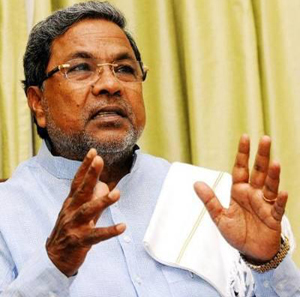
'Unhappy' Congress high command asks Karnataka CM to clarify flag row

DHNS
July 18, 2017

New Delhi, Jul 18: The Congress high command is "unhappy" over the Karnataka Government's decision to constitute a separate committee for designing a state flag and has asked Chief Minister Siddaramaiah to come up with a clarification to end the controversy.cm

With the opposition parties targeting the Congress for what they charged flaring up separatists mindset among the public, the party top brass wanted to put an end the controversy.

"The Congress does not have a policy for a state having a separate flag. I have asked the government to clarify the issue," K C Venugopal, AICC General Secretary in-charge of Karnataka told DH. He also said that the country has only one flag and that is the national flag.

Congress senior leader and Rajya Sabha MP Renuka Chaudhury also said one country should have one flag. "I don't know what is the reason for Karnataka to have a separate flag, she commented.

Sanjay Raut, the Shiv Sena spokesperson, demanded the dismissal of the state government. "The Congress ruled government in Karnataka is triggering separatism in the state" he said demanding the imposition of presidential rule immediately.

The Karnataka government has formed a nine-member committee to submit a report on designing a separate flag for the state and providing a legal standing for it. Chief Minister Siddaramaiah defended his government's move on the grounds that constitution does not bar states from having its own flag.

State Congress sources said that the party was trying to build a narrative on Kannada pride to counter BJP's Hindutva agenda ahead of next year's assembly elections.

The committee, headed by the principal secretary, Department of Kannada and Culture, was set up last month after a representation from noted Kannada writer and journalist Patil Puttappa, and social worker Bheemappa Gundappa Gadada.

Puttappa and Gadada in their representation had requested the government to design a separate flag for 'Kannada Naadu' and accord it legal standing.

Comments

Shamshuddin mohammed
 - 
Thursday, 20 Jul 2017

Bhakthon send parikkar to Pakistan now

Add new comment

  • Coastaldigest.com reserves the right to delete or block any comments.
  • Coastaldigset.com is not responsible for its readers’ comments.
  • Comments that are abusive, incendiary or irrelevant are strictly prohibited.
  • Please use a genuine email ID and provide your name to avoid reject.
News Network
March 15,2020

While it makes perfect sense for IT employees to work from remote locations via video conferencing and collaboration tools seamlessly - especially in the case of tech giants like Google or Microsoft -- workers from the non-IT companies and small and medium enterprises (SMBs) are the worst-hit in India as most of them have little or no clue about how these messaging and collaboration tools work amid the coronavirus pandemic.

Small companies -- from corporate to education verticals -- are scrambling to get their act together as new coronavirus threat has reached their premises, prompting them to send employees home who have age-old laptops, poor network and connectivity with no UPS backups and little knowledge about how to handle group chat and collaboration software like Zoom, Google Hangouts Meet, Microsoft Teams and Flock etc.

Instead of halting operations, however, businesses can choose to shift towards remote working methods with teaching non-IT staff on how to use the latest digital software to connect and work, say industry experts.

The training will take some time and may hamper productivity in the short run but is a win-win situation for the non-tech companies in the long run, in case any such global emergency arises in the future.

According to a latest report by Gartner, 54 per cent of HR leaders have cited that poor technology and/or infrastructure for remote working is the biggest barrier to effective remote working.

Sandy Shen, Senior Director Analyst, Gartner, says that with COVID-19 disrupting the business landscape, CIOs should relook at the digital fulfillment of market demand.

"The value of digital channels, products and operations is immediately obvious to companies everywhere right now. This is a wake-up call for organisations that have placed too much focus on daily operational needs at the expense of investing in digital business and long-term resilience," warned Shen.

Businesses that can shift technology capacity and investments to digital platforms will mitigate the impact of the outbreak and keep their companies running smoothly now, and over the long term.

"Videoconferencing, messaging, collaboration tools and document sharing are just a few examples of technologies that facilitate remote work. Additional bandwidth and network capacity may also be needed, given the increasing number of users and volume of communications," informed Shen.

The IT industry's apex body Nasscom has asked the government to relax norms for a month to allow work-from-home for technology and back-office employees as a measure to deal with the spread of Covid-19 in India.

Networking giant Cisco said that it has seen "significant growth" in the usage of its web conferencing and video-conferencing service Webex in India.

According to Muneer Ahmad, Business Head, ViewSonic India, due to COVID-19 pandemic, the corporate and educational sector is severely getting affected in the country.

"ViewSonic IFP has a cloud-based software which help teachers and corporates to connect through video conferencing to multiple people at the same time and can split the screen into six screens. It can also connect with various tools like Skype, Cisco WebEx, Zoom, Google Hangouts and GoToMeeting," Ahmad told IANS.

Co-working sector has also taken a hit and the industry is looking at several measures to tackle it -- from ensuring supply of juices rich in Vitamin C to supply of disinfectants and giving work from home facilities.

"The scheduled visits of the clients at our co-working offices have been postponed. Few of our clients have cancelled their outstation meetings and have now started audio/video conferencing for virtual meetings," said Nakul Mathur, MD, Avanta India.

According to reports, India has approximately 1,000 co-working locations (as of September 2019) and is the second-largest market for the co-working industry after China.

As India's first licensed B2B Virtual Network Operator, CloudConnect Communications offers a collaborative platform that allows companies to overcome the COVID-19 threat while maintaining seamless business continuity and optimum employee productivity.

"We offer a secure, robust, reliable, scalable and trackable mobile-first unified communication infrastructure that aids remote teleworking so that businesses can continue operating even under any unforeseen circumstances," said Gokul Tandon, Executive Chairman, CloudConnect Communications.


Comments

Add new comment

  • Coastaldigest.com reserves the right to delete or block any comments.
  • Coastaldigset.com is not responsible for its readers’ comments.
  • Comments that are abusive, incendiary or irrelevant are strictly prohibited.
  • Please use a genuine email ID and provide your name to avoid reject.
News Network
March 6,2020

Bengaluru, Mar 6: At least 13 persons, including women and children, were killed and five critically wounded when an SUV collided with a car that had crashed against a road divider moments ago near Kunigal in Tumakuru district of Karnataka in the early hours of Friday, police said.

Of the victims, while 12 died on the spot, a child breathed his last in a hospital, they added.

The injured were admitted to the hospital, the police said.

Among the dead, 10 were from Tamil Nadu and three from Bengaluru. All of them were pilgrims who were on their way to Dharmasthala in Karnataka.

There were five women and two children among the dead, the police said.

"Thirteen persons have died. The incident occurred post midnight. A car crashed against the road divider and another car collided with it," Tumakuru Superintendent of Police (SP) K Vamsi Krishna said.

The police had to struggle to pull the bodies out from the mangled vehicles.

On learning about the incident, relatives of the victims rushed to the spot.

Comments

Add new comment

  • Coastaldigest.com reserves the right to delete or block any comments.
  • Coastaldigset.com is not responsible for its readers’ comments.
  • Comments that are abusive, incendiary or irrelevant are strictly prohibited.
  • Please use a genuine email ID and provide your name to avoid reject.
News Network
June 20,2020

Bengaluru, Jun 20: The Karnataka Health Department has issued guidelines on the admission of COVID-19 patients in private hospitals after clinical assessment, mandating that the district surveillance officer (DSO) should be first informed to initiate further procedures, an official said on Friday.

"A health team sent by the DSO should visit the home or hospital where the patient is staying. The team should conduct a rapid assessment of his or her health condition," said Karnataka's Additional Chief Secretary Jawaid Akhtar.

In the rapid health condition assessment, the team should first check the patient's body temperature, followed by SpO2 (oxygen saturation) level and confirm if there are any comorbidities such as hypertension, diabetes, tuberculosis, HIV, cancer, stroke etc.

Depending on the health condition of patients, Akhtar said, two categories have been made.

"Those who have body temperature greater than 37.5 degrees Celsius, SpO2 level below 94 percent, elderly (above 60 years) and suffering from known comorbid conditions should be taken to a dedicated Covid hospital (DCH)," he said.

"All other patients, even if older but not suffering from co-morbidities, those below 60 and suffering from co-morbidities and asymptomatic cases should be taken to a dedicated Covid health centre (DCHC) or a private hospital as opted by the patient," he added.

Private hospitals have been asked to pitch in due to the rising number of cases in Karnataka. Currently, there are 2943 active cases in the state after 337 cases were reported on Friday.

"The patients are assessed clinically and evaluated at DCHCs or private hospitals with appropriate diagnostic tests. After evaluation, if the patients are asymptomatic, they are shifted to a COVID Care Centre (CCC) for further management," said Akhtar.

CCCs are expected to be equipped with ventilated rooms, pulse oximeters, handheld thermal scanners and blood pressure apparatus.

A nurse has to be present round the clock for every 50 patients and should visit each patient twice a day for assessment whereas the medical officer has to visit the CCC once a day. He should also be available on call in case of an emergency.

Staff serving food and others should wear personal protective equipment and an N-95 mask. Explaining the procedures at DCHCs, Akhtar said general examinations for medical conditions like body temperature, BP, pulse, oxygen saturation and urine output should be in place.

Investigations such as complete blood count, fasting blood sugar, random blood sugar, liver function tests, renal function tests, ECG and chest X-ray facilities should be available.

"DCHCs should ensure that above examinations are over in an orderly timeline of 24 hours and depending on the examination, the patient is continued to be lodged at the DCHC or sent to DCH or CCC," said the senior officer.

Likewise, the discharge policy should be done as per the protocols issued by the Health Department from time to time.

The Karnataka government is yet to fix an upper limit on the cost of treating COVID-19 patients in private hospitals. While reports indicated that this could be capped at Rs 5200 per day, health officials are yet to specify this is the case. Private hospitals in the state have asked the government to take a collaborative approach in deciding the fixed cap on treatment cost.

Comments

Add new comment

  • Coastaldigest.com reserves the right to delete or block any comments.
  • Coastaldigset.com is not responsible for its readers’ comments.
  • Comments that are abusive, incendiary or irrelevant are strictly prohibited.
  • Please use a genuine email ID and provide your name to avoid reject.