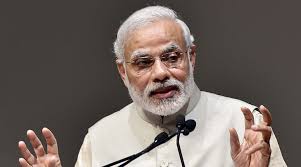
Unity & Love are basic mantras to address Kashmir problem: PM

August 28, 2016

New Delhi, Aug 28: Prime Minister Narendra Modi today said "Ekta" (unity) and "Mamata" (love) are the basic mantras for addressing the Kashmir problem even as he slammed those pushing children to create unrest, saying they will have to give answers to those "innocent" kids some day. He emphasised that if any life is lost in Kashmir, whether of any youth or any securityman, "that loss is ours, of our own country".

modipmSpeaking on the unrest in the valley in his monthly radio programme 'Mann Ki Baat', Modi said, "From the interactions I had with all parties on Kashmir, one thing emerged from those, which can be put in simple words as 'Ekta' and 'Mamata'. These two things were the basic mantra."

He said all the political parties had spoken in one voice on Kashmir, sending out a "message to the world as well as separatist forces" besides conveying "our sentiments to the people of Kashmir". He equated it to the passage of landmark GST Bill by Parliament for which all the parties came together.

"It is the view of all of us, the view of 125 crore people from a pradhan of a village to the Prime Minister, that if any life is lost in Kashmir, whether of any youth or any securityman, that loss is ours, our own country," Modi said.

At the same time, he slammed "those people who push small children to try to create unrest in Kashmir", saying "some day, they will have to give answers to these innocent children". The Prime Minister's remarks came a day after Jammu and Kashmir Chief MInister Mehbooba Mufti met him and presented a "three-pronged action plan" that includes dialogue with all stakeholders.

Comments

abdul
 - 
Sunday, 28 Aug 2016

Devil preaching the peace & harmony

Add new comment

  • Coastaldigest.com reserves the right to delete or block any comments.
  • Coastaldigset.com is not responsible for its readers’ comments.
  • Comments that are abusive, incendiary or irrelevant are strictly prohibited.
  • Please use a genuine email ID and provide your name to avoid reject.
News Network
July 18,2020

Golaghat, Jul 18: A total of 96 animals have died in the Kaziranga National Park in Golaghat district of Assam due to floods, the state government informed on Saturday.

"So far, 96 animals have died in the park including eight rhinos, seven wild boars, two swamp deers, 74 hog deer and two porcupines," park officials said.

A report from the government of Assam stated that a total of 132 animals had been rescued from the Kaziranga National Park. The park is currently 85 per cent submerged under floodwaters.

"Water level at Pasighar and Dibrugarh are below the prescribed danger level. The floodwater in Numaligarh, Dhansirimukh and Tezpur are still above danger level," the report stated.

At least 76 people have died and nearly 54 lakh people have been affected in 30 districts of Assam due to floods caused by the monsoon rains and the rise in water levels of the Brahmaputra river, informed the Assam State Disaster Management Authority (ASDMA) on Friday.

Comments

Add new comment

  • Coastaldigest.com reserves the right to delete or block any comments.
  • Coastaldigset.com is not responsible for its readers’ comments.
  • Comments that are abusive, incendiary or irrelevant are strictly prohibited.
  • Please use a genuine email ID and provide your name to avoid reject.
News Network
July 10,2020

New Delhi, July 10: Hours before gangster Vikas Dubey was killed in an alleged police encounter on Friday, a plea was filed in the Supreme Court demanding urgent listing for action into his "possible killing" by Uttar Pradesh Police.

Advocate Ghanshyam Upadhyay had apprehended in his plea that there is a high possibility that Dubey will also be killed in a 'fake' encounter after his arrest from Ujjain in Madhya Pradesh a day ago.

Upadhyay claimed that the UP Police was expected to "concoct the same story of encounter" for Dubey like it did when four of his associates were killed after the 2 July incident.

Dubey was the primary accused in the killing of eight policemen in Kanpur on July 2. He was arrested from Ujjain on Thursday. He was killed in a police encounter, when he allegedly tried to flee on Friday morning.

"During the hunt for Dubey and co-accused, five of his accused aides were arrested/caught and then killed by the police in the name of encounter...Thus, there is every possibility that even Dubey shall be killed by Uttar Pradesh Police like other co-accused once his custody is obtained," Upadhyay feared.

He submitted that the killing of the accused by the police in the name of encounter no matter how heinous the crime was "against the rule of law and serious violation of human rights and nothing sort of Talibanisation of the country". Upadhyay sought hearing in the matter on Friday itself, citing extreme urgency.

Comments

Add new comment

  • Coastaldigest.com reserves the right to delete or block any comments.
  • Coastaldigset.com is not responsible for its readers’ comments.
  • Comments that are abusive, incendiary or irrelevant are strictly prohibited.
  • Please use a genuine email ID and provide your name to avoid reject.
Agencies
June 6,2020

United Nations, Jun 6: The coronavirus disease has not "exploded" in India, but the risk of that happening remains as the country moves towards unlocking its nationwide lockdown that was imposed in March to contain the Covid-19, according to a top WHO expert.

WHO Health Emergencies Programme Executive Director Michael Ryan on Friday said the doubling time of the coronavirus cases in India is about three weeks at this stage.

“So the direction of travel of the epidemic is not exponential but it is still growing,” he said, adding that the impact of the pandemic is different in different parts of India and varies between urban and rural settings.

“In South Asia, not just in India but in Bangladesh and...in Pakistan, other countries in South Asia, with large dense populations, the disease has not exploded. But there is always the risk of that happening,” Ryan said in Geneva.

He stressed that as the disease generates and creates a foothold in communities, it can accelerate at any time as has been seen in a number of settings.

Ryan noted that measures taken in India such as the nationwide lockdown have had an impact in slowing transmission but the risk of an increase in cases looms as the country opens up.

“The measures taken in India certainly had an impact in dampening transmission and as India, as in other large countries, open up and as people begin to move again, there's always a risk of the disease bouncing back up,” he said.

He added that there are specific issues in India regarding the large amount of migration, the dense populations in the urban environment and the fact that many workers have no choice but to go to work every day.

India went past Italy to become the sixth worst-hit nation by the COVID-19 pandemic.

India saw a record single-day jump of 9,887 coronavirus cases and 294 deaths on Saturday, pushing the nationwide infection tally to 2,36,657 and the death toll to 6,642, according to the health ministry.

The lockdown in India, was first clamped on March 25 and spanned for 21 days, while the second phase of the curbs began on April 15 and stretched for 19 days till May 3. The third phase of the lockdown was in effect for 14 days and ended on May 17. The fourth phase ended on May 31.

The country had registered 512 coronavirus infection cases till March 24.

The nation-wide lockdown in containment zones will continue till June 30 in India but extensive relaxations in a phased manner from June 8 are listed in the Union home ministry's fresh guidelines on tackling the Covid-19 pandemic issued last week.

WHO Chief Scientist Soumya Swaminathan said the over 200,000 current coronavirus cases in India, a country of over 1.3 billion people, "look big but for a country of this size, it's still modest.”

She stressed that it is important for India to keep track of the growth rate, the doubling time of the virus and to make sure that that number doesn't get worse.

She said that India is a “heterogeneous and huge country” with very densely populated cities and much lower density in some rural areas and varying health systems in different states and these offer challenges to the control of Covid-19.

Swaminathan added that as the lockdown and restrictions are lifted, it must be ensured that all precautions are taken by people.

“We've been making this point repeatedly that really if you want behaviour change at a large level, people need to understand the rationale for asking them to do certain things (such as) wearing masks,” she said.

In many urban areas in India, it's impossible to maintain physical distancing, she said adding that it then becomes very important for people to wear appropriate face coverings when they are out, in office settings, in public transport and educational institutions.

“As some states are thinking about opening, every institution, organisation, industry and sector needs to think about what are the measures that need to be put in place before you can allow a functioning and it may never be back to normal.”

She said that in many professions working from home can be encouraged but in several jobs, people have to go to work and in such cases measures must be put in place that allow people to protect themselves and others.

“I think communication and behaviour change is a very large part of this whole exercise,” she added.


Comments

Add new comment

  • Coastaldigest.com reserves the right to delete or block any comments.
  • Coastaldigset.com is not responsible for its readers’ comments.
  • Comments that are abusive, incendiary or irrelevant are strictly prohibited.
  • Please use a genuine email ID and provide your name to avoid reject.