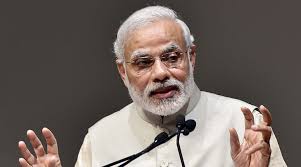
Unity & Love are basic mantras to address Kashmir problem: PM

August 28, 2016

New Delhi, Aug 28: Prime Minister Narendra Modi today said "Ekta" (unity) and "Mamata" (love) are the basic mantras for addressing the Kashmir problem even as he slammed those pushing children to create unrest, saying they will have to give answers to those "innocent" kids some day. He emphasised that if any life is lost in Kashmir, whether of any youth or any securityman, "that loss is ours, of our own country".

modipmSpeaking on the unrest in the valley in his monthly radio programme 'Mann Ki Baat', Modi said, "From the interactions I had with all parties on Kashmir, one thing emerged from those, which can be put in simple words as 'Ekta' and 'Mamata'. These two things were the basic mantra."

He said all the political parties had spoken in one voice on Kashmir, sending out a "message to the world as well as separatist forces" besides conveying "our sentiments to the people of Kashmir". He equated it to the passage of landmark GST Bill by Parliament for which all the parties came together.

"It is the view of all of us, the view of 125 crore people from a pradhan of a village to the Prime Minister, that if any life is lost in Kashmir, whether of any youth or any securityman, that loss is ours, our own country," Modi said.

At the same time, he slammed "those people who push small children to try to create unrest in Kashmir", saying "some day, they will have to give answers to these innocent children". The Prime Minister's remarks came a day after Jammu and Kashmir Chief MInister Mehbooba Mufti met him and presented a "three-pronged action plan" that includes dialogue with all stakeholders.

Comments

abdul
 - 
Sunday, 28 Aug 2016

Devil preaching the peace & harmony

Add new comment

  • Coastaldigest.com reserves the right to delete or block any comments.
  • Coastaldigset.com is not responsible for its readers’ comments.
  • Comments that are abusive, incendiary or irrelevant are strictly prohibited.
  • Please use a genuine email ID and provide your name to avoid reject.
News Network
January 13,2020

Jan 13: For the first time in years, the government of India’s Prime Minister Narendra Modi is playing defense. Protests have sprung up across the country against an amendment to India’s laws — which came into effect on Friday — that makes it easier for members of some religions to become citizens of India. The government claims this is simply an attempt to protect religious minorities in the Muslim-majority countries that border India; but protesters see it as the first step toward a formal repudiation of India’s constitutionally guaranteed secularism — and one that must be resisted.

Modi was re-elected prime minister last year with an enhanced majority; his hold over the country’s politics is absolute. The formal opposition is weak, discredited and disorganized. Yet, somehow, the anti-Citizenship Act protests have taken hold. No political party is behind them; they are generally arranged by student unions, neighborhood associations and the like.

Yet this aspect of their character is precisely what will worry Modi and his right-hand man, Home Minister Amit Shah. They know how to mock and delegitimize opposition parties with ruthless efficiency. Yet creating a narrative that paints large, flag-waving crowds as traitors is not quite that easy.

For that is how these protests look: large groups of young people, many carrying witty signs and the national flag. They meet and read the preamble to India’s Constitution, into which the promise of secularism was written in the 1970’s.

They carry photographs of the Constitution’s drafter, the Columbia University-trained economist and lawyer B. R. Ambedkar. These are not the mobs the government wanted. They hoped for angry Muslims rampaging through the streets of India’s cities, whom they could point to and say: “See? We must protect you from them.” But, in spite of sometimes brutal repression, the protests have largely been nonviolent.

One, in Shaheen Bagh in a Muslim-dominated sector of New Delhi, began simply as a set of local women in a square, armed with hot tea and blankets against the chill Delhi winter. It has now become the focal point of a very different sort of resistance than what the government expected. Nothing could cure the delusions of India’s Hindu middle class, trained to see India’s Muslims as dangerous threats, as effectively as a group of otherwise clearly apolitical women sipping sweet tea and sharing their fears and food with anyone who will listen.

Modi was re-elected less than a year ago; what could have changed in India since then? Not much, I suspect, in most places that voted for him and his party — particularly the vast rural hinterland of northern India. But urban India was also possibly never quite as content as electoral results suggested. India’s growth dipped below 5% in recent quarters; demand has crashed, and uncertainty about the future is widespread. Worse, the government’s response to the protests was clearly ill-judged. University campuses were attacked, in one case by the police and later by masked men almost certainly connected to the ruling party.

Protesters were harassed and detained with little cause. The courts seemed uninterested. And, slowly, anger began to grow on social media — not just on Twitter, but also on Instagram, previously the preserve of pretty bowls of salad. Instagram is the one social medium over which Modi’s party does not have a stranglehold; and it is where these protests, with their photogenic signs and flags, have found a natural home. As a result, people across urban India who would never previously have gone to a demonstration or a political rally have been slowly politicized.

India is, in fact, becoming more like a normal democracy. “Normal,” that is, for the 2020’s. Liberal democracies across the world are politically divided, often between more liberal urban centers and coasts, and angrier, “left-behind” hinterlands. Modi’s political secret was that he was that rare populist who could unite both the hopeful cities and the resentful countryside. Yet this once magic formula seems to have become ineffective. Five of India’s six largest cities are not ruled by Modi’s Bharatiya Janata Party in any case — the financial hub of Mumbai changed hands recently. The BJP has set its sights on winning state elections in Delhi in a few weeks. Which way the capital’s voters will go is uncertain. But that itself is revealing — last year, Modi swept all seven parliamentary seats in Delhi.

In the end, the Citizenship Amendment Act is now law, the BJP might manage to win Delhi, and the protests might die down as the days get unmanageably hot and state repression increases. But urban India has put Modi on notice. His days of being India’s unifier are over: From now on, like all the other populists, he will have to keep one eye on the streets of his country’s cities.


Comments

Add new comment

  • Coastaldigest.com reserves the right to delete or block any comments.
  • Coastaldigset.com is not responsible for its readers’ comments.
  • Comments that are abusive, incendiary or irrelevant are strictly prohibited.
  • Please use a genuine email ID and provide your name to avoid reject.
News Network
July 1,2020

Patna, July 1: A wedding ceremony in rural Patna a fortnight ago where the groom was running high fever, two days before he died and his body cremated without being tested for COVID 19, appears to have set off the biggest infection chain in Bihar so far, health department officials said on Tuesday.

More than 111 people have tested positive in Paliganj sub-division of Patna district, about 55 km from the state capital, in the last few days, out of over 350 who have been tested upon contact tracing, they said. Fifteen of his relatives who attended the wedding tested positive for the contagion and apparently infected others.

The officials, who requested anonymity, said the groom was a software engineer based in Gurugram and had returned home for his marriage in the last week of May. A few days after the ''tilak'' ceremony, he started showing symptoms of the disease.

On June 15, the date of wedding, he was running high fever and wanted the ceremony to be deferred, but relented upon the insistence of family members who made him swallow paracetamol tablets and go through the rituals.
On June 17, his condition deteriorated significantly and family members made a dash to AIIMS, Patna, but he died on the way.

The body was cremated in a huff, without the authorities being informed. But somebody telephoned the district magistrate and narrated the whole episode. All close relatives of the deceased, who attended the ceremony, were tested on June 19. Of them 15 tested positive, the officials said.

As a measure to contain the spread of the disease, a special camp was set up at the village where the marriage took place on June 24-26 during which samples of 364 people were collected. Of them, 86 tested positive, the officials added.

The sudden explosion of the dreaded coronavirus has triggered panic in the area. Although most who tested positive were asymptomatic, they have been admitted to isolation centres in Bihta and Phulwarisharif.

Block Development Officer Chiranjeev Pandey said Meetha Kuan, Khagari Mohalla and parts of Paliganj Bazaar have been sealed for thorough sanitisation.

Patna district happens to be the worst-affected in Bihar with 699 confirmed cases till date and five casualties, according to figures provided by the administration. The number of active cases is 372.

On Monday, when the state witnessed its biggest single day spike with 394 cases, Patna district accounted for more than 20 per cent of these. About eighty cases were reported from Paliganj alone.

Comments

Add new comment

  • Coastaldigest.com reserves the right to delete or block any comments.
  • Coastaldigset.com is not responsible for its readers’ comments.
  • Comments that are abusive, incendiary or irrelevant are strictly prohibited.
  • Please use a genuine email ID and provide your name to avoid reject.
News Network
June 20,2020

Hyderabad, Jun 20: IAF Chief Air Chief Marshal RKS Bhadauria on Saturday said that the force is well prepared and suitably deployed to respond to any contingency and it will never let the sacrifice of the bravehearts of Galwan go in vain.

"It should be very clear that we are well prepared and suitably deployed to respond to any contingency. I assure the nation that we are determined to deliver and will never let the sacrifice of the braves of Galwan go in vain," IAF Chief Air Chief Marshal Bhadauria said here.

Bhadauria was speaking at the Combined Graduation Parade (CGP) at Air Force Academy in Hyderabad.

His remarks come days after 20 Indian soldiers lost their lives in the violent face-off on June 15-16 during an attempt by the Chinese troops to unilaterally change the status quo during the de-escalation in eastern Ladakh.

Speaking about the current border situation with China, he said: "We are aware of the situation, be it on LAC or beyond, be it their air deployments, their posture and kind of deployments. We've full analysis and we have taken necessary action that we need to take to handle any contingency that may come up."

"We are monitoring all the moments and we are aware of the full situation," he added.

He further said that in spite of the "unacceptable Chinese action" at Galwan Valley in eastern Ladakh, which claimed lives of 20 Indian Army personnel, efforts are underway to ensure that the current situation at the Line of Actual Control (LAC) is resolved peacefully.

He asserted that the IAF is determined to deliver and the development at the LAC in Ladakh is a small snapshot of what the force is required to handle at short notice.

The IAF Chief further appealed to people to join him in paying tribute Colonel Santosh Babu and his brave men who made the sacrifice while defending the LAC in Galwan valley.

"The gallant actions in a highly-challenging situation have demonstrated our resolve to protect India's sovereignty at any cost," the Indian Air Force (IAF) chief said.

Comments

Add new comment

  • Coastaldigest.com reserves the right to delete or block any comments.
  • Coastaldigset.com is not responsible for its readers’ comments.
  • Comments that are abusive, incendiary or irrelevant are strictly prohibited.
  • Please use a genuine email ID and provide your name to avoid reject.