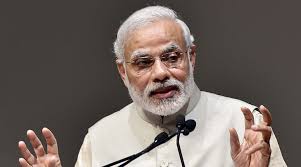
Unity & Love are basic mantras to address Kashmir problem: PM

August 28, 2016

New Delhi, Aug 28: Prime Minister Narendra Modi today said "Ekta" (unity) and "Mamata" (love) are the basic mantras for addressing the Kashmir problem even as he slammed those pushing children to create unrest, saying they will have to give answers to those "innocent" kids some day. He emphasised that if any life is lost in Kashmir, whether of any youth or any securityman, "that loss is ours, of our own country".

modipmSpeaking on the unrest in the valley in his monthly radio programme 'Mann Ki Baat', Modi said, "From the interactions I had with all parties on Kashmir, one thing emerged from those, which can be put in simple words as 'Ekta' and 'Mamata'. These two things were the basic mantra."

He said all the political parties had spoken in one voice on Kashmir, sending out a "message to the world as well as separatist forces" besides conveying "our sentiments to the people of Kashmir". He equated it to the passage of landmark GST Bill by Parliament for which all the parties came together.

"It is the view of all of us, the view of 125 crore people from a pradhan of a village to the Prime Minister, that if any life is lost in Kashmir, whether of any youth or any securityman, that loss is ours, our own country," Modi said.

At the same time, he slammed "those people who push small children to try to create unrest in Kashmir", saying "some day, they will have to give answers to these innocent children". The Prime Minister's remarks came a day after Jammu and Kashmir Chief MInister Mehbooba Mufti met him and presented a "three-pronged action plan" that includes dialogue with all stakeholders.

Comments

abdul
 - 
Sunday, 28 Aug 2016

Devil preaching the peace & harmony

Add new comment

  • Coastaldigest.com reserves the right to delete or block any comments.
  • Coastaldigset.com is not responsible for its readers’ comments.
  • Comments that are abusive, incendiary or irrelevant are strictly prohibited.
  • Please use a genuine email ID and provide your name to avoid reject.
News Network
February 24,2020

New Delhi, Feb 24: They hail from vastly different backgrounds — Donald Trump is the son of a property tycoon while Narendra Modi is a descendant of a poor tea-seller.

Yet the two teetotallers, loved by right-wing nationalists in their home countries, share striking similarities that have seen them forge a close personal bond, analysts say.

Ahead of the American leader's first official visit to India, which begins in Modi's home state of Gujarat on Monday, the world's biggest democracy has gone out of its way to showcase the chemistry between them.

In Gujarat's capital Ahmedabad, large billboards with the words "two dynamic personalities, one momentous occasion" and "two strong nations, one great friendship" have gone up across the city.

"There's a lot that Trump and Modi share in common, and not surprisingly these convergences have translated into a warm chemistry between the two," Michael Kugelman of the Washington-based Wilson Center said.

"Personality politics are a major part of international diplomacy today. The idea of closed-door dialogue between top leaders has often taken a backseat to very public and spectacle-laden summitry."

Since assuming the top political office in their respective countries — Modi in 2014 and Trump in 2017 — the two men have been regularly compared to each other.

Trump, 73, and Modi, 69, both command crowds of adoring flag-waving supporters at rallies. A virtual cult of personality has emerged around them, with their faces and names at the centre of their political parties' campaigns.

A focus of Trump's administration has been his crackdown on migrants, including a travel ban that affects several Muslim-majority nations, among others, while critics charge that Modi has sought to differentiate Muslims from other immigrants through a contentious citizenship law that has sparked protests.

Both promote their countries' nationalist and trade protectionist movements — Trump with his "America First" clarion call and Modi with his "Make in India" mantra.

And while they head the world's largest democracies, critics have described the pair as part of a global club of strongmen that includes Russia's Vladimir Putin and Brazil's Jair Bolsonaro.

"There are many qualities that Trump and Modi share — a love for political grandstanding and an unshakable conviction that they can achieve the best solutions or deals," former Indian diplomat Rakesh Sood said.

Modi and Trump have sought to use their friendship to forge closer bonds between the two nations, even as they grapple with ongoing tensions over trade and defence.

Despite sharing many similarities in style and substance, analysts say there are some notable differences between the pair.

Modi is an insider who rose through the ranks of the Bharatiya Janata Party after starting out as a cadre in Rashtriya Swayamsevak Sangh.

Trump is a businessman and a political outsider who has in some sense taken over the Republican Party.

"Modi is a more conventional leader than is Trump in that he hasn't sought to revolutionise the office he holds in the way that Trump has," said Kugelman, a longtime observer of South Asian politics.

He added that genuine personal connections between leaders of both countries have helped to grow the partnership.

"George Bush and Manmohan Singh, Barack Obama and Singh, Obama and Modi, now Modi and Trump — there has been a strong chemistry in all these pairings that has clearly helped the relationship move forward," he added.

Trump has also stood by the Indian leader during controversial decisions, including his revocation of autonomy for Kashmir and his order for jets to enter Pakistani territory following a suicide bombing.

Analysts said the leaders would use the visit to bolster their image with voters.

A mega "Namaste Trump" rally in Ahmedabad on Monday will be modelled after the "Howdy, Modi" Houston extravaganza last year when the Indian leader visited the US and the two leaders appeared before tens of thousands of Indian-Americans at a football stadium.

"The success of this visit... will have a positive impact on his (Trump's) re-election campaign and the people of Indian origin who are voters in the US — a majority of them are from Gujarat," former Indian diplomat Surendra Kumar said.

"On the Indian side, the fact that Prime Minister Modi... (shares) such warmth, bonhomie and informality with the most powerful man on Earth adds to his stature... as well as with hardcore supporters."


Comments

Add new comment

  • Coastaldigest.com reserves the right to delete or block any comments.
  • Coastaldigset.com is not responsible for its readers’ comments.
  • Comments that are abusive, incendiary or irrelevant are strictly prohibited.
  • Please use a genuine email ID and provide your name to avoid reject.
News Network
April 11,2020

New Delhi, Apr 11: As India battles the Covid-19 crisis, Prime Minister Narendra Modi on Saturday held a video conference with chief ministers primarily to take their feedback on whether the 21-nation-wide lockdown be extended beyond April 14 to stem the tide of the infections.

The Central government is understood to have also obtained views on the issue from all the relevant agencies and stakeholders involved in the efforts to contain the spread of the pandemic.

The video conference, which began at 11am, comes amidst indications that the central government may extend the nationwide lockdown with some possible relaxations even as Punjab and Odisha have already announced extending the lockdown beyond April 14 when the current spell of 21-day shutdown across the country ends on Tuesday.

The Union Home Ministry has sought views of state governments on various aspects, including whether more categories of people and services need to be exempted. In the current lockdown only essential services are exempted.

This is for the second time the prime minister is interacting with the chief ministers via video link after the lockdown was imposed.

During his April 2 interaction with chief ministers, Modi had pitched for a "staggered" exit from the ongoing lockdown.

A PTI tally of numbers reported by various states as on Thursday at 9.30pm showed a total of 7,510 having been affected by the virus nationwide so far with at least 251 deaths. More than 700 have been cured and discharged. However, the last update from the Union Health Ministry put the number of confirmed infections at 7,447 and the death toll at 239.

Addressing floor leaders of various parties who have representation in Parliament, Modi had on Wednesday made it clear that the lockdown cannot be lifted in one go, asserting that the priority of his government is to "save each and every life".

According to an official statement after the Wednesday interaction, the prime minister told these leaders that states, district administrations and experts have suggested extension of the lockdown to contain the spread of the virus.

Before the lockdown was announced on March 24, the prime minister had interacted with the chief ministers on March 20 to discuss ways and means to check the spread of the novel coronavirus.

Comments

Add new comment

  • Coastaldigest.com reserves the right to delete or block any comments.
  • Coastaldigset.com is not responsible for its readers’ comments.
  • Comments that are abusive, incendiary or irrelevant are strictly prohibited.
  • Please use a genuine email ID and provide your name to avoid reject.
News Network
January 1,2020

New Delhi, Jan 1: The new Army chief Lieutenant General MM Naravane on Wednesday said that India needs to pay more attention to its border along China and asserted that the force is capable of dealing with any security challenge.

"We have been giving attention to our western front in the past. The northern front now also requires an equal amount of attention... The Army is capable of tackling any dangers to the country," General Naravane told reporters after receiving the first Guard of Honour as the Army chief.

"In that context, we are now going in for capability development and enhancement of our capacities even in our northern borders which includes the northeastern part of our country," he said.

On the border dispute with China, the Army chief said that continuing peace along the border will pave the way for a solution.

He said: "We have been able to maintain peace and tranquility along borders and I'm sure that situation will prevail. By maintaining this, we will be able to set the stage for the eventual solution."

General Naravane said that operational readiness and modernisation will be among the top priorities of the Army under his leadership.

"Our priority will be to be ready to meet any challenge and to be operationally prepared at all times. This will happen as a result of modernisation. We will continue to build our capability especially in the North and Northeast region of our country," he said.

He said that the Indian Army will pay special attention to respect human rights. "We will also pay special emphasis on raising security awareness among ranks and file and pay special attention to respect human rights," the Army chief said.

Assuring the country on security, he said, "All three services — the Army, the Navy and the Air Force — are ready to defend the country."

He extended wishes to people in the new year and hoped that the country will make huge progress in this decade.

General Naravane took over as the 28th Chief of the Army Staff (COAS) on Tuesday, succeeding General Bipin Rawat who has become India's first Chief of Defence Staff (CDS).

General Naravane was previously the Vice Chief of Army Staff.

Comments

Add new comment

  • Coastaldigest.com reserves the right to delete or block any comments.
  • Coastaldigset.com is not responsible for its readers’ comments.
  • Comments that are abusive, incendiary or irrelevant are strictly prohibited.
  • Please use a genuine email ID and provide your name to avoid reject.