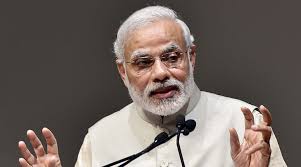
Unity & Love are basic mantras to address Kashmir problem: PM

August 28, 2016

New Delhi, Aug 28: Prime Minister Narendra Modi today said "Ekta" (unity) and "Mamata" (love) are the basic mantras for addressing the Kashmir problem even as he slammed those pushing children to create unrest, saying they will have to give answers to those "innocent" kids some day. He emphasised that if any life is lost in Kashmir, whether of any youth or any securityman, "that loss is ours, of our own country".

modipmSpeaking on the unrest in the valley in his monthly radio programme 'Mann Ki Baat', Modi said, "From the interactions I had with all parties on Kashmir, one thing emerged from those, which can be put in simple words as 'Ekta' and 'Mamata'. These two things were the basic mantra."

He said all the political parties had spoken in one voice on Kashmir, sending out a "message to the world as well as separatist forces" besides conveying "our sentiments to the people of Kashmir". He equated it to the passage of landmark GST Bill by Parliament for which all the parties came together.

"It is the view of all of us, the view of 125 crore people from a pradhan of a village to the Prime Minister, that if any life is lost in Kashmir, whether of any youth or any securityman, that loss is ours, our own country," Modi said.

At the same time, he slammed "those people who push small children to try to create unrest in Kashmir", saying "some day, they will have to give answers to these innocent children". The Prime Minister's remarks came a day after Jammu and Kashmir Chief MInister Mehbooba Mufti met him and presented a "three-pronged action plan" that includes dialogue with all stakeholders.

Comments

abdul
 - 
Sunday, 28 Aug 2016

Devil preaching the peace & harmony

Add new comment

  • Coastaldigest.com reserves the right to delete or block any comments.
  • Coastaldigset.com is not responsible for its readers’ comments.
  • Comments that are abusive, incendiary or irrelevant are strictly prohibited.
  • Please use a genuine email ID and provide your name to avoid reject.
Agencies
June 22,2020

New Delhi, Jun 22: India's COVID-19 cases per lakh people is one of the lowest in the world despite its high population density, and the recovery rate has now reached almost 56 per cent, the Union Health Ministry said on Monday.

For every one lakh population, there are 30.04 coronavirus cases in India, while the global average is over three times at 114.67, the ministry said, referring to the WHO Situation Report 153, dated June 21.

“This low figure is thus a testimony to the graded, pre-emptive and pro-active approach the Government of India along with the states and UTs took for prevention, containment and management of COVID-19," the ministry said in a statement.

Citing the WHO Situation Report, the ministry said the US has 671.24 cases per lakh population, while Germany, Spain, Brazil and the UK have 583.88, 526.22, 489.42 and 448.86 cases per lakh population, respectively.

It said Russia has 400.82 cases per lakh people, while Italy, Canada, Iran and Turkey have 393.52, 268.98, 242.82 and 223.53, respectively.

Coming back to India, as on Monday morning, the total number of coronavirus cases stood at 4,25,282 and the death toll at 13,699, according to figures issued by the ministry.

In its update issued at 8 AM Monday, the ministry said 9,440 COVID-19 patients recovered in the last 24 hours, taking the total number of recoveries to 2,37,195, a recovery rate of 55.77 per cent.

Presently, there are 1,74,387 active cases and all are under medical supervision, it said.

"The difference between the recovered patients and the active COVID-19 cases continues to widen. Today, the number of recovered patients has crossed the number of active patients by 62,808," the ministry said.

The COVID-19 testing infrastructure is continuously being ramped up and number of government labs has been increased to 723 and the private labs to 262, adding up to a total of 985, it said.

According to the Indian Council of Medical Research, a total of 69,50,493 samples have been tested up to 21 June, 1,43,267 of them just on Sunday.

On Monday, the country added 14,821 new COVID-19 cases in a single day, pushing the tally to 4,25,282, while the death toll rose to 13,699 with 445 new fatalities reported till 8 am.

The country breached the four lakh-mark on Sunday, eight days after crossing three lakh COVID-19 cases. It has recorded 2,34,747 infections since June 1.

Monday was the 11th day in a row when the country registered over 10,000 cases.

Comments

Add new comment

  • Coastaldigest.com reserves the right to delete or block any comments.
  • Coastaldigset.com is not responsible for its readers’ comments.
  • Comments that are abusive, incendiary or irrelevant are strictly prohibited.
  • Please use a genuine email ID and provide your name to avoid reject.
Agencies
May 23,2020

New Delhi, May 23: The nationwide lockdown will no longer help India in its fight against COVID-19, and in its place community-driven containment, isolation and quarantine strategies have to be brought into play, leading virologist Shahid Jameel said.

The recipient of Shanti Swarup Bhatnagar Prize for Science and Technology also stressed that testing should be carried out vigorously to identify coronavirus hotspots and isolate those areas.

"Our current testing rate at 1,744 tests per million population is one of the lowest in the world. We should deploy both antibody tests and confirmatory PCR tests. This will tell us about pockets of ongoing infection and past (recovered) infection. This will provide data to open up gradually and let economic activity resume," Jameel told PTI in an interview.

He stressed that testing has to be dynamic to continuously monitor red, orange and green zones and change these based on that data.

About community transmission of COVID-19 in India, Jameel said the country reached that stage long ago.

"We reached community transmission a long time ago. It's just that the health authorities are not admitting it. Even ICMR's own study of SARI (severe acute respiratory illness) showed that about 40 per cent of those who tested positive for SARS-CoV-2 did not have any history of overseas travel or contact to a known case. If this is not community transmission, then what is?" he posed.

Lockdown bought India time in its fight against coronavirus, but continuing it is unlikely to yield any further dividend, Jameel said.

"Instead, community-driven local lockdowns, isolations and quarantines have to come into play. Building trust is most important so that people follow rules. A public health problem cannot be dealt with as a law-and-order problem."

The nationwide lockdown, initially imposed from March 25 to April 14, has been extended thrice and will continue at least till May 31. The virus has claimed 3,720 lives and infected over 1.25 lakh people in the country so far.

Jameel has expertise in the fields of molecular biology, infectious diseases, and biotechnology. He is the CEO of Wellcome Trust/Department of Biotechnology's India Alliance and is best known for extensive research in Hepatitis E virus and HIV.

He said COVID-19 will eventually be controlled through herd immunity, which is acquired in two ways – when a sufficient fraction of the population gets infected and recovers, and with vaccination.

"It is estimated that for SARS-CoV-2 at least 60 per cent of the population would have to be infected and recovered, or vaccinated. This will happen over the course of the next few years," Jameel said.

Herd immunity is reached when the majority of a population becomes immune to an infectious disease, either because they have become infected and recovered, or through vaccination. When that happens, the disease is less likely to spread to people who aren't immune, because there just aren't enough infectious carriers.

"India has 1.38 billion people, a population density of about 400/sq km and a healthcare system ranked at 143 in the world. If we allow 60 per cent people to get infected quickly in the hopes of herd immunity, that would mean 830 million infections," Jameel said.

"If 15 per cent need hospitalization that means about 125 million isolation beds (we have 0.3 million). If five per cent need oxygen and ventilatory support, this amounts to about 42 million oxygen support and ICU beds; we have 0.1 million oxygen support beds and 34,000 ICU beds. This would overwhelm the healthcare system causing mayhem," he said.

Jameel said if the population level mortality is 0.5 per cent that would mean 40 lakh deaths. "Are we prepared to pay this price for herd immunity in the short term? Clearly not," he said.

He said it is unlikely that a vaccine would be available by the end of the year.

"Even then, we don't know yet how long it would give protection – weeks, months, one year, a few years? I don't think we will return to pre-coronavirus days for at least the next 3-5 years. This is also a chance to evaluate if we want to return to those unsustainable, environment-damaging ways. COVID-19 is a timely warning to reform our way of living," he said.

Jameel said it is hard to predict but plausible that COVID-19 would return in second or third wave.

"Later waves come when we don't understand the disease and become lax. A comparison to Spanish Flu is not entirely valid because in 1918 no one knew what caused it. No one had seen a virus till the mid-1930s as the electron microscope needed to view those was invented in 1931," he said.

"Today we know a lot more about the pathogen, its genetic makeup, how it transmits and how to prevent it. We need to be sensible and follow expert advice," he said.

If there is any scientific evidence linking deforestation, rapid urbanisation, climate change with pandemics like COVID-19, he said zoonotic viruses -- those that jump from animals to humans -- happen so when wild animal–human contacts increase.

"Deforestation destroys animal habitats bringing them closer to humans. When you cut forests, bats come to roost on trees closer to human habitations. Their viruses in secretions/stool get transmitted to domestic animals and on to humans. This happened clearly with Nipah virus outbreak in Malaysia in 1997-98 from fruit bats to pigs to humans," he said.

"COVID-19 possibly arose in wet animal markets due to dietary habits that bring all kinds of live and dead wild animals in close contact with humans," Jameel added.


Comments

Add new comment

  • Coastaldigest.com reserves the right to delete or block any comments.
  • Coastaldigset.com is not responsible for its readers’ comments.
  • Comments that are abusive, incendiary or irrelevant are strictly prohibited.
  • Please use a genuine email ID and provide your name to avoid reject.
News Network
August 8,2020

New Delhi, Aug 8: The Union Health Secretary Rajesh Bhushan on Friday directed the governments of four states -- Gujarat, Karnataka, Tamil Nadu, and Telangana, to analyse the factors driving the high COVID-19 mortality and devise ways and means to reduce the mortality.

Apart from the higher case mortality, these states account for 17 per cent of India's active cases, high daily new cases, low tests per million, and high confirmation percentage.

In a high-level virtual meeting, Bhushan advised state administrations to adhere to measures suggested by central advisories and guidelines to prevent and reduce mortality due to coronavirus infection.

According to the health ministry, 16 districts in these four states are reporting maximum virus fatalities. It includes -- Ahmedabad and Surat in Gujarat; Belagavi, Bengaluru urban, Kalaburagi and Udupi in Karnataka; Chennai, Kanchipuram, Ranipet, Theni, Thiruvallur, Tiruchirappalli, Tuticorin and Virudhnagar in Tamil Nadu; and Hyderabad and Medchal-Malkajgiri in Telangana respectively.

"The districts were advised to ensure that the advisories, guidelines and clinical treatment protocols issued by the Health Ministry are adopted and effectively implemented to reduce the mortality among COVID-19 patients and other preventable deaths among all sections of the people, particularly those with co-morbidities, pregnant women, the elderly and children," said the health ministry official.

"States were advised to ensure optimum capacity utilization of testing labs, increase tests per million population and reduce confirmation percentage, in addition to ensuring timely availability of ambulances with target zero refusal," the official further said.

"States were also advised to analyze availability and need for projected beds and oxygen, and plan in a timely manner. States and district administration have also been advised to ensure good infection prevention and control practices to control infection in the healthcare workers," said the official.

Principal Secretary (Health) and MD (NHM) from the four States along with district surveillance officers, district collectors, commissioners of the municipal corporation, Chief Medical Officers, and Medical Superintendent of Medical Colleges participated in the meeting.

Comments

Add new comment

  • Coastaldigest.com reserves the right to delete or block any comments.
  • Coastaldigset.com is not responsible for its readers’ comments.
  • Comments that are abusive, incendiary or irrelevant are strictly prohibited.
  • Please use a genuine email ID and provide your name to avoid reject.