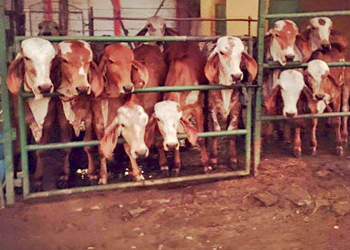
Upalokayukta unearths Rs 22-cr fodder scam in Tumakuru goshalas

DHNS
June 17, 2017

Bengaluru, Jun 17: The state seems to be staring at a big fodder scam. The Upalokayukta enquiry report, conducted with respect to goshalas (cattle-sheds) in Tumakuru district, reveals misappropriation of Rs 22 crore in less than a year.goshalas

The Upalokayukta has issued notices to 127 officials of the rank of assistant commissioners and below in the district for initiation of action in this regard.

The state government had released funds to district administrations for constructing goshalas, purchase and distribution of fodder in December-February 2016-17. In view of the severe drought across 139 taluks, the government had directed district administrations to ensure availability of fodder to cattle.

On a tip-off that large scale irregularities had taken place at goshalas in distribution of fodder, Upalokayukta Justice Subhash B Adi made surprise visits to goshalas in March-April 2017. It was found that the ledger book detailing receipts and distribution of fodder was mishandled and that there was mismatch of stocks mentioned in the books and fodder available in goshalas. The Upalokayukta had visited Ranganahalli (Gubbi taluk), Ullasathopu, C B Agrahara, Ranganathapura, Bhoothappanagudi, J Hosahalli (Sira taluk), Tovinakere (Koratagere taluk), Gadabanahalli Thopu, Ayyanabavi, Baguvala (Tiptur taluk), T B Cross, Aremallanahalli (Turuvekere taluk) Y N Hosakote, Nagalamadike, Venkatapura (Pavagad taluk) and Godekere, Vajra, Karehalli, Hulikal, Durgammanna Betta (Chikkanayakanahalli taluk).

The enquiry report submitted by Lokayukta officials stated that the district administration officials misappropriated funds and also left the goshalas in a pitiable state.

“Misappropriation of Rs 33.96 lakh released to goshalas in seven taluks has been found. Similarly, a total of Rs 21.98 crore towards the purchase of fodder has been misappropriated,” the report said.

Apart from the misappropriation, the enquiry revealed that the district administration had not followed the guidelines issued periodically by the state government. The enquiry report stated that almost all the goshalas were unhygienic and did not use scientific weighing scales. “At some goshalas, the fodder was distributed without weighing. The officials had not provided proper lighting and toilet facilities to farmers staying with cattle at night despite a government circular in this regard.”

Justice Adi confirmed issuance of notices. “I had visited goshalas only in Tumakuru district. The report suggested misappropriation of funds and notices have been issued to record the comments of officials,” he said.

Comments

Cow and the politics
 - 
Saturday, 17 Jun 2017

Ok, now i understand the purpose of all this cow slaughter ban. It is money making strategy by bhakts. Wah re wah sabse bade Chor to yeh log hain

RR
 - 
Sunday, 18 Jun 2017

So this is the reason behind potraitng animals as MATA .. PITA...
When innocents realize this and bycot these sangees....?
JAI HIND

Add new comment

  • Coastaldigest.com reserves the right to delete or block any comments.
  • Coastaldigset.com is not responsible for its readers’ comments.
  • Comments that are abusive, incendiary or irrelevant are strictly prohibited.
  • Please use a genuine email ID and provide your name to avoid reject.
Media Release
January 23,2020

Mangaluru, Jan 23: With the results of Joint Entrance Examination (JEE-Main) out, it is celebration time at CFAL (Centre for Advanced Learning), Mangalore’s top training institute as 12 of its students have secured above 99 percentile, out of 120 students who appeared at the prestigious national examination held in January this year. The students are: Kaustubh Rao (99.79), Ujwal Kumar (99.77), Dheeraj Kamath (99.74), Pramod Rao (99.68), Santhosh M (99.59), Mohan Nayak (99.49), Rihan D’silva (99.43), Rishan D’silva (99.41), Pranav Rao (99.41), Aamod BK (99.29), Anmol J Shetty (99.22) and Madhura Sabhahit (99.083).

Apart from the above students, 8 students have scored above 98 percentile, the details of the students are: D.K. Goutham (98.67), Tejah S.S. (98.49), Akash Shetty (98.4), Tejas Bhat K (98.34), Ninaad PS (98.31), Shreepoorna Rao (98.3), K. Annapoorna Prabhu (98.3) and Rakshith Sajjan (98.2). The results of many more students are awaited.

A total of 8,69,010 students had appeared in the said exam from across India. The students who have attempted the JEE Main exam in January can attempt the exams again in April to better their percentile. Students who clear JEE Main qualify for JEE Advanced and are eligible for seats at the NIT’s and other top institutions of the country.

JEE – The most challenging undergraduate admission test

Joint Entrance Examination (JEE) conducted this year by National Testing Agency (NTA) is a national level examination for students to qualify and pursue engineering degree at under graduate level. Paper 1 is held for BE/B.Tech admissions and Paper 2 for B. Arch/B. Planning. JEE Main is a critical criterion for admission in India’s most prestigious and elite universities like IITs and NIT’s.

Those students who clear JEE Main can take the JEE advanced – which is a pre-requisite requirement for admission in the Indian Institute of Technology and Indian School of Mines (Dhanbad)

CFAL – The first name in training

The training at CFAL consists of defined hours of classes, tests and mock exams, unique course material, experienced professors and hence is the first choice for students appearing for STEM examinations including JEE, NTSE, KYPY, OLYMPIADS etc.  The centre was established with the intention of giving students of Mangalore information, guidance and tools required to qualify the competitive exams. However, the main aim of CFAL is to inculcate passion for Math and Science learning among students and to encourage research and innovation in the subjects.

Comments

Add new comment

  • Coastaldigest.com reserves the right to delete or block any comments.
  • Coastaldigset.com is not responsible for its readers’ comments.
  • Comments that are abusive, incendiary or irrelevant are strictly prohibited.
  • Please use a genuine email ID and provide your name to avoid reject.
Ram Puniyani
June 29,2020

In Minneapolis, US an African American, George Floyd lost his life as the white policeman, Derek Chauvin, caught hold of him and put his knee on his neck. This is a technique developed by Israel police. For nine long minutes the knee of the while policeman was on the neck of George, who kept shouting, I can’t breathe.

Following this gruesome murder America erupted with protests, ‘Black lives matter’. The protestors were not just African Americans but also a large section of whites. Within US one police Chief apologized for the act of this. In a touching gesture of apology the police force came on its knees. This had reverberations in different parts of the World.

The act was the outcome of the remnants of the racial hatred against blacks by the whites. It is the hatred and the perceptions which are the roots of such acts of violence. What was also touching that the state of democracy in US is so deep that even the police apologized, the nation, whites and blacks, stood up as a sensitive collective against this violence.

US is not the only country where the brutal acts of violence torment the marginalized sections of society. In India there is a list of dalits, minorities and adivasis who are regularly subjected to such acts. But the reaction is very different. We have witnessed the case of Tabrez Ansari, who was tied to the pole by the mob and beaten ruthlessly. When he was taken to police station, police took enough time to take him to hospital and Tabrez died.

Mohsin Sheikh, a Pune techie was murdered by Hindu Rashtra Sena mob, the day Modi came to power in 2014. Afrazul was killed by Shambhulal Regar, videotaped the act released on social media. Regar believed that Muslims are indulging in love Jihad, so deserve such a fate. Mohammad Akhlaq is one among many names who were mob lynched on the issue of beef cow. The list can fill pages after pages.

Recently a young dalit boy was shot dead for the crime of entering a temple. In Una four dalits were stripped above waste and beaten mercilessly. Commenting on this act the Union Minister Ramvilas Paswan commented that it is a minor incident. Again the list of atrocities against dalits is long enough. The question is what Paswan is saying is the typical response to such gruesome murders and tortures. In US loss of one black life, created the democratic and humane response. In India there is a general silence in response to these atrocities. Some times after a good lapse of time, the Prime Minister will utter, ‘Mother Bharati has lost a son’. Most of the time victim is blamed. Some social groups raise their voice in some fora but by and large the deafening silence from the country is the norm.

India is regarded as the largest democracy. Democracy is the rule of law, and the ground on which the injustices are opposed. In America though the present President is insensitive person, but its institutions and processes of democratic articulations are strong. The institutions have deepened their roots and though prejudices may be guiding the actions of some of the officers like the killer of George, there are also police officers who can tell their President to shut up if he has nothing meaningful to say on the issue. The prejudices against Blacks may be prevalent and deep in character, still there are large average sections of society, who on the principles of ‘Black lives matter’. There are large sections of vocal population who can protest the violation of basic norms of democracy and humanism.

In India by contrast there are multiple reasons as to why the lives of Tabrez Ansari, Mohammad Akhlaq, Una dalit victims and their likes don’t matter. Though we claim that we are a democracy, insensitivity to injustices is on the rise. The strong propaganda against the people from margins has become so vicious during last few decades that any violence against them has become sort of a new normal. The large populace, though disturbed by such brutalities, is also fed the strong dose of biases against the victims. The communal forces have a great command over effective section of media and large section of social media, which generates Hate against these disadvantaged groups, thereby the response is muted, if at all.

As such also the process of deepening of our democracy has been weak. Democracy is a dynamic process; it’s not a fixed entity. Decades ago workers and dalits could protest for their rights. Now even if peasants make strong protests, dominant media presents it as blocking of traffic! How the roots of democracy are eroded and are visible in the form where the criticism of the ruling dispensation is labelled as anti National..

Our institutions have been eroded over a period of time, and these institutions coming to the rescue of the marginalized sections have been now become unthinkable. The outreach of communal, divisive ideology, the ideology which looks down on minorities, dalits and Adivasis has risen by leaps and bounds.

The democracy in India is gradually being turned in to a hollow shell, the rule of law being converted in to rule of an ideology, which does not have faith in Indian Constitution, which looks down upon pluralism and diversity of this country, which is more concerned for the privileges of the upper caste, rich and affluent. The crux of the matter is the weak nature of democracy, which was on way to become strong, but from decades of 1980s, as emotive issues took over, the strength of democracy started dwindling, and that’s when the murders of the types of George Floyd, become passé. One does complement the deeper roots of American democracy and its ability to protect the democratic institutions, which is not the case in India, where protests of the type, which were witnessed after George Floyd’s murder may be unthinkable, at least in the present times. 

Comments

Add new comment

  • Coastaldigest.com reserves the right to delete or block any comments.
  • Coastaldigset.com is not responsible for its readers’ comments.
  • Comments that are abusive, incendiary or irrelevant are strictly prohibited.
  • Please use a genuine email ID and provide your name to avoid reject.
News Network
January 4,2020

Puttur, Jan 4: As many as 27 passengers travelling in a private bus escaped with minor injuries after it toppled and fell into a roadside trench at Amai near Perne on Mangaluru-Bengaluru national highway last night, police said on Saturday.

Police said that the driver of the Bengaluru-bond bus lost control over the vehicle while traversing through the narrow bridge at Amai.

The bus was damaged in the mishap.

Comments

SAYED HUSAIN
 - 
Sunday, 5 Jan 2020

this is one of the important case that now seen to be increasing these days.  and one of the most problem that is faced and had has to be found a solution is overspeeding by bus driving which have resulted in enomours numbers of accidents with negligence of passengers lifes inside the bus.  passengers safety and lifes are not given value anymore. and another important factor is overspeeding in humps  which have resulted in backbone injuries in high number of passengers

Add new comment

  • Coastaldigest.com reserves the right to delete or block any comments.
  • Coastaldigset.com is not responsible for its readers’ comments.
  • Comments that are abusive, incendiary or irrelevant are strictly prohibited.
  • Please use a genuine email ID and provide your name to avoid reject.