



Upalokayukta unearths Rs 22-cr fodder scam in Tumakuru goshalas

DHNS
June 17, 2017

Bengaluru, Jun 17: The state seems to be staring at a big fodder scam. The Upalokayukta enquiry report, conducted with respect to goshalas (cattle-sheds) in Tumakuru district, reveals misappropriation of Rs 22 crore in less than a year.goshalas
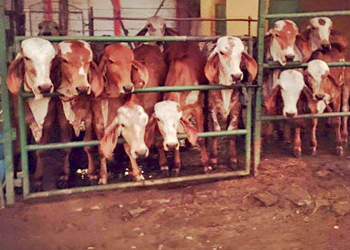
The Upalokayukta has issued notices to 127 officials of the rank of assistant commissioners and below in the district for initiation of action in this regard.

The state government had released funds to district administrations for constructing goshalas, purchase and distribution of fodder in December-February 2016-17. In view of the severe drought across 139 taluks, the government had directed district administrations to ensure availability of fodder to cattle.

On a tip-off that large scale irregularities had taken place at goshalas in distribution of fodder, Upalokayukta Justice Subhash B Adi made surprise visits to goshalas in March-April 2017. It was found that the ledger book detailing receipts and distribution of fodder was mishandled and that there was mismatch of stocks mentioned in the books and fodder available in goshalas. The Upalokayukta had visited Ranganahalli (Gubbi taluk), Ullasathopu, C B Agrahara, Ranganathapura, Bhoothappanagudi, J Hosahalli (Sira taluk), Tovinakere (Koratagere taluk), Gadabanahalli Thopu, Ayyanabavi, Baguvala (Tiptur taluk), T B Cross, Aremallanahalli (Turuvekere taluk) Y N Hosakote, Nagalamadike, Venkatapura (Pavagad taluk) and Godekere, Vajra, Karehalli, Hulikal, Durgammanna Betta (Chikkanayakanahalli taluk).

The enquiry report submitted by Lokayukta officials stated that the district administration officials misappropriated funds and also left the goshalas in a pitiable state.

“Misappropriation of Rs 33.96 lakh released to goshalas in seven taluks has been found. Similarly, a total of Rs 21.98 crore towards the purchase of fodder has been misappropriated,” the report said.

Apart from the misappropriation, the enquiry revealed that the district administration had not followed the guidelines issued periodically by the state government. The enquiry report stated that almost all the goshalas were unhygienic and did not use scientific weighing scales. “At some goshalas, the fodder was distributed without weighing. The officials had not provided proper lighting and toilet facilities to farmers staying with cattle at night despite a government circular in this regard.”

Justice Adi confirmed issuance of notices. “I had visited goshalas only in Tumakuru district. The report suggested misappropriation of funds and notices have been issued to record the comments of officials,” he said.

Comments

Cow and the politics
 - 
Saturday, 17 Jun 2017

Ok, now i understand the purpose of all this cow slaughter ban. It is money making strategy by bhakts. Wah re wah sabse bade Chor to yeh log hain

RR
 - 
Sunday, 18 Jun 2017

So this is the reason behind potraitng animals as MATA .. PITA...
When innocents realize this and bycot these sangees....?
JAI HIND

Add new comment

  • Coastaldigest.com reserves the right to delete or block any comments.
  • Coastaldigset.com is not responsible for its readers’ comments.
  • Comments that are abusive, incendiary or irrelevant are strictly prohibited.
  • Please use a genuine email ID and provide your name to avoid reject.
News Network
June 26,2020

Bengaluru, Jun 26: Karnataka recorded 445 new Covid cases, majority of whom were contacts of earlier positive cases, breaching the 11,000 mark to settle at 11,005, an official said on Friday.

"New cases reported from Thursday 5 p.m. to Friday 5 p.m., 445," said a health official on Friday.

In the past 24 hours, 10 patients succumbed to the virus in Karnataka, three in Bengaluru Urban and one each in Kolar, Dharwad, Shivamogga, Bagalkote, Bidar, Kalaburagi and Ballari.

Like everyday, contacts of earlier cases outnumbered domestic returnees in the number of infections, constituting 39 per cent.

Positive cases with domestic travel history numbered 65, a mere 15 per cent and majority to Maharashtra.

There were also 21 cases with international travel history to countries like Oman, Qatar, Saudi Arabia and Dubai.

On Friday, cases spiked in Bengaluru Urban, Ballari, Kalaburagi, Koppal, Dakshina Kannada, Dharwad, Raichur, Gadag, Chamarajanagar, Udupi, Yadgir, Mandya, Uttara Kannada, Bagalkote, Shivamogga, Kolar and Mysuru.

Among the new cases, Bengaluru Urban accounted for 144, followed by Ballari (47), Kalaburagi (42), Koppal (36), Dakshina Kannada (33), Dharwad (30), Raichur (14), Gadag (12), Chamarajanagar (11), Udupi (9), Yadgir (7), Mandya, Uttara Kannada, Bagalkote, Shivamogga and Kolar (6 each).

Mysuru (5), Chikkamagaluru and Kodagu (4 each), Hassan and Bengaluru Rural (3 each), Vijayapura, Tumkur and Haveri (2 each) and Bidar, Belagavi, Davangere, Ramanagara and Chitradurga (1 each).

As many 144 patients are suffering from Influenza-like Illness (ILI) and 19 from Severe Acute Respiratory Infection (SARI).

In all, 5.68 lakh samples have been tested so far, of which 5.41 lakh tested negative.

Meanwhile, 178 patients are admitted in the ICU.

Of the total 180 deaths, Bengaluru Urban has accounted for 81, followed by Bidar (16), Kalaburagi (15), Ballari (9) and Dakshina Kannada (8), among others.

Comments

Add new comment

  • Coastaldigest.com reserves the right to delete or block any comments.
  • Coastaldigset.com is not responsible for its readers’ comments.
  • Comments that are abusive, incendiary or irrelevant are strictly prohibited.
  • Please use a genuine email ID and provide your name to avoid reject.
News Network
February 24,2020

Bengaluru, Feb 24: Census authorities in Karnataka have requested deputy commissioners in the state’s districts to hold outreach and awareness campaigns about the National Population Register (NPR), as they fear misgivings about the exercise could hurt the forthcoming enumeration of population.

The house-listing phase of the Census and updating of NPR will be rolled out simultaneously by mid-April in the BJP-ruled state.

About 1,50,000 enumerators will handle the massive exercise.

Officials believe widespread awareness will help address concerns about the NPR data-gathering process and make people cooperate with enumerators when they visit houses for both NPR and census work.

“Sensing the kind of questions that enumerators may face when they do house visits, in all video conferences with deputy commissioners of districts, we have requested to establish contact with local representatives,” SB Vijay Kumar, director of Census Operations in Karnataka told news agency. “We have asked them to organise outreach programmes to ensure that people’s doubts are resolved before the information gathering work begins,” he added.

Census operations are handled by the Union home ministry. Several district officials are said to have raised concerns about the possibility of people refusing to share information when the work on the census and NPR begins in two months. This would affect the quality of the census work, making the exercise incomplete.

news channel earlier reported that people in parts of Karnataka had declined to share personal information with officials visiting households in connection with government programmes, suspecting them of gathering data for the yet-to-be unveiled National Register of Citizens, following enactment of the Citizenship Amendment Act (CAA) recently.

Kumar said district authorities will train and sensitise enumerators to tread carefully while gathering information. Enumerators will be told not to demand information but seek it gently.

“We will tell enumerators to proactively engage with people. For instance, if an old man in a village does not know his exact date or place of birth, the enumerator may engage in a conversation with the person that may elicit some anecdotes and roughly establish the year and the place of birth,” the census director said.

As of now, the NPR questionnaire has 21queries, but officials say it has not yet been finalised.

With most of the census and NPR data gathering and storage happening digitally this time, the challenge before census officials is to convince people that the data would remain safe.

“Individual data is sealed and all that we can see is collective data. The information is consolidated and tailor-made. We are telling district officials to create awareness about data safety as well,” Kumar said.

Comments

Add new comment

  • Coastaldigest.com reserves the right to delete or block any comments.
  • Coastaldigset.com is not responsible for its readers’ comments.
  • Comments that are abusive, incendiary or irrelevant are strictly prohibited.
  • Please use a genuine email ID and provide your name to avoid reject.
News Network
April 2,2020

The current physical distancing guidelines provided by the World Health Organisation (WHO) and by the US Centers for Disease Control and Prevention (CDC) may not be adequate to curb the coronavirus spread, according to a research which says the gas cloud from a cough or sneeze may help virus particles travel up to 8 metres. The research, published in the Journal of the American Medical Association, noted that the the current guidelines issued by the WHO and CDC are based on outdated models from the 1930s of how gas clouds from a cough, sneeze, or exhalation spread.

Study author, MIT associate professor Lydia Bourouiba, warned that droplets of all sizes can travel 23 to 27 feet, or 7-8 metres, carrying the pathogen.

According to Bourouiba, the current guidelines are based on "arbitrary" assumptions of droplet size, "overly simplified", and "may limit the effectiveness of the proposed interventions" against the deadly pandemic.

 She explained that the old guidelines assume droplets to be one of two categories, small or large, taking short-range semi-ballistic trajectories when a person exhales, coughs, or sneezes.

However based on more recent discoveries, the MIT scientist said, sneezes and coughs are made of a puff cloud that carries ambient air, transporting within it clusters of droplets of a wide range of sizes.

Bourouiba warned that this puff cloud, with ambient air entrapped in it, can offer the droplets moisture and warmth that can prevent it from evaporation in the outer environment.

"The locally moist and warm atmosphere within the turbulent gas cloud allows the contained droplets to evade evaporation for much longer than occurs with isolated droplets," she said.

"Under these conditions, the lifetime of a droplet could be considerably extended by a factor of up to 1000, from a fraction of a second to minutes," the researcher explained in the study.

The MIT scientist, who has researched the dynamics of coughs and sneezes for years, added that these droplets settle along the trajectory of a cough or sneeze contaminating surfaces, with their residues staying suspended in the air for hours.

"Even when maximum containment policies were enforced, the rapid international spread of COVID-19 suggests that using arbitrary droplet size cutoffs may not accurately reflect what actually occurs with respiratory emissions, possibly contributing to the ineffectiveness of some procedures used to limit the spread of respiratory disease," Bourouiba wrote in the study

Comments

Add new comment

  • Coastaldigest.com reserves the right to delete or block any comments.
  • Coastaldigset.com is not responsible for its readers’ comments.
  • Comments that are abusive, incendiary or irrelevant are strictly prohibited.
  • Please use a genuine email ID and provide your name to avoid reject.