



Upalokayukta unearths Rs 22-cr fodder scam in Tumakuru goshalas

DHNS
June 17, 2017

Bengaluru, Jun 17: The state seems to be staring at a big fodder scam. The Upalokayukta enquiry report, conducted with respect to goshalas (cattle-sheds) in Tumakuru district, reveals misappropriation of Rs 22 crore in less than a year.goshalas
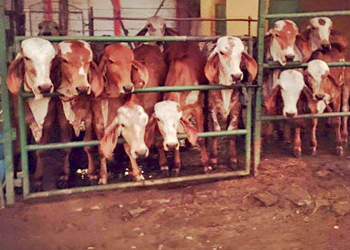
The Upalokayukta has issued notices to 127 officials of the rank of assistant commissioners and below in the district for initiation of action in this regard.

The state government had released funds to district administrations for constructing goshalas, purchase and distribution of fodder in December-February 2016-17. In view of the severe drought across 139 taluks, the government had directed district administrations to ensure availability of fodder to cattle.

On a tip-off that large scale irregularities had taken place at goshalas in distribution of fodder, Upalokayukta Justice Subhash B Adi made surprise visits to goshalas in March-April 2017. It was found that the ledger book detailing receipts and distribution of fodder was mishandled and that there was mismatch of stocks mentioned in the books and fodder available in goshalas. The Upalokayukta had visited Ranganahalli (Gubbi taluk), Ullasathopu, C B Agrahara, Ranganathapura, Bhoothappanagudi, J Hosahalli (Sira taluk), Tovinakere (Koratagere taluk), Gadabanahalli Thopu, Ayyanabavi, Baguvala (Tiptur taluk), T B Cross, Aremallanahalli (Turuvekere taluk) Y N Hosakote, Nagalamadike, Venkatapura (Pavagad taluk) and Godekere, Vajra, Karehalli, Hulikal, Durgammanna Betta (Chikkanayakanahalli taluk).

The enquiry report submitted by Lokayukta officials stated that the district administration officials misappropriated funds and also left the goshalas in a pitiable state.

“Misappropriation of Rs 33.96 lakh released to goshalas in seven taluks has been found. Similarly, a total of Rs 21.98 crore towards the purchase of fodder has been misappropriated,” the report said.

Apart from the misappropriation, the enquiry revealed that the district administration had not followed the guidelines issued periodically by the state government. The enquiry report stated that almost all the goshalas were unhygienic and did not use scientific weighing scales. “At some goshalas, the fodder was distributed without weighing. The officials had not provided proper lighting and toilet facilities to farmers staying with cattle at night despite a government circular in this regard.”

Justice Adi confirmed issuance of notices. “I had visited goshalas only in Tumakuru district. The report suggested misappropriation of funds and notices have been issued to record the comments of officials,” he said.

Comments

Cow and the politics
 - 
Saturday, 17 Jun 2017

Ok, now i understand the purpose of all this cow slaughter ban. It is money making strategy by bhakts. Wah re wah sabse bade Chor to yeh log hain

RR
 - 
Sunday, 18 Jun 2017

So this is the reason behind potraitng animals as MATA .. PITA...
When innocents realize this and bycot these sangees....?
JAI HIND

Add new comment

  • Coastaldigest.com reserves the right to delete or block any comments.
  • Coastaldigset.com is not responsible for its readers’ comments.
  • Comments that are abusive, incendiary or irrelevant are strictly prohibited.
  • Please use a genuine email ID and provide your name to avoid reject.
Agencies
May 8,2020

Washington D.C., May 8: The prime time for brain development in a child's life is the first year, where the infant spends most of the time asleep. It is the time when neural connections form and sensory memories are encoded.

However, when sleep is disrupted, as occurs more often among children with autism, brain development may be affected, too.

New research led by the University of Washington finds that sleep problems in a baby's first 12 months may not only precede an autism diagnosis but also may be associated with altered growth trajectory in a key part of the brain, the hippocampus.

The study, which was published in the American Journal of Psychiatry, researchers report that in a sample of more than 400 taken of 6- to 12-month-old infants, those who were later diagnosed with autism were more likely to have had difficulty falling asleep.

It also states that this sleep difficulty was associated with altered growth trajectories in the hippocampus.

"The hippocampus is critical for learning and memory, and changes in the size of the hippocampus have been associated with poor sleep in adults and older children.

As many as 80 per cent of the children with autism spectrum disorder have sleep problems," said Annette Estes, director of the UW Autism Center and senior author of the study.

"In our clinical experience, parents have a lot of concerns about their children's sleep, and in our work on early autism intervention, we observed that sleep problems were holding children and families back," added Estes, who is also a UW professor of speech and hearing sciences.

"It could be that altered sleep is part-and-parcel of autism for some children. One clue is that behavioural interventions to improve sleep don't work for all children with autism, even when their parents are doing everything just right. This suggests that there may be a biological component to sleep problems for some children with autism," said Estes.

To consider links among sleep, brain development, and autism, researchers at the IBIS Network looked at MRI scans of 432 infants, surveyed parents about sleep patterns, and measured cognitive functioning using a standardized assessment.

At the outset of the study, infants were classified according to their risk for developing autism: Those who were at higher risk of developing autism -- about two-thirds of the study sample -- had an older sibling who had already been diagnosed.

Infant siblings of children with autism have a 20 per cent chance of developing autism spectrum disorder -- a much higher risk than children in the general population.

In the current study, 127 of the 432 infants were identified as "low risk" at the time the MRI scans were taken because they had no family history of autism.

They later evaluated all the participants at 24 months of age to determine whether they had developed autism. Of the roughly 300 children originally considered "high familial risk," 71 were diagnosed with autism spectrum disorder at that age.

Problems with sleep were more common among the infants later diagnosed with an autism spectrum disorder, as were larger hippocampi. No other subcortical brain structures were affected, including the amygdala, which is responsible for certain emotions and aspects of memory, or the thalamus, a signal transmitter from the spinal cord to the cerebral cortex.

The authors note that while parents reported more sleep difficulties among infants who developed autism compared to those who did not, the differences were very subtle and only observed when looking at group averages across hundreds of infants.

Sleep patterns in the first years of life change rapidly as infants transition from sleeping around the clock to a more adult-like sleep/wake cycle. Until further research is completed, Estes said, it is not possible to interpret challenges with sleep as an early sign of increased risk for autism.

Comments

Add new comment

  • Coastaldigest.com reserves the right to delete or block any comments.
  • Coastaldigset.com is not responsible for its readers’ comments.
  • Comments that are abusive, incendiary or irrelevant are strictly prohibited.
  • Please use a genuine email ID and provide your name to avoid reject.
coastaldigest.com web desk
May 23,2020

The decision of the Indian government to ease the coronavirus-linked global travel restrictions imposed on those having OCI cards has given a big relief to many stranded overseas citizens of India across the world.

OCI card is issued to people of Indian origin globally which gives them almost all the privileges of an Indian national except for the right to vote, government service and buying agricultural land. The OCI card gives them a visa-free travel to India.

On Friday, the central government allowed certain categories of OCI card holders, who are stranded abroad, to come to the country. Earlier, according to the regulations issued by the Indian government in April, visas of foreign nationals and OCI cards were suspended as part of the new international travel restrictions following the COVID-19 pandemic.

This privilege of visa free travel to India was causing distress among a large number of people of Indian-origin and Indian citizens in countries like the US whose children were OCI card holders as they were born in this country.

Many Indian parents, several of whom lost their jobs as a result of the economic crisis due to coronavirus pandemic, but were not allowed to take the special evacuation flights of Air India from various US cities, took to social media and urged the Indian leaders to allow them to travel to India.

“This is a big relief for the OCI card holders. It was a humanitarian crisis in the making. I am pleased that the Indian Government listened to their voices,” said social activist Prem Bhandari, chairman of Jaipur Foot USA, who has been taking up the cause of the OCI card holders.

Dr Arathi Krishna, former deputy chairperson of NRI Forum of Karnataka government, who had been demanding this relaxation, many of the thousands of stranded OCI card holders in defferent parts of the world were in pursuading her to exert pressure on the authorities concerned for this much needed relaxation.

The restrictions on traveling of OCI card holders to India was issued by govt of India on March 13 in the wake of global outbreak of coronavirus pandemic. 

She said: "Many parents who are Indian nationals could not travel for emergency purpose to India after repatriation flights started due to their minor children being OCI card holders. Many children who were OCI card holders could not travel to India to perform last rites when there was death in their family due to these restrictions"

"I was constantly pressurising and bringing these issues to the attention of ministry officials in External Affairs and Home Affairs departments. I was following up with Mr Dammu Ravi who is heading the COVID task force  task firce in the ministry of overseas Indian affairs who took interest in solving this problem through his consistent efforts with MHA. Iam thankful to Fireign Secretary too for his efforts and concern and to MHA for making it easier now for OCI card holders to travel in repatriation flights with emergency reasons," she said.

Comments

Add new comment

  • Coastaldigest.com reserves the right to delete or block any comments.
  • Coastaldigset.com is not responsible for its readers’ comments.
  • Comments that are abusive, incendiary or irrelevant are strictly prohibited.
  • Please use a genuine email ID and provide your name to avoid reject.