



Upalokayukta unearths Rs 22-cr fodder scam in Tumakuru goshalas

DHNS
June 17, 2017

Bengaluru, Jun 17: The state seems to be staring at a big fodder scam. The Upalokayukta enquiry report, conducted with respect to goshalas (cattle-sheds) in Tumakuru district, reveals misappropriation of Rs 22 crore in less than a year.goshalas
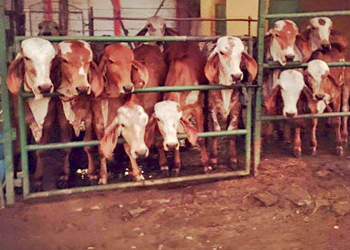
The Upalokayukta has issued notices to 127 officials of the rank of assistant commissioners and below in the district for initiation of action in this regard.

The state government had released funds to district administrations for constructing goshalas, purchase and distribution of fodder in December-February 2016-17. In view of the severe drought across 139 taluks, the government had directed district administrations to ensure availability of fodder to cattle.

On a tip-off that large scale irregularities had taken place at goshalas in distribution of fodder, Upalokayukta Justice Subhash B Adi made surprise visits to goshalas in March-April 2017. It was found that the ledger book detailing receipts and distribution of fodder was mishandled and that there was mismatch of stocks mentioned in the books and fodder available in goshalas. The Upalokayukta had visited Ranganahalli (Gubbi taluk), Ullasathopu, C B Agrahara, Ranganathapura, Bhoothappanagudi, J Hosahalli (Sira taluk), Tovinakere (Koratagere taluk), Gadabanahalli Thopu, Ayyanabavi, Baguvala (Tiptur taluk), T B Cross, Aremallanahalli (Turuvekere taluk) Y N Hosakote, Nagalamadike, Venkatapura (Pavagad taluk) and Godekere, Vajra, Karehalli, Hulikal, Durgammanna Betta (Chikkanayakanahalli taluk).

The enquiry report submitted by Lokayukta officials stated that the district administration officials misappropriated funds and also left the goshalas in a pitiable state.

“Misappropriation of Rs 33.96 lakh released to goshalas in seven taluks has been found. Similarly, a total of Rs 21.98 crore towards the purchase of fodder has been misappropriated,” the report said.

Apart from the misappropriation, the enquiry revealed that the district administration had not followed the guidelines issued periodically by the state government. The enquiry report stated that almost all the goshalas were unhygienic and did not use scientific weighing scales. “At some goshalas, the fodder was distributed without weighing. The officials had not provided proper lighting and toilet facilities to farmers staying with cattle at night despite a government circular in this regard.”

Justice Adi confirmed issuance of notices. “I had visited goshalas only in Tumakuru district. The report suggested misappropriation of funds and notices have been issued to record the comments of officials,” he said.

Comments

Cow and the politics
 - 
Saturday, 17 Jun 2017

Ok, now i understand the purpose of all this cow slaughter ban. It is money making strategy by bhakts. Wah re wah sabse bade Chor to yeh log hain

RR
 - 
Sunday, 18 Jun 2017

So this is the reason behind potraitng animals as MATA .. PITA...
When innocents realize this and bycot these sangees....?
JAI HIND

Add new comment

  • Coastaldigest.com reserves the right to delete or block any comments.
  • Coastaldigset.com is not responsible for its readers’ comments.
  • Comments that are abusive, incendiary or irrelevant are strictly prohibited.
  • Please use a genuine email ID and provide your name to avoid reject.
News Network
June 16,2020

Shivamogga, Jun 16: The Deputy Commissioner on Tuesday announced a ban on movement of heavy goods vehicles in the Agumbe ghat section between June 15 and October 15 as a precautionary measure, as there was possibility of landslides due to heavy rain during the monsoon season.

All trucks over 12 tonnes will be prohibited from passing through the ghat, DC K B Shivakumar said in a statement here.

The authorities have suggested two alternative routes for the movement of heavy freight vehicles – the Shimoga-Thirthahalli-Sringeri-Kerekatte-Karkala-Udupi-Mangaluru route and the Shimoga-Thirthahalli-Mastikette-Hulikal-Hosangadi-Siddapura-Udupi-Mangaluru route.

Comments

Add new comment

  • Coastaldigest.com reserves the right to delete or block any comments.
  • Coastaldigset.com is not responsible for its readers’ comments.
  • Comments that are abusive, incendiary or irrelevant are strictly prohibited.
  • Please use a genuine email ID and provide your name to avoid reject.
News Network
May 19,2020

Bengaluru, May 19: Containment zones in Karnataka will be much smaller in size under the latest lockdown norms. However, rules and loopholes will be tightened and action against violators will be stringent in order to check the spread of the disease.

Revised guidelines issued by the Centre to the state, reveal containment zones are delineated based on mapping of cases and contacts. Intensive action will be carried out in these areas with the aim of breaking the chain of transmission. Therefore, the area of a containment zone should be appropriately defined by the district administration/local urban bodies with technical inputs at local level.

The health department is considering shrinking the size of containment zones from the existing 100 metres to open up more space for economic activities. Medical education minister K Sudhakar, also a member of the Covid taskforce, said additional chief secretary (health department) Javed Akthar will issue a new definition of a containment zone after the Covid-19 taskforce holds its next meeting.

“We are planning to further shrink it and restrict containment zones to an apartment complex, independent house or even a lane where the Covid-19 patient resides,” Sudhakar said. He went on to say bigger containment zones will impede businesses and normal activities in the vicinity, something which the government wants to avoid.

The minister said Karnataka will also do away with colour-coding districts. “With restrictions being relaxed for almost all activities, it does not make sense to pursue with colour codes. It is either containment zone or outside containment zone,” he said.

In rural areas, the minister said containment zones will be identified by the taluk heads. Government sources say it is difficult to restrict activities to certain areas or smaller location in rural areas as farmers and people will have to travel to the outskirts of their villages for their livelihood.

An official said, a containment operation (large outbreak or cluster) is deemed successful when no case is reported in 28 days from the containment zone.

Comments

Add new comment

  • Coastaldigest.com reserves the right to delete or block any comments.
  • Coastaldigset.com is not responsible for its readers’ comments.
  • Comments that are abusive, incendiary or irrelevant are strictly prohibited.
  • Please use a genuine email ID and provide your name to avoid reject.
News Network
January 29,2020

Newsroom, Jan 29: Karnataka’s capital has earned the unwelcome distinction of global capital of traffic congestion. According to a report by TomTom, the Netherlands-based global provider of navigation, traffic and map products, Bengaluru beat 415 other cities across 57 countries to earn the title of world's most traffic congested city in 2019.

“Bengaluru takes the top spot this year with drivers in the southern Indian city expecting to spend an average of 71% extra travel time stuck in traffic," TomTom said in the ninth edition of its annual Traffic Index.

Three other Indian cities, namely, Mumbai, Pune and New Delhi are also ranked in the 2019 edition of TomTom’s Traffic Index of the world’s most traffic-congested cities. 

The report released on Tuesday ranks cities by the average time added to a trip. TomTom index also includes details on when congestion is heaviest and lightest, how highways compare with surface streets, and how much time drivers wasted waiting for other drivers to get out of their way.

Following closely on the heels of Bengaluru is Manila, Philippines, with the similar 71% traffic congestion. Among the top five worst traffic affected cities are Mumbai and Pune from India at the fourth and fifth place respectively, while Bogota, Colombia is on third spot.

Delhi, the national capital of India is on the 8th spot, while Moscow (Russia), Lima (Peru), Istanbul (Turkey) and Jakarta (Indonesia) are on 6th, 7th, 9th and 10th spot respectively.

Mumbai recorded a 65% traffic congestion with 9th September, 2019 being the worst day. On an average, a Mumbaikar lost 209 hours in traffic congestion. Pune has 59% traffic congestion with 2nd August, 2019 being the worst day. 193 hours are lost due to congestion. Delhi, on the other hand, has 56% traffic congestion. 23rd October, 2019 was the worst day, while 190 hours are lost in traffic congestion.

Interestingly, among all the four Indian cities, Delhi has the most number of cars. Previous studies have concluded that Delhi has the best road conditions among the Metro cities of India.

If you are wondering what exactly the percentages mean, a 53% congestion level in Bangkok, for example, means that a trip will take 53% more time than it would during Bangkok’s baseline uncongested conditions.

TomTom calculates the baseline per city by analyzing free-flow travel times of all vehicles on the entire road network – recorded 24/7, 365 days a year. The report by Dutch navigation and mapping company ranks cities by the average time added to a trip. It also includes details on when congestion is heaviest and lightest, and how much time drivers wasted waiting for other drivers to get out of their way.

Comments

Add new comment

  • Coastaldigest.com reserves the right to delete or block any comments.
  • Coastaldigset.com is not responsible for its readers’ comments.
  • Comments that are abusive, incendiary or irrelevant are strictly prohibited.
  • Please use a genuine email ID and provide your name to avoid reject.