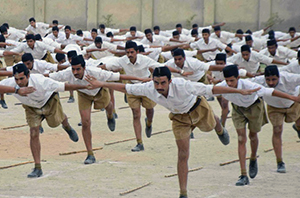
UP's RSS schools claim 30% rise in Muslim kids in 2 years

June 20, 2016

Allahabad, June 20: About 7,000 Muslim students are studying in 1,200 Rashtriya Swayamsevak Sangh (RSS) schools across Uttar Pradesh, an increase of 30% in the last two years after a BJP-led government came to power at the Centre, the right-wing outfit has said.rss

RSS, known for its Hindutva ideology, said these students were following all rules like reciting 'slokas' and 'bhojan mantras', and were doing very well in studies and sports. Most of these students are enrolled in rural areas.

Authorities at Saraswati Shishu Mandir and Saraswati Vidya Mandir claim that Muslim boys and girls had brought laurels to their schools in the fields of sports, cultural activities and academics as well. Chintamani Singh, state inspector of Vidhya Bharti, which manages these schools, said, "Our students such as Mohammad Aqib, Aftab Alam, Ejaj Ahmad, Gufranuddin and Mohammad Akaram have won medals at national sporting events and youth commonwealth games."

RSS sources said these numbers shatter the mainst ream propaganda about the organisation that is widely regarded as BJP's ideological parent. At these schools, the day starts for students with surya namaskar and singing of Vande Mataram besides vedic hymns.

Singh said these children attend classes like any other student and mingle with their peers. There are 4,672 boys and 2,218 girls from the community pursuing education up to class XII at these schools, he added. Vidya Bharti also recently recruited eight Muslim teachers.
"The quality of education is the prime reason why Muslim parents send their wards to our schools," he said. A Muslim boy studying at an RSS-managed school topped his high school examination in Assam earlier this month. "RSS is not antiMuslim or against any religion, it is pro-India with no communal agenda," an RSS source said.

Comments

naren kotian
 - 
Tuesday, 21 Jun 2016

hats off to RSS , Moral education and samskar given by RSS made us ultra nationalists and we learnt not to back stab mother land like one peculiar community from middle east . jai ho RSS ... We must penetrate the enemy like mossad does as in coming days more anti india works will be done by one sect which has roots in middle east.it is the RSS samskar becoz of this nearly 60% of Indian army , navy , airforce are from sangh parivar associated organsiation . we dont need lecture from third rated people who isnpite of 15% sends meagre 1% army jawans . RSS power truly visible among US lobbiests and even today pakistani minister feared growing threat from powerful sangh parivar in coming days . jai sri ram ... bholo bharath mata ki jai ... vande mataram ... hara hara modi .. jai jai modi ...

Add new comment

  • Coastaldigest.com reserves the right to delete or block any comments.
  • Coastaldigset.com is not responsible for its readers’ comments.
  • Comments that are abusive, incendiary or irrelevant are strictly prohibited.
  • Please use a genuine email ID and provide your name to avoid reject.
Media Release
February 14,2020

Veteran journalist P. Sainath has said that the nation is in a crisis. And this crisis is not limited to just the rural area. It has become a national crisis at various areas such as agriculture, education, economy, job creation etc.

He was delivering the endowment lecture on the topic ‘Indian democracy at the post-liberalization and post-truth era’ at Media Manthan 2020 organized by the PG department of journalism and mass communication at St Aloysius College (Autonomous). 

Mr Sainath said that the many policies adopted in the 90s led to India becoming unusually unequal. Referring to the speech Ambedkar had made at the Constituent Assembly while handing over the draft of the Constitution, Mr Sainath said, “Ambedkar had warned about the weakness of Indian democracy that liberty without equality allows the supremacy of a few over the multitude. Liberty, equality and fraternity must be kept together as we cannot have one without the other.” 

Mr Sainath stated that the agrarian crisis was no longer about the loss of productivity, employment or about farmer suicide; it was a societal, civilizational crisis. Commenting on the lopsided policies such as cow-slaughter ban, he explained how cow slaughter ban had adversely affected many industries due to their interdependency. While Muslims who slaughtered cows were rendered helpless, the cattle traders who were mostly OBCs lost their earnings as the cattle prices crashed. An important industry like Kolhapur sandals industry in Maharashtra went bankrupt as a result of the cow slaughter ban in Maharashtra. He said the policymakers had no idea how the rural industries were interconnected. Demonetisation too devastated the rural economy as 98 percent of rural transactions happen through cash. 

Mr Sainath also spoke about the crisis of inequality which affects the Dalits and the Adivasis far more than anyone else as 90 percent of the rural households take home less than Rs 10,000/- per month. “Women are yet another group whose labour is never counted in the gross domestic product. Women and girls globally do unpaid work which amounts to about 12.5 billion working hours per year. Monetarily speaking, this is worth 10.8 trillion dollars,” Mr Sainath added. 

Speaking about the crisis of jobs Mr Sainath said that major companies were laying off employees just to create more profits for the investors and the adoption of artificial intelligence in the industry would further destroy millions of jobs.

Rector of St Aloysius College Institutions Fr Dionysius Vaz SJ, Principal Dr (Fr) Praveen Martis SJ, HOD of Journalism and Mass Communication department Dr (Fr) Melwyn Pinto SJ were present.

‘Veerappan and Vijay Mallya’s business models are interesting!’

Addressing the gathering during his endowment lecture on Friday, Mr Sainath made an interesting comment on the so called ‘revenue model’. “Whenever I visit IIMs and IITs for lectures on my PARI project, the students there ask me what my revenue model for my project is. I tell them that I do not have a revenue model. In fact, journalism does not begin with a revenue model. Gandhiji, Ambedkar, Bhagat Singh were all great journalists. But they did not have a revenue model,” Mr Sainath said.

On a lighter note, he said that the best revenue model that he liked was that of forest brigand Veerappan and liquor baron Vijay Mallya. “Veerappan ruled the forest for forty years and from the top ministers to the villagers he could dictate terms and liver royally. Similarly, Mallya’s revenue model was to steal the banks and run away abroad and live like a king,” Mr Sainath added.

Journalism is not and can never be a business. It is a calling, he opined. While newspaper can be a business, television can be a business, journalism per se cannot be reduced to a business. “Unfortunately today, journalists are recruited on a contract basis and they have no bargaining power; and there are no unions to fight for their cause. Hence, they are at the mercy of the corporate media houses for their survival and are made to write stories that cannot be called journalism,” Mr Sainath said.

Answering a question as to the pressures he faced as a journalist, he said that external pressures from the government or others could be very well handled. It is the internal pressures from once own media house that journalists find it difficult to manage.


 

Comments

Add new comment

  • Coastaldigest.com reserves the right to delete or block any comments.
  • Coastaldigset.com is not responsible for its readers’ comments.
  • Comments that are abusive, incendiary or irrelevant are strictly prohibited.
  • Please use a genuine email ID and provide your name to avoid reject.
News Network
January 12,2020

With an aim to provide water to stray animals in Mangaluru, an animal activist announced a project 'Jal' under which free water bowls will be distributed to the people across the city.

Tauseef Ahmed believes many animals and birds do not find source to drink water which leads to death.
"Finding clean and safe drinking water has been a major issue in a lot of places. We humans when we face some scarcity we manage by taking the water out from the well," Ahmed told ANI.

"Unfortunately, that's not the case with when it comes to animals and birds. They do not find sources for water to drink so they eventually end up drinking sewage water and they fall sick. In some cases, even that is not available and due to dehydration, they die," he added.

Under the "Jal" project, Ahmed will distribute free water bowls to the people and expects them to make equal efforts in saving the lives of the animals.

"So, this project "Jal" will be providing 100 free water bowls all over Mangaluru. We are distributing it free of cost. All you have to do is keep the bowls outside in the garden or any places where animals frequently visit. Every day, we just have to fill the bowls with water for the animals. It will help a lot of animals to survive in the harsh weather of summers," Ahmed highlighted.

"We have used cement to make the bowls which will keep the eater really cool. We are spending close to 74 rs per bowl. We have made around 100 bowls and will continue making it. We are trying to cover as many animals as we can," he said.

Comments

Add new comment

  • Coastaldigest.com reserves the right to delete or block any comments.
  • Coastaldigset.com is not responsible for its readers’ comments.
  • Comments that are abusive, incendiary or irrelevant are strictly prohibited.
  • Please use a genuine email ID and provide your name to avoid reject.
News Network
January 6,2020

Bengaluru, Jan 6: Activist Irom Chanu Sharmila took part in a protest against the Citizenship Amendment Act (CAA), National Register of Citizens (NRC) and National Population Register (NPR) at Sir Puttanna Chetty Town Hall here on Sunday.

Sharmila, who came in the protest along with her child, took part in a 'burqa and bindi' protest marking the birth anniversary of social reformer Savitribai Phule.

Protests have erupted across the country over the CAA which grants citizenship to Hindu, Sikh, Jain, Parsi, Buddhist, and Christian refugees from Pakistan, Afghanistan, and Bangladesh, who came to India on or before December 31, 2014.

Comments

Add new comment

  • Coastaldigest.com reserves the right to delete or block any comments.
  • Coastaldigset.com is not responsible for its readers’ comments.
  • Comments that are abusive, incendiary or irrelevant are strictly prohibited.
  • Please use a genuine email ID and provide your name to avoid reject.