


US Army allows hijabs, beards, turbans for servicemen

January 5, 2017

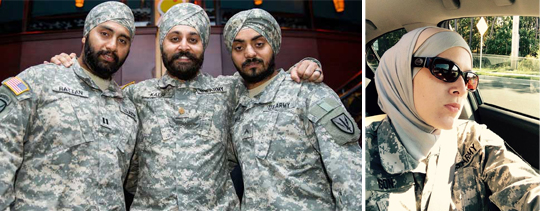
Washington, Jan 5: The US Army has issued a new regulation under which servicemen who wear turbans, hijabs or beards can now be enrolled in the military, making the force more inclusive of minority religions and cultures.
Untitled-1 copy

The new set of rules, issued by Secretary of the Army Eric Fanning, allows religious accommodations to be approved at the brigade-level. Previously it was at the level of Secretary.

Once that approval occurs, the change will ensure that the religious accommodation is enduring and applies to most positions within the US Army.

"This is a major progress, not just for the Sikh-American community but for our nation's military. Sikh-Americans love this country and want a fair chance to serve in our country on equal footing. Today's announcement will help do just that," Congressman Joe Crowley said welcoming the directive issued by the US Army Secretary.

"We are a stronger nation, with a stronger military because of our respect for religious and personal freedom," he said.

The move has been welcomed by Sikh-Americans and US lawmakers who have been on the forefront of a national campaign in this regard for the past several years. Before the January 3 changes announced by the US Army, Sikh-Americans and others had to be granted a limited accommodation or permission to serve in the army while maintaining their articles of faith.

Such accommodations were neither permanent nor guaranteed, and had to be renewed after virtually every assignment. Service members had also been required to remove their articles of faith while their accommodation request is pending, once again subjecting them to the difficult position of choosing between their faith and job.

Sikh-American Coalition, which has been on the forefront of such a campaign, welcomed the move, but said that this is still short of what they have been asking for.

"While we still seek a permanent policy change that enables all religious minorities to freely serve without exception, we are pleased with the progress that this new policy represents for religious tolerance and diversity by our nation's largest employer," said the coalition's legal director Harsimran Kaur.

The new provisions updates rules governing religious liberty that significantly improve the standards for Sikhs and other religious minorities who seek to serve their country with their religious articles of faith intact, she said.

Under the new policy, Brigade commanders must grant religious accommodations for unshorn beards, unshorn hair, turbans and Muslim hijabs unless the requestor's religious belief is not sincere or the army identifies a specific, concrete hazard.

Last week, the New York Police Department (NYPD), in a move aimed at inclusiveness, said it will allow its Sikh officers to wear turbans and maintain beards.

According to the latest regulation, accommodations must be granted across all duty positions except in certain limited circumstances.

The army intends to conduct additional testing for the use of protective equipment by bearded soldiers.

"The Sikh articles of faith have always been consistent with the best of American values and we are pleased that the burden no longer rests with Sikh soldiers to prove this through a lengthy administrative process," said Amandeep Sidhu, partner at McDermott Will and Emery.

In 1981, a prohibitive ban was placed on Sikh-American soldiers.

Last year, four Sikh-American soldiers, including the decorated Captain Simratpal Singh, filed a lawsuit against the US Army in this regard.

"My turban and beard represent my commitment to pluralism and equality. This policy change underscore's the military's commitment to these values and is a sign of meaningful progress that will ensure the strength of our democracy," said Major Kalsi, who was the first Sikh-American in more than a generation to be allowed to serve in the US military without violating his articles of faith.

Comments

s
 - 
Thursday, 5 Jan 2017

and our army does not allow anything except turbans, sighting reasons of uniformity. allowing such things only shows the diversity in our army and the public will realize all faiths support the army and are protecting the country. this is very important in the current political climate of polarization and divisiveness.

Add new comment

  • Coastaldigest.com reserves the right to delete or block any comments.
  • Coastaldigset.com is not responsible for its readers’ comments.
  • Comments that are abusive, incendiary or irrelevant are strictly prohibited.
  • Please use a genuine email ID and provide your name to avoid reject.
News Network
June 30,2020

Bengaluru, Jun 30: Private medical colleges in Bengaluru have agreed to join hands with the Karnataka government for the treatment of COVID-19 patients.

The representatives from private medical colleges have promised the state government to provide 2000 beds immediately and another 4500 beds will be added within a week.

The development took place as Chief Minister BS Yediyurappa on Tuesday held a second round of meeting with representatives of private hospitals at Vidhana Soudha over COVID-19. 

The Chief Minister and Medical Education Minister Dr K Sudhakar held separate meetings with the representatives from private colleges administration and all the private colleges have assured to extend their support to the government decision. 

"There are 11 private and three government medical colleges in the city and we will get about 6500 beds from these for COVID treatment," Dr Sudhakar informed media after the meeting.

He further said, "These facilities including doctors and staff will be made available to the government within a week and the beds will be allocated to COVID patients through BBMP's centralised system. The insurance facility will be extended to the doctors and staff serving in these private hospitals also."

PG students in private medical colleges and other staff will be utilised in COVID Care Centres, the minister said.

"There will be some changes in the treatment protocols going forward. The decision regarding this will be taken in the meeting that will be held in the evening under the chairmanship of the CM," the minister explained.

According to him, symptomatic patients, persons aged above 60 years and those with comorbidities like diabetes, hypertension and serious kidney, liver, lungs and heart-related ailments will be admitted to hospitals. 

Other asymptomatic persons will be monitored in COVID care centres. Detailed notification with these guidelines will be released tomorrow, the minister said.

The meeting was chaired by CM BS Yediyurappa and Deputy CM Ashwatnarayana, Ministers Basavaraj Bommai, R Ashoka and senior officials were also present.

Comments

Add new comment

  • Coastaldigest.com reserves the right to delete or block any comments.
  • Coastaldigset.com is not responsible for its readers’ comments.
  • Comments that are abusive, incendiary or irrelevant are strictly prohibited.
  • Please use a genuine email ID and provide your name to avoid reject.
News Network
April 5,2020

Bengaluru, Apr 5: The COVID-19 related lockdown has substantially improved the air quality of Bengaluru, taking it from satisfactory level to good, a senior state pollution control board offcial said here on Sunday.

"During the course of the lockdown 19 problem, we reached good position from satisfactory.

It is between zero to 50 AQI (Air Quality Index) now. We have good quality air," the Karnataka State Pollution Control Board member secretary Basavaraj Patil told PTI.

He said the indicator for knowing the air quality in

"If the AQI is zero to 50 then it is good. If it is 50 to 100 then it is satisfactory. 101 to 150 is moderate and if it is 151 to 200, then it is poor, he explained.

Patil said as per available recrods, there has been a 60 to 65 per cent reduction in pollution during the lockdown.

The city railway station and Peenya industrial area, which used to be among the areas with highest AQI, has seen pollution levels come down significantly, he said.

Another major contributor of pollution was construction activities, which too had ground to a halt due to the lockdown, resulting in zero dust emission.

Patil opined that the improved air quality would boost the immune system of the people.

"It will improve the immune system of people, including those who have breathing problems like asthma," he said.

He asked the public to learn lessons from the lockdown and later switch to sustainable means of transport such as public transport, walking and cycling,.

"We can still reduce the pollution load even after the lockdown is over," Patil said.

Comments

Add new comment

  • Coastaldigest.com reserves the right to delete or block any comments.
  • Coastaldigset.com is not responsible for its readers’ comments.
  • Comments that are abusive, incendiary or irrelevant are strictly prohibited.
  • Please use a genuine email ID and provide your name to avoid reject.
News Network
March 15,2020

While it makes perfect sense for IT employees to work from remote locations via video conferencing and collaboration tools seamlessly - especially in the case of tech giants like Google or Microsoft -- workers from the non-IT companies and small and medium enterprises (SMBs) are the worst-hit in India as most of them have little or no clue about how these messaging and collaboration tools work amid the coronavirus pandemic.

Small companies -- from corporate to education verticals -- are scrambling to get their act together as new coronavirus threat has reached their premises, prompting them to send employees home who have age-old laptops, poor network and connectivity with no UPS backups and little knowledge about how to handle group chat and collaboration software like Zoom, Google Hangouts Meet, Microsoft Teams and Flock etc.

Instead of halting operations, however, businesses can choose to shift towards remote working methods with teaching non-IT staff on how to use the latest digital software to connect and work, say industry experts.

The training will take some time and may hamper productivity in the short run but is a win-win situation for the non-tech companies in the long run, in case any such global emergency arises in the future.

According to a latest report by Gartner, 54 per cent of HR leaders have cited that poor technology and/or infrastructure for remote working is the biggest barrier to effective remote working.

Sandy Shen, Senior Director Analyst, Gartner, says that with COVID-19 disrupting the business landscape, CIOs should relook at the digital fulfillment of market demand.

"The value of digital channels, products and operations is immediately obvious to companies everywhere right now. This is a wake-up call for organisations that have placed too much focus on daily operational needs at the expense of investing in digital business and long-term resilience," warned Shen.

Businesses that can shift technology capacity and investments to digital platforms will mitigate the impact of the outbreak and keep their companies running smoothly now, and over the long term.

"Videoconferencing, messaging, collaboration tools and document sharing are just a few examples of technologies that facilitate remote work. Additional bandwidth and network capacity may also be needed, given the increasing number of users and volume of communications," informed Shen.

The IT industry's apex body Nasscom has asked the government to relax norms for a month to allow work-from-home for technology and back-office employees as a measure to deal with the spread of Covid-19 in India.

Networking giant Cisco said that it has seen "significant growth" in the usage of its web conferencing and video-conferencing service Webex in India.

According to Muneer Ahmad, Business Head, ViewSonic India, due to COVID-19 pandemic, the corporate and educational sector is severely getting affected in the country.

"ViewSonic IFP has a cloud-based software which help teachers and corporates to connect through video conferencing to multiple people at the same time and can split the screen into six screens. It can also connect with various tools like Skype, Cisco WebEx, Zoom, Google Hangouts and GoToMeeting," Ahmad told IANS.

Co-working sector has also taken a hit and the industry is looking at several measures to tackle it -- from ensuring supply of juices rich in Vitamin C to supply of disinfectants and giving work from home facilities.

"The scheduled visits of the clients at our co-working offices have been postponed. Few of our clients have cancelled their outstation meetings and have now started audio/video conferencing for virtual meetings," said Nakul Mathur, MD, Avanta India.

According to reports, India has approximately 1,000 co-working locations (as of September 2019) and is the second-largest market for the co-working industry after China.

As India's first licensed B2B Virtual Network Operator, CloudConnect Communications offers a collaborative platform that allows companies to overcome the COVID-19 threat while maintaining seamless business continuity and optimum employee productivity.

"We offer a secure, robust, reliable, scalable and trackable mobile-first unified communication infrastructure that aids remote teleworking so that businesses can continue operating even under any unforeseen circumstances," said Gokul Tandon, Executive Chairman, CloudConnect Communications.

Comments

Add new comment

  • Coastaldigest.com reserves the right to delete or block any comments.
  • Coastaldigset.com is not responsible for its readers’ comments.
  • Comments that are abusive, incendiary or irrelevant are strictly prohibited.
  • Please use a genuine email ID and provide your name to avoid reject.