


US Army allows hijabs, beards, turbans for servicemen

January 5, 2017

Washington, Jan 5: The US Army has issued a new regulation under which servicemen who wear turbans, hijabs or beards can now be enrolled in the military, making the force more inclusive of minority religions and cultures.
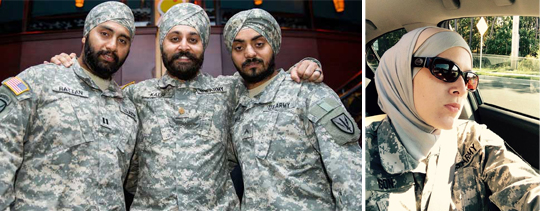
Untitled-1 copy

The new set of rules, issued by Secretary of the Army Eric Fanning, allows religious accommodations to be approved at the brigade-level. Previously it was at the level of Secretary.

Once that approval occurs, the change will ensure that the religious accommodation is enduring and applies to most positions within the US Army.

"This is a major progress, not just for the Sikh-American community but for our nation's military. Sikh-Americans love this country and want a fair chance to serve in our country on equal footing. Today's announcement will help do just that," Congressman Joe Crowley said welcoming the directive issued by the US Army Secretary.

"We are a stronger nation, with a stronger military because of our respect for religious and personal freedom," he said.

The move has been welcomed by Sikh-Americans and US lawmakers who have been on the forefront of a national campaign in this regard for the past several years. Before the January 3 changes announced by the US Army, Sikh-Americans and others had to be granted a limited accommodation or permission to serve in the army while maintaining their articles of faith.

Such accommodations were neither permanent nor guaranteed, and had to be renewed after virtually every assignment. Service members had also been required to remove their articles of faith while their accommodation request is pending, once again subjecting them to the difficult position of choosing between their faith and job.

Sikh-American Coalition, which has been on the forefront of such a campaign, welcomed the move, but said that this is still short of what they have been asking for.

"While we still seek a permanent policy change that enables all religious minorities to freely serve without exception, we are pleased with the progress that this new policy represents for religious tolerance and diversity by our nation's largest employer," said the coalition's legal director Harsimran Kaur.

The new provisions updates rules governing religious liberty that significantly improve the standards for Sikhs and other religious minorities who seek to serve their country with their religious articles of faith intact, she said.

Under the new policy, Brigade commanders must grant religious accommodations for unshorn beards, unshorn hair, turbans and Muslim hijabs unless the requestor's religious belief is not sincere or the army identifies a specific, concrete hazard.

Last week, the New York Police Department (NYPD), in a move aimed at inclusiveness, said it will allow its Sikh officers to wear turbans and maintain beards.

According to the latest regulation, accommodations must be granted across all duty positions except in certain limited circumstances.

The army intends to conduct additional testing for the use of protective equipment by bearded soldiers.

"The Sikh articles of faith have always been consistent with the best of American values and we are pleased that the burden no longer rests with Sikh soldiers to prove this through a lengthy administrative process," said Amandeep Sidhu, partner at McDermott Will and Emery.

In 1981, a prohibitive ban was placed on Sikh-American soldiers.

Last year, four Sikh-American soldiers, including the decorated Captain Simratpal Singh, filed a lawsuit against the US Army in this regard.

"My turban and beard represent my commitment to pluralism and equality. This policy change underscore's the military's commitment to these values and is a sign of meaningful progress that will ensure the strength of our democracy," said Major Kalsi, who was the first Sikh-American in more than a generation to be allowed to serve in the US military without violating his articles of faith.

Comments

s
 - 
Thursday, 5 Jan 2017

and our army does not allow anything except turbans, sighting reasons of uniformity. allowing such things only shows the diversity in our army and the public will realize all faiths support the army and are protecting the country. this is very important in the current political climate of polarization and divisiveness.

Add new comment

  • Coastaldigest.com reserves the right to delete or block any comments.
  • Coastaldigset.com is not responsible for its readers’ comments.
  • Comments that are abusive, incendiary or irrelevant are strictly prohibited.
  • Please use a genuine email ID and provide your name to avoid reject.
Agencies
April 15,2020

San Diego, Apr 15: Several people lost their sense of smell or taste weeks ago globally and are still waiting for it to come back and now, researchers have identified an association between sensory loss and novel coronavirus 2019 (COVID-19) infection, indicating that loss of smell and taste may be considered as early symptoms of the deadly disease.

Interestingly, the study also found that persons who reported experiencing a sore throat more often tested negative for COVID-19.

The team from University of California-San Diego found high prevalence and unique presentation of certain sensory impairments in patients positive with COVID-19.

Of those who reported a loss of smell and taste, the loss was typically profound, not mild.

"Based on our study, if you have smell and taste loss, you are more than 10 times more likely to have COVID-19 infection than other causes of infection. The most common first sign of a COVID-19 infection remains fever, but fatigue and loss of smell and taste follow as other very common initial symptoms," explained study researcher Carol Yan from UC San Diego.

"We know COVID-19 is an extremely contagious virus. This study supports the need to be aware of smell and taste loss as early signs of COVID-19," Yan added.

For the findings, published in the journal International Forum of Allergy and Rhinology, the research team surveyed 1,480 patients with flu-like symptoms and concerns regarding potential COVID-19 infection who underwent testing at UC San Diego Health from March 3 through March 29, 2020.

Within that total, 102 patients tested positive for the virus and 1,378 tested negatives. The study included responses from 59 COVID-19-positive patients and 203 COVID-19-negative patients.

Encouragingly, the rate of recovery of smell and taste was high and occurred usually within two to four weeks of infection.

"Our study not only showed that the high incidence of smell and taste is specific to COVID-19 infection but we fortunately also found that for the majority of people sensory recovery was generally rapid," said Yan.

"Among the COVID-19 patients with smell loss, more than 70 per cent had reported improvement of smell at the time of the survey and of those who hadn't reported improvement, many had only been diagnosed recently," she added.

Sensory return typically matched the timing of disease recovery.

In an effort to decrease the risk of virus transmission, UC San Diego Health now includes loss of smell and taste as a screening requirement for visitors and staff, as well as a marker for testing patients who may be positive for the virus.

"It is our hope that with these findings other institutions will follow suit and not only list smell and taste loss as a symptom of COVID-19, but use it as a screening measure for the virus across the world," Yan said.

Comments

Add new comment

  • Coastaldigest.com reserves the right to delete or block any comments.
  • Coastaldigset.com is not responsible for its readers’ comments.
  • Comments that are abusive, incendiary or irrelevant are strictly prohibited.
  • Please use a genuine email ID and provide your name to avoid reject.
News Network
April 14,2020

Dubai, Apr 14: Around 2,500 Indians have approached Indian missions in the United Arab Emirates (UAE) seeking help to be flown home during the ongoing coronavirus lockdown, top diplomats have said.

The Indian Embassy in Abu Dhabi and the Indian Consulate in Dubai together have received requests from "a little more than 1,000 individuals" while the latter has received an additional request from an employer who has laid-off around 1,000 Indian workers, reports Gulf News on Monday.

According to the Indian Ambassador to the UAE Pavan Kapoor, the missions have not been bombarded with mass requests from the people who wish to take an immediate flight home unlike widespread reports on social media.

Most of the individuals who have expressed their interest to return home are visitors and those who lost their jobs, he told Gulf News.

Consul General of India in Dubai, Vipul said his mission had received nearly 1000 requests via email and phone from people who want to return home.

"A majority of them are visit visa holders. On Sunday, we got information about another large group of around 1,000 Indian workers who have lost jobs. The employer has got in touch to know the options to send them back home as early as possible," he told Gulf News.

However, the diplomatic heads refuted unverified reports that claim tens of thousands of Indians were scrambling to fly home during the pandemic.

They added that the missions have been aiding hundreds of workers, who have been left in the lurch by their employers, with provisions.

The Indian government had said that flight services cannot be resumed during the lockdown period, which has now been extended till May 3.

Comments

Add new comment

  • Coastaldigest.com reserves the right to delete or block any comments.
  • Coastaldigset.com is not responsible for its readers’ comments.
  • Comments that are abusive, incendiary or irrelevant are strictly prohibited.
  • Please use a genuine email ID and provide your name to avoid reject.
News Network
January 22,2020

Udupi, Jan 22: Udupi district authorities was on high alert following the bomb detected at Mangalore International Airport (MIA).

Udupi railway police said that security had been strengthened in all the railway stations, including Padubudri, Senapur, Barkur, Kundapur and Indrali in the district.

The police in mufti and uniform were on constant beats in the railway stations. Besides, dog squads and bomb detection squads have been deputed in the railways stations, they said.

Comments

Add new comment

  • Coastaldigest.com reserves the right to delete or block any comments.
  • Coastaldigset.com is not responsible for its readers’ comments.
  • Comments that are abusive, incendiary or irrelevant are strictly prohibited.
  • Please use a genuine email ID and provide your name to avoid reject.