


US Army allows hijabs, beards, turbans for servicemen

January 5, 2017

Washington, Jan 5: The US Army has issued a new regulation under which servicemen who wear turbans, hijabs or beards can now be enrolled in the military, making the force more inclusive of minority religions and cultures.
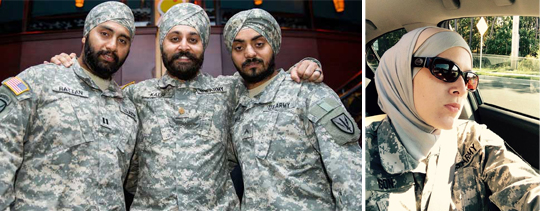
Untitled-1 copy

The new set of rules, issued by Secretary of the Army Eric Fanning, allows religious accommodations to be approved at the brigade-level. Previously it was at the level of Secretary.

Once that approval occurs, the change will ensure that the religious accommodation is enduring and applies to most positions within the US Army.

"This is a major progress, not just for the Sikh-American community but for our nation's military. Sikh-Americans love this country and want a fair chance to serve in our country on equal footing. Today's announcement will help do just that," Congressman Joe Crowley said welcoming the directive issued by the US Army Secretary.

"We are a stronger nation, with a stronger military because of our respect for religious and personal freedom," he said.

The move has been welcomed by Sikh-Americans and US lawmakers who have been on the forefront of a national campaign in this regard for the past several years. Before the January 3 changes announced by the US Army, Sikh-Americans and others had to be granted a limited accommodation or permission to serve in the army while maintaining their articles of faith.

Such accommodations were neither permanent nor guaranteed, and had to be renewed after virtually every assignment. Service members had also been required to remove their articles of faith while their accommodation request is pending, once again subjecting them to the difficult position of choosing between their faith and job.

Sikh-American Coalition, which has been on the forefront of such a campaign, welcomed the move, but said that this is still short of what they have been asking for.

"While we still seek a permanent policy change that enables all religious minorities to freely serve without exception, we are pleased with the progress that this new policy represents for religious tolerance and diversity by our nation's largest employer," said the coalition's legal director Harsimran Kaur.

The new provisions updates rules governing religious liberty that significantly improve the standards for Sikhs and other religious minorities who seek to serve their country with their religious articles of faith intact, she said.

Under the new policy, Brigade commanders must grant religious accommodations for unshorn beards, unshorn hair, turbans and Muslim hijabs unless the requestor's religious belief is not sincere or the army identifies a specific, concrete hazard.

Last week, the New York Police Department (NYPD), in a move aimed at inclusiveness, said it will allow its Sikh officers to wear turbans and maintain beards.

According to the latest regulation, accommodations must be granted across all duty positions except in certain limited circumstances.

The army intends to conduct additional testing for the use of protective equipment by bearded soldiers.

"The Sikh articles of faith have always been consistent with the best of American values and we are pleased that the burden no longer rests with Sikh soldiers to prove this through a lengthy administrative process," said Amandeep Sidhu, partner at McDermott Will and Emery.

In 1981, a prohibitive ban was placed on Sikh-American soldiers.

Last year, four Sikh-American soldiers, including the decorated Captain Simratpal Singh, filed a lawsuit against the US Army in this regard.

"My turban and beard represent my commitment to pluralism and equality. This policy change underscore's the military's commitment to these values and is a sign of meaningful progress that will ensure the strength of our democracy," said Major Kalsi, who was the first Sikh-American in more than a generation to be allowed to serve in the US military without violating his articles of faith.

Comments

s
 - 
Thursday, 5 Jan 2017

and our army does not allow anything except turbans, sighting reasons of uniformity. allowing such things only shows the diversity in our army and the public will realize all faiths support the army and are protecting the country. this is very important in the current political climate of polarization and divisiveness.

Add new comment

  • Coastaldigest.com reserves the right to delete or block any comments.
  • Coastaldigset.com is not responsible for its readers’ comments.
  • Comments that are abusive, incendiary or irrelevant are strictly prohibited.
  • Please use a genuine email ID and provide your name to avoid reject.
News Network
July 8,2020

Bengaluru, Jul 8: The expert committee constituted by the Karnataka government to look into imparting online education in the wake of the COVID-19 lockdown submitted its report on Tuesday to the Minister for Primary and Secondary Education, S Suresh Kumar.

Amid growing pressure by educational institutions to allow them to run online classes for the students, the government set up the committee headed by noted educationist M K Sridhar.

The Minister told reporters that some schools wanted to run online classes, including for LKG and UKG students. It had also come to the government's notice that schools were reportedly charging hefty fees in the name of online teaching, he added.

"To address the concerns of parents, schools, and the future of the children, the committee was formed,"Kumar said. He further said that the government would study the recommendations and hold discussions with officials and various stakeholders before arriving at a decision.

The Education Department said that the committee, in its report, titled "Continuation of Learning in School Education of Karnataka: Guidelines During COVID-19 Pandemic for Technology Enabled Education and Beyond", has recommended teaching online or by using printed material. The committee suggested that children in the age group of three to six be taught online by way of story-telling, rhymes and games strictly in the presence of parents thrice a week just for one session a day For students from class one to three, it advised two periods a day and three days a week for online teaching.

Students from class three to five would have classes five days a week and two classes for 30 minutes a day. For students from class six to eight, there could be three classes a day for a duration of 30 minutes to 45 minutes each, while for students of class nine and 10 there would be four sessions a day between 30 and 45 minutes each.

The committee also suggested usage of Doordarshan and Akashwani for the government school children. Suresh Kumar said there were a few petitions filed in the Karnataka High Court regarding online teaching to the children.

Comments

Add new comment

  • Coastaldigest.com reserves the right to delete or block any comments.
  • Coastaldigset.com is not responsible for its readers’ comments.
  • Comments that are abusive, incendiary or irrelevant are strictly prohibited.
  • Please use a genuine email ID and provide your name to avoid reject.
News Network
February 12,2020

Kathmandu, Feb 12: Nepal has suspended the licence of a mountainous resort for three months due to poor security management and managerial weakness at the hotel where eight Indian tourists, including four minors, died of possible asphyxiation, according to media reports.

Kathmandu: Nepal has suspended the licence of a mountainous resort for three months due to poor security management and managerial weakness at the hotel where eight Indian tourists, including four minors, died of possible asphyxiation, according to media reports.

Tragedy struck a group of 15 tourists from Kerala when eight of them died on January 21 due to possible asphyxiation after they fell unconscious probably due to a gas leak from a heater in their room at a mountainous resort in Makwanpur district.

The tourists were airlifted to HAMS hospital here where they were pronounced dead on arrival. Makwanpur police said the victims might have fallen unconscious due to asphyxiation.

The Department of Tourism on Sunday imposed a ban on the operation of Daman-based Everest Panorama Resort for three months based on the report submitted by a probe committee formed to investigate the death of the Indian tourists from Kerala, the Kathmandu Post reported on Tuesday.

The department decided to shut down the resort as the report submitted by a probe committee pointed out poor security management and managerial weakness at the resort for the incident, it said.

The Ministry of Culture, Tourism and Civil Aviation had formed the probe committee under Surendra Thapa, the director of the Department of Tourism. After a field inspection, the committee had submitted its report a few days ago, pointing to the shortcomings of the resort.

During the investigation, the committee found the resort had not been following the recommended safety measures and was providing substandard services to its guests, The Himalayan Times reported.

Moreover, the committee discovered that the resort had not fulfilled the criteria set by DoT to be categorised a 'resort', it said.

Mira Acharya, director of DoT was quoted as saying by the report that the resort's operations have been halted as per Section 15 of Tourism Act-1979.

"If the resort owner wishes to resume services after three months of suspension, the resort should be upgraded as per the Hotel, Lodge, Restaurant, Bar and Tourist Guide Rules-1981 and also meet the criteria mentioned in a notice published in the Nepal Gazette under the title 'Hotel Classification and Criteria'," Acharya said.

She added that the resort would also have to undergo the Environment Impact Assessment to get the permission from DoT to resume operation.

Meanwhile, the resort management has said that they will work towards meeting the standards fixed by the department and run the resort efficiently.

"We will work towards meeting the standards fixed by the department and run the resort efficiently. We are saddened by the tragic incident. We will ensure that such incidents don't occur in the future,” said Sudesh Gautam, the operator of the resort was quoted as saying by the Kathmandu Post.

The group, after travelling to Pokhara -- a popular mountainous tourist destination -- was on their way back home and stayed at Everest Panorama Resort in Daman.

Those who were killed were Praveen Krishnan Nair, his wife Saranya Sasi and their three children and Ranjith Kumar Adatholath Punathil, his wife Indu Lakshmi Peethambaran Ragalatha and their son.

Everest Panorama Resort was established 28 years ago in Daman Simbhajyang area, a tourist destination in Bagmati Province. The tourist numbers, according to Thaha Hotel Association, have plunged after the tragic accident of January 27.

Comments

Add new comment

  • Coastaldigest.com reserves the right to delete or block any comments.
  • Coastaldigset.com is not responsible for its readers’ comments.
  • Comments that are abusive, incendiary or irrelevant are strictly prohibited.
  • Please use a genuine email ID and provide your name to avoid reject.
News Network
May 26,2020

Newsroom, May 26: A migrant worker died of hunger while a 10-month-old boy suffering from fever and breathing difficulties died negligence in two separate incidents onboard Shramik Special trains in Uttar Pradesh.

The 46-year-old dead migrant worker’s nephew, who was accompanying him, said that the victim had not eaten anything in the last 60 hours.

Raveesh Yadav said that no food or water was provided on the train, which they had boarded from Mumbai to travel to their native place in Jaunpur district in Uttar Pradesh.

Yadav and his uncle were working as construction workers in Mumbai.

Yadav told the paper that the train had left the Lokmanya Terminal in Mumbai, at 7pm on May 20 and arrived at its final stop, Varanasi Cantonment station, at 7.30am on May 23.

“But my uncle, who was complaining of hunger and pain all over his body, fainted half an hour before we reached Varanasi Cantonment and died within a few minutes,” Raveesh was quoted as saying.

He added that he and his uncle were hungry when they boarded the train but could not find food or water to buy.

Railways’ apathy

Meanwhile, the family of 10 month old child, who died in the train, alleged that the railways did not arrange for a doctor despite their repeated pleas.

The railway doctors had been moved to Covid-19 hospitals and by the time a doctor was provided at Tundla railway station, it was too late, the report quoted the child's grandfather, Dev Lal, as saying.

Lal said that the family members had tried to speak to the GRP at many stations, including at Aligarh, where the train had halted. "But they showed no interest and said any help would be available only in Tundla,” Lal said.

Railways officials then took the kin to a quarantine centre in Tundla, as they suspected that the baby had died because of the novel coronavirus.  It was only on Monday that the incident came to light when another individual at the quarantine facility intimated journalists after the condition of the child's mother worsened.

Last November, the mother of the child, Priyanka Devi of Bihar's Notan village in West Champaran, had gone to visit her parents who reside in Noida with the baby, who was then just four months old. Her husband Pramod Kumar is a farmer, the report added.

Comments

andh bakth
 - 
Tuesday, 26 May 2020

Vote for BJP and you need only hindutva dont worry about food, job etc.......jai modiji

very sad for baby:(

Add new comment

  • Coastaldigest.com reserves the right to delete or block any comments.
  • Coastaldigset.com is not responsible for its readers’ comments.
  • Comments that are abusive, incendiary or irrelevant are strictly prohibited.
  • Please use a genuine email ID and provide your name to avoid reject.