


US Army allows hijabs, beards, turbans for servicemen

January 5, 2017

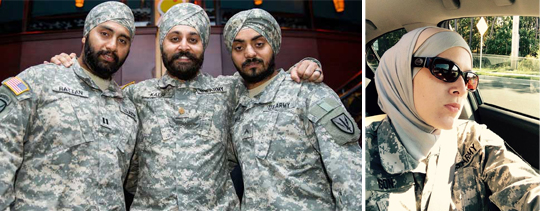
Washington, Jan 5: The US Army has issued a new regulation under which servicemen who wear turbans, hijabs or beards can now be enrolled in the military, making the force more inclusive of minority religions and cultures.
Untitled-1 copy

The new set of rules, issued by Secretary of the Army Eric Fanning, allows religious accommodations to be approved at the brigade-level. Previously it was at the level of Secretary.

Once that approval occurs, the change will ensure that the religious accommodation is enduring and applies to most positions within the US Army.

"This is a major progress, not just for the Sikh-American community but for our nation's military. Sikh-Americans love this country and want a fair chance to serve in our country on equal footing. Today's announcement will help do just that," Congressman Joe Crowley said welcoming the directive issued by the US Army Secretary.

"We are a stronger nation, with a stronger military because of our respect for religious and personal freedom," he said.

The move has been welcomed by Sikh-Americans and US lawmakers who have been on the forefront of a national campaign in this regard for the past several years. Before the January 3 changes announced by the US Army, Sikh-Americans and others had to be granted a limited accommodation or permission to serve in the army while maintaining their articles of faith.

Such accommodations were neither permanent nor guaranteed, and had to be renewed after virtually every assignment. Service members had also been required to remove their articles of faith while their accommodation request is pending, once again subjecting them to the difficult position of choosing between their faith and job.

Sikh-American Coalition, which has been on the forefront of such a campaign, welcomed the move, but said that this is still short of what they have been asking for.

"While we still seek a permanent policy change that enables all religious minorities to freely serve without exception, we are pleased with the progress that this new policy represents for religious tolerance and diversity by our nation's largest employer," said the coalition's legal director Harsimran Kaur.

The new provisions updates rules governing religious liberty that significantly improve the standards for Sikhs and other religious minorities who seek to serve their country with their religious articles of faith intact, she said.

Under the new policy, Brigade commanders must grant religious accommodations for unshorn beards, unshorn hair, turbans and Muslim hijabs unless the requestor's religious belief is not sincere or the army identifies a specific, concrete hazard.

Last week, the New York Police Department (NYPD), in a move aimed at inclusiveness, said it will allow its Sikh officers to wear turbans and maintain beards.

According to the latest regulation, accommodations must be granted across all duty positions except in certain limited circumstances.

The army intends to conduct additional testing for the use of protective equipment by bearded soldiers.

"The Sikh articles of faith have always been consistent with the best of American values and we are pleased that the burden no longer rests with Sikh soldiers to prove this through a lengthy administrative process," said Amandeep Sidhu, partner at McDermott Will and Emery.

In 1981, a prohibitive ban was placed on Sikh-American soldiers.

Last year, four Sikh-American soldiers, including the decorated Captain Simratpal Singh, filed a lawsuit against the US Army in this regard.

"My turban and beard represent my commitment to pluralism and equality. This policy change underscore's the military's commitment to these values and is a sign of meaningful progress that will ensure the strength of our democracy," said Major Kalsi, who was the first Sikh-American in more than a generation to be allowed to serve in the US military without violating his articles of faith.

Comments

s
 - 
Thursday, 5 Jan 2017

and our army does not allow anything except turbans, sighting reasons of uniformity. allowing such things only shows the diversity in our army and the public will realize all faiths support the army and are protecting the country. this is very important in the current political climate of polarization and divisiveness.

Add new comment

  • Coastaldigest.com reserves the right to delete or block any comments.
  • Coastaldigset.com is not responsible for its readers’ comments.
  • Comments that are abusive, incendiary or irrelevant are strictly prohibited.
  • Please use a genuine email ID and provide your name to avoid reject.
Agencies
June 12,2020

Bengaluru, Jun 12: The Central government has identified Karnataka's Udupi and Yadgir among the "emerging districts of concern" for COVID-19 in the country. Confirming the development, a top official of the state health department said, "they (centre) had reviewed these two districts a few days back...there was a sudden spurt of cases due to Maharashtra returnees turning positive." Sources said union cabinet secretary Rajiv Gauba, during a recent video conference with state chief secretaries and health secretaries, had shared his thoughts on the issue.

According to the information shared, districts with more than 400 cases, half of which was reported post-May 18 lockdown relaxation, have been identified as "emerging districts of concern." They are concentrated in the seven states/union territories of Maharashtra, Rajasthan, Tamil Nadu, West Bengal, Karnataka, Jammu and Kashmir and Haryana. "Udupi and Yadgir from Karnataka, along with Gurugram in Haryana and Kolhapur in Maharashtra have 90 per cent of the cases recorded after May 18," they said.

As on June 11 evening, Udupi had a total of 969 positive cases, out of which 619 are active, while 735 positive cases have been reported in Yadgir, out of which 626 are active. The two districts had reported a total of only 11 cases each as on May 18. While Udupi till last evening had seen 349 discharges, it was 108 in Yadgir.

Both districts have reported one COVID related fatality so far. As of June 11 evening, cumulatively 6,245 COVID-19 positive cases were confirmed in the state, which included 72 deaths and 2,976 discharges.

Comments

Add new comment

  • Coastaldigest.com reserves the right to delete or block any comments.
  • Coastaldigset.com is not responsible for its readers’ comments.
  • Comments that are abusive, incendiary or irrelevant are strictly prohibited.
  • Please use a genuine email ID and provide your name to avoid reject.
coastaldigest.com news network
June 21,2020

Udupi, June 21: An entrepreneur lost his life after the car he was driving veered off the road and plunged into a roadside tank near Barkuru in Brahmavar taluk of Udupi district today.

The deceased has been identified as Santosh Shetty, a resident of Vakwadi in Kundapur taluk. He is the proprietor of Laxmi Glass and Plywood, Koteshwara. 

A woman, identified as Shweta, who was also on board the car suffered critical injuries.  

The mishap occurred when the duo was heading to Vakwadi from Brahmavar in Hyundai Car sedan car. 

Shetty lost control over his vehicle while negotiating a curve at Chaulikere and the car plunged off the road as there was no barricade. 

Even though local residents began rescue operation immediately, Shetty breathed his last on the spot. Shweta was rescued and shifted to a hospital in Manipal for treatment.

Comments

Add new comment

  • Coastaldigest.com reserves the right to delete or block any comments.
  • Coastaldigset.com is not responsible for its readers’ comments.
  • Comments that are abusive, incendiary or irrelevant are strictly prohibited.
  • Please use a genuine email ID and provide your name to avoid reject.
News Network
July 7,2020

Bengaluru, Jul 7: There seems no impact of Covid-19 on kharif crop sowing in Karnataka with the current year actually being ahead of previous years, according to an official here on Monday.

"In agriculture, as far as sowing is concerned, there is no impact of COVID-19," Agriculture Commissioner Brijesh Kumar Dikshit told IANS. One of the reasons, according to Dikshit, is that people in rural areas are aware, but not scared of the pandemic.

"In rural India, coronavirus is there. People are aware, not scared. They are taking precautions, but don't have any phobia," he said.

Another reason was that by June the number of infections in Karnataka was not as high as other states, when a lot of sowing was done, he said.

By the end of June, Karnataka saw 15,242 Covid-19 cases. Of that, 7,074 were active.

The sowing is ahead of previous year as it's mostly dependent on weather. "It's ahead of previous years. Agriculture is directed by weather and rains had been slightly earlier this year," he said.

According to Karnataka State Natural Disaster Monitoring Centre, at 185 mm the state received 14 mm less rain in June against the normal 199 mm. "It's like a normal year, or slightly a good year," he said.

Some crops will be sown in the last fortnight of July and few more will extend up to August 15. "The last two weeks will be critical and on July 31 we should be able to tell whether we are short or ahead," he said.

According to preliminary indications, the Commissioner said the area under agriculture is increasing this year, which could also be because that labourers might have come back.

Comments

Add new comment

  • Coastaldigest.com reserves the right to delete or block any comments.
  • Coastaldigset.com is not responsible for its readers’ comments.
  • Comments that are abusive, incendiary or irrelevant are strictly prohibited.
  • Please use a genuine email ID and provide your name to avoid reject.