


US Army allows hijabs, beards, turbans for servicemen

January 5, 2017

Washington, Jan 5: The US Army has issued a new regulation under which servicemen who wear turbans, hijabs or beards can now be enrolled in the military, making the force more inclusive of minority religions and cultures.
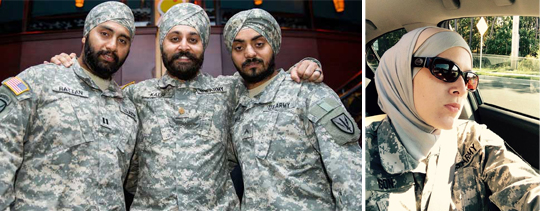
Untitled-1 copy

The new set of rules, issued by Secretary of the Army Eric Fanning, allows religious accommodations to be approved at the brigade-level. Previously it was at the level of Secretary.

Once that approval occurs, the change will ensure that the religious accommodation is enduring and applies to most positions within the US Army.

"This is a major progress, not just for the Sikh-American community but for our nation's military. Sikh-Americans love this country and want a fair chance to serve in our country on equal footing. Today's announcement will help do just that," Congressman Joe Crowley said welcoming the directive issued by the US Army Secretary.

"We are a stronger nation, with a stronger military because of our respect for religious and personal freedom," he said.

The move has been welcomed by Sikh-Americans and US lawmakers who have been on the forefront of a national campaign in this regard for the past several years. Before the January 3 changes announced by the US Army, Sikh-Americans and others had to be granted a limited accommodation or permission to serve in the army while maintaining their articles of faith.

Such accommodations were neither permanent nor guaranteed, and had to be renewed after virtually every assignment. Service members had also been required to remove their articles of faith while their accommodation request is pending, once again subjecting them to the difficult position of choosing between their faith and job.

Sikh-American Coalition, which has been on the forefront of such a campaign, welcomed the move, but said that this is still short of what they have been asking for.

"While we still seek a permanent policy change that enables all religious minorities to freely serve without exception, we are pleased with the progress that this new policy represents for religious tolerance and diversity by our nation's largest employer," said the coalition's legal director Harsimran Kaur.

The new provisions updates rules governing religious liberty that significantly improve the standards for Sikhs and other religious minorities who seek to serve their country with their religious articles of faith intact, she said.

Under the new policy, Brigade commanders must grant religious accommodations for unshorn beards, unshorn hair, turbans and Muslim hijabs unless the requestor's religious belief is not sincere or the army identifies a specific, concrete hazard.

Last week, the New York Police Department (NYPD), in a move aimed at inclusiveness, said it will allow its Sikh officers to wear turbans and maintain beards.

According to the latest regulation, accommodations must be granted across all duty positions except in certain limited circumstances.

The army intends to conduct additional testing for the use of protective equipment by bearded soldiers.

"The Sikh articles of faith have always been consistent with the best of American values and we are pleased that the burden no longer rests with Sikh soldiers to prove this through a lengthy administrative process," said Amandeep Sidhu, partner at McDermott Will and Emery.

In 1981, a prohibitive ban was placed on Sikh-American soldiers.

Last year, four Sikh-American soldiers, including the decorated Captain Simratpal Singh, filed a lawsuit against the US Army in this regard.

"My turban and beard represent my commitment to pluralism and equality. This policy change underscore's the military's commitment to these values and is a sign of meaningful progress that will ensure the strength of our democracy," said Major Kalsi, who was the first Sikh-American in more than a generation to be allowed to serve in the US military without violating his articles of faith.

Comments

s
 - 
Thursday, 5 Jan 2017

and our army does not allow anything except turbans, sighting reasons of uniformity. allowing such things only shows the diversity in our army and the public will realize all faiths support the army and are protecting the country. this is very important in the current political climate of polarization and divisiveness.

Add new comment

  • Coastaldigest.com reserves the right to delete or block any comments.
  • Coastaldigset.com is not responsible for its readers’ comments.
  • Comments that are abusive, incendiary or irrelevant are strictly prohibited.
  • Please use a genuine email ID and provide your name to avoid reject.
News Network
January 21,2020

Bengaluru, Jan 21: Controversial Mysuru ruler Tipu Sultan will remain in state-syllabus textbooks in the next academic year (2020-21) too. But the government will form another committee to look at the subject afresh.

"Efforts are on to give textbooks and uniforms the day schools open next academic year. After a discussion with the CM, we decided to not make any changes in the textbooks for the upcoming academic year,"said primary and secondary education minister S Suresh Kumar.

No political angle, says minister

However, we will form a committee to look into it again,” said the minister.

Three months ago, Madikeri MLA Appachu Ranjan had written to the minister seeking removal of contents on Tipu Sultan from Karnataka state syllabus books of classes 6,7 and 10. The minister said: “Appachu Ranjan is a five-time MLA. When he sent a letter, it’s my duty to seek an opinion on it. There’s no political angle here.”

Comments

Add new comment

  • Coastaldigest.com reserves the right to delete or block any comments.
  • Coastaldigset.com is not responsible for its readers’ comments.
  • Comments that are abusive, incendiary or irrelevant are strictly prohibited.
  • Please use a genuine email ID and provide your name to avoid reject.
coastaldigest.com news network
May 31,2020

Bengaluru, May 31: With places of worship expected to reopen on June 8, the Karnataka State Minorities Commission has released guidelines for mosques and dargahs, that include social distancing, temperature testing and compulsory hand washing.

Abdul Azeem, commission chairman said, "Everyone will have to maintain one-metre distance and carry their prayer mats. They will all be scanned and Farz prayers will be held for 10-15 minutes. Friday prayers should be completed within 20 minutes."

Distribution of tabarukh, shaking hands, and overcrowding inside mosques will not be allowed.  The Muzrai department also issued guidelines for temples, like mandatory face masks, sanitisation of sanctum sanctorum and thermal screening.

In a letter, the Hindu Religious Institutions and Charitable Endowment Department mentioned that while temple authorities and devotees should wear masks, priests, helpers and workers are exempt, in the core area of the temple.

"Devotees should be scanned using infrared thermometers at the temple entrance, and must be given hand sanitiser. The temple trust is expected to bear the expenses," it added.

Comments

Add new comment

  • Coastaldigest.com reserves the right to delete or block any comments.
  • Coastaldigset.com is not responsible for its readers’ comments.
  • Comments that are abusive, incendiary or irrelevant are strictly prohibited.
  • Please use a genuine email ID and provide your name to avoid reject.
News Network
January 15,2020

Bengaluru, Jan 15: The Indian startups secured 12.7 billion in funding last year -- a 15% growth compared to 2018 - and Bengaluru startup community topped the list, with securing $5.3 billion across 267 deals, a new report said on Tuesday.

In total, the Indian startups attracted 766 deals in 2019, taking total deal count between 2014-2019 to 5,011, said DataLabs by Inc42 in its annual startup funding report.

Sequoia took the top spot as the most active VC in 2019 with 53 deals, followed by Accel that participated in 38 deals. Blume Ventures, Matrix Partners and Tiger Global were in the top five VCs in 2019.

"The Indian startup economy is entering new decade with over $58 billion in fundraising and 2,984 funded startups between 2014-2019," the findings showed.

With an average of $21 million, the ticket size value of funding increased by 15% in 2019.

Ecommerce and fintech -- with $2.6 billion funding each -- took the top slot with 93 deals and 125 deals, respectively.

"Ecommerce continued to remain at the top by the end of 2019. The growing investor confidence towards sub-sectors such as vertical ecommerce, social commerce and private label businesses is one major factor for ecommerce maintaining its lead," a DataLabs spokesperson said in a statement.

According to the estimates, the funding amount and deal count in 2020 will be around $12.6 billion at a 1% decline from 2019.

"Nevertheless, the investment activity is expected to rise in 2021," said the report.

The data suggests that 2019 had lowest number of startups funded (664) in the last five years, with seed-stage funding deals dropping by 53%, compared to 2016.

With $252 million in funding, seed-stage deal value fell by 44% (compared to 2018) as only 306 seed funding deals were recorded, the report said.

The enterprise tech had a blockbuster year with total funding of $1.15 billion across 114 deals in 2019. The sector recorded a 49% surge in total funding amount, compared to 2018.

The Indian startup economy saw 275 unique VCs participating in funding in 2019, said the report.

Comments

Add new comment

  • Coastaldigest.com reserves the right to delete or block any comments.
  • Coastaldigset.com is not responsible for its readers’ comments.
  • Comments that are abusive, incendiary or irrelevant are strictly prohibited.
  • Please use a genuine email ID and provide your name to avoid reject.