


US Army allows hijabs, beards, turbans for servicemen

January 5, 2017

Washington, Jan 5: The US Army has issued a new regulation under which servicemen who wear turbans, hijabs or beards can now be enrolled in the military, making the force more inclusive of minority religions and cultures.
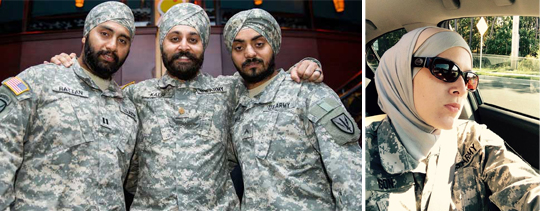
Untitled-1 copy

The new set of rules, issued by Secretary of the Army Eric Fanning, allows religious accommodations to be approved at the brigade-level. Previously it was at the level of Secretary.

Once that approval occurs, the change will ensure that the religious accommodation is enduring and applies to most positions within the US Army.

"This is a major progress, not just for the Sikh-American community but for our nation's military. Sikh-Americans love this country and want a fair chance to serve in our country on equal footing. Today's announcement will help do just that," Congressman Joe Crowley said welcoming the directive issued by the US Army Secretary.

"We are a stronger nation, with a stronger military because of our respect for religious and personal freedom," he said.

The move has been welcomed by Sikh-Americans and US lawmakers who have been on the forefront of a national campaign in this regard for the past several years. Before the January 3 changes announced by the US Army, Sikh-Americans and others had to be granted a limited accommodation or permission to serve in the army while maintaining their articles of faith.

Such accommodations were neither permanent nor guaranteed, and had to be renewed after virtually every assignment. Service members had also been required to remove their articles of faith while their accommodation request is pending, once again subjecting them to the difficult position of choosing between their faith and job.

Sikh-American Coalition, which has been on the forefront of such a campaign, welcomed the move, but said that this is still short of what they have been asking for.

"While we still seek a permanent policy change that enables all religious minorities to freely serve without exception, we are pleased with the progress that this new policy represents for religious tolerance and diversity by our nation's largest employer," said the coalition's legal director Harsimran Kaur.

The new provisions updates rules governing religious liberty that significantly improve the standards for Sikhs and other religious minorities who seek to serve their country with their religious articles of faith intact, she said.

Under the new policy, Brigade commanders must grant religious accommodations for unshorn beards, unshorn hair, turbans and Muslim hijabs unless the requestor's religious belief is not sincere or the army identifies a specific, concrete hazard.

Last week, the New York Police Department (NYPD), in a move aimed at inclusiveness, said it will allow its Sikh officers to wear turbans and maintain beards.

According to the latest regulation, accommodations must be granted across all duty positions except in certain limited circumstances.

The army intends to conduct additional testing for the use of protective equipment by bearded soldiers.

"The Sikh articles of faith have always been consistent with the best of American values and we are pleased that the burden no longer rests with Sikh soldiers to prove this through a lengthy administrative process," said Amandeep Sidhu, partner at McDermott Will and Emery.

In 1981, a prohibitive ban was placed on Sikh-American soldiers.

Last year, four Sikh-American soldiers, including the decorated Captain Simratpal Singh, filed a lawsuit against the US Army in this regard.

"My turban and beard represent my commitment to pluralism and equality. This policy change underscore's the military's commitment to these values and is a sign of meaningful progress that will ensure the strength of our democracy," said Major Kalsi, who was the first Sikh-American in more than a generation to be allowed to serve in the US military without violating his articles of faith.

Comments

s
 - 
Thursday, 5 Jan 2017

and our army does not allow anything except turbans, sighting reasons of uniformity. allowing such things only shows the diversity in our army and the public will realize all faiths support the army and are protecting the country. this is very important in the current political climate of polarization and divisiveness.

Add new comment

  • Coastaldigest.com reserves the right to delete or block any comments.
  • Coastaldigset.com is not responsible for its readers’ comments.
  • Comments that are abusive, incendiary or irrelevant are strictly prohibited.
  • Please use a genuine email ID and provide your name to avoid reject.
News Network
May 1,2020

Bengaluru, May 1: Karnataka government has assigned State Nodal Officers after the Ministry of Home Affairs (MHA) order regarding the inter-state movement of stranded migrant workers, tourists, pilgrims and students during the lockdown period.

The Nodal officers have also been appointed for coordination with 11 different states.

In an order issued on Thursday, Karnataka Government wrote, "To facilitate smooth and orderly movement of persons across State borders as per SOPs, the undersigned, in the exercise of powers conferred under the Disaster Management Act, 2005, and in the capacity as Chairman, State Executive Committee, hereby appoint the following officers as Nodal officers to coordinate with Nodal Officers of States/Union Territories (UTs) mentioned against their names."

Dr Rajkumar Khatri, IAS and Arun Jeji Chakravarthy, IPS will be overall in charge of the movement of stranded people from outside States/UTs to Karnataka.

N Manjunatha Prasad, IAS and P S Sandhu, IPS will be overall in charge of the movement of stranded people from Karnataka to other States/UTs.

Comments

Add new comment

  • Coastaldigest.com reserves the right to delete or block any comments.
  • Coastaldigset.com is not responsible for its readers’ comments.
  • Comments that are abusive, incendiary or irrelevant are strictly prohibited.
  • Please use a genuine email ID and provide your name to avoid reject.
Agencies
May 8,2020

Washington D.C., May 8: The prime time for brain development in a child's life is the first year, where the infant spends most of the time asleep. It is the time when neural connections form and sensory memories are encoded.

However, when sleep is disrupted, as occurs more often among children with autism, brain development may be affected, too.

New research led by the University of Washington finds that sleep problems in a baby's first 12 months may not only precede an autism diagnosis but also may be associated with altered growth trajectory in a key part of the brain, the hippocampus.

The study, which was published in the American Journal of Psychiatry, researchers report that in a sample of more than 400 taken of 6- to 12-month-old infants, those who were later diagnosed with autism were more likely to have had difficulty falling asleep.

It also states that this sleep difficulty was associated with altered growth trajectories in the hippocampus.

"The hippocampus is critical for learning and memory, and changes in the size of the hippocampus have been associated with poor sleep in adults and older children.

As many as 80 per cent of the children with autism spectrum disorder have sleep problems," said Annette Estes, director of the UW Autism Center and senior author of the study.

"In our clinical experience, parents have a lot of concerns about their children's sleep, and in our work on early autism intervention, we observed that sleep problems were holding children and families back," added Estes, who is also a UW professor of speech and hearing sciences.

"It could be that altered sleep is part-and-parcel of autism for some children. One clue is that behavioural interventions to improve sleep don't work for all children with autism, even when their parents are doing everything just right. This suggests that there may be a biological component to sleep problems for some children with autism," said Estes.

To consider links among sleep, brain development, and autism, researchers at the IBIS Network looked at MRI scans of 432 infants, surveyed parents about sleep patterns, and measured cognitive functioning using a standardized assessment.

At the outset of the study, infants were classified according to their risk for developing autism: Those who were at higher risk of developing autism -- about two-thirds of the study sample -- had an older sibling who had already been diagnosed.

Infant siblings of children with autism have a 20 per cent chance of developing autism spectrum disorder -- a much higher risk than children in the general population.

In the current study, 127 of the 432 infants were identified as "low risk" at the time the MRI scans were taken because they had no family history of autism.

They later evaluated all the participants at 24 months of age to determine whether they had developed autism. Of the roughly 300 children originally considered "high familial risk," 71 were diagnosed with autism spectrum disorder at that age.

Problems with sleep were more common among the infants later diagnosed with an autism spectrum disorder, as were larger hippocampi. No other subcortical brain structures were affected, including the amygdala, which is responsible for certain emotions and aspects of memory, or the thalamus, a signal transmitter from the spinal cord to the cerebral cortex.

The authors note that while parents reported more sleep difficulties among infants who developed autism compared to those who did not, the differences were very subtle and only observed when looking at group averages across hundreds of infants.

Sleep patterns in the first years of life change rapidly as infants transition from sleeping around the clock to a more adult-like sleep/wake cycle. Until further research is completed, Estes said, it is not possible to interpret challenges with sleep as an early sign of increased risk for autism.

Comments

Add new comment

  • Coastaldigest.com reserves the right to delete or block any comments.
  • Coastaldigset.com is not responsible for its readers’ comments.
  • Comments that are abusive, incendiary or irrelevant are strictly prohibited.
  • Please use a genuine email ID and provide your name to avoid reject.
News Network
April 13,2020

Kundapur, Apr 13: The city police, burdened with the enforcement of COVID-19 lockdown decided to undertake door delivery of essential items to ensure people remained indoor, official sources said here on Monday.

According to them, the police would be delivering items to the houses in Kumdapur, Byndoor, Gongolli, Shankara Narayana, Kundapur Rural, Kota and Amavasebail.

The police will start spreading awareness with this regard for three days starting from today (April 13).

Comments

Add new comment

  • Coastaldigest.com reserves the right to delete or block any comments.
  • Coastaldigset.com is not responsible for its readers’ comments.
  • Comments that are abusive, incendiary or irrelevant are strictly prohibited.
  • Please use a genuine email ID and provide your name to avoid reject.