


US Army allows hijabs, beards, turbans for servicemen

January 5, 2017

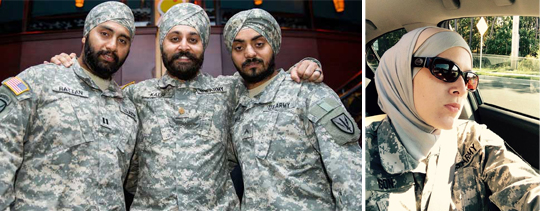
Washington, Jan 5: The US Army has issued a new regulation under which servicemen who wear turbans, hijabs or beards can now be enrolled in the military, making the force more inclusive of minority religions and cultures.
Untitled-1 copy

The new set of rules, issued by Secretary of the Army Eric Fanning, allows religious accommodations to be approved at the brigade-level. Previously it was at the level of Secretary.

Once that approval occurs, the change will ensure that the religious accommodation is enduring and applies to most positions within the US Army.

"This is a major progress, not just for the Sikh-American community but for our nation's military. Sikh-Americans love this country and want a fair chance to serve in our country on equal footing. Today's announcement will help do just that," Congressman Joe Crowley said welcoming the directive issued by the US Army Secretary.

"We are a stronger nation, with a stronger military because of our respect for religious and personal freedom," he said.

The move has been welcomed by Sikh-Americans and US lawmakers who have been on the forefront of a national campaign in this regard for the past several years. Before the January 3 changes announced by the US Army, Sikh-Americans and others had to be granted a limited accommodation or permission to serve in the army while maintaining their articles of faith.

Such accommodations were neither permanent nor guaranteed, and had to be renewed after virtually every assignment. Service members had also been required to remove their articles of faith while their accommodation request is pending, once again subjecting them to the difficult position of choosing between their faith and job.

Sikh-American Coalition, which has been on the forefront of such a campaign, welcomed the move, but said that this is still short of what they have been asking for.

"While we still seek a permanent policy change that enables all religious minorities to freely serve without exception, we are pleased with the progress that this new policy represents for religious tolerance and diversity by our nation's largest employer," said the coalition's legal director Harsimran Kaur.

The new provisions updates rules governing religious liberty that significantly improve the standards for Sikhs and other religious minorities who seek to serve their country with their religious articles of faith intact, she said.

Under the new policy, Brigade commanders must grant religious accommodations for unshorn beards, unshorn hair, turbans and Muslim hijabs unless the requestor's religious belief is not sincere or the army identifies a specific, concrete hazard.

Last week, the New York Police Department (NYPD), in a move aimed at inclusiveness, said it will allow its Sikh officers to wear turbans and maintain beards.

According to the latest regulation, accommodations must be granted across all duty positions except in certain limited circumstances.

The army intends to conduct additional testing for the use of protective equipment by bearded soldiers.

"The Sikh articles of faith have always been consistent with the best of American values and we are pleased that the burden no longer rests with Sikh soldiers to prove this through a lengthy administrative process," said Amandeep Sidhu, partner at McDermott Will and Emery.

In 1981, a prohibitive ban was placed on Sikh-American soldiers.

Last year, four Sikh-American soldiers, including the decorated Captain Simratpal Singh, filed a lawsuit against the US Army in this regard.

"My turban and beard represent my commitment to pluralism and equality. This policy change underscore's the military's commitment to these values and is a sign of meaningful progress that will ensure the strength of our democracy," said Major Kalsi, who was the first Sikh-American in more than a generation to be allowed to serve in the US military without violating his articles of faith.

Comments

s
 - 
Thursday, 5 Jan 2017

and our army does not allow anything except turbans, sighting reasons of uniformity. allowing such things only shows the diversity in our army and the public will realize all faiths support the army and are protecting the country. this is very important in the current political climate of polarization and divisiveness.

Add new comment

  • Coastaldigest.com reserves the right to delete or block any comments.
  • Coastaldigset.com is not responsible for its readers’ comments.
  • Comments that are abusive, incendiary or irrelevant are strictly prohibited.
  • Please use a genuine email ID and provide your name to avoid reject.
News Network
July 20,2020

Bengaluru, Jul 20: Janata Dal (Secular) leader HD Kumaraswamy has urged the Karnataka government to stop putting warning signboards in front of COVID-19 patients' houses alleging that they are leading to "social discrimination and untouchability" in the present times.

"A local government warning signboards in front of the homes of COVID-19 infected people is leading to neo-social discrimination and untouchability in the new age. Even after infection, the individual and family should live with dignity. The government should immediately stop the practice of placing signboards," Kumaraswamy's first tweet read.

"Instead of placing them in front of their homes and creating untouchability, send health workers to their homes to create courage and awareness. They should be told not to leave the house. There is no such degrading practice left behind. I would like to ask Chief Minister Karnataka BS Yediyurappa to pay attention to this," he added.

The former chief minister further said that threatening to cancel the licenses of medical colleges for refusing treatment to patients would not solve the problem and urged the government to take them into confidence instead of rebuking them.

"Refusing treatment is the fault of any hospital. But for the same reason, threatening to cancel government medical college licenses is not right. There is no profit in this emergency of health. MCI also has the power to revoke the licenses of medical colleges. Remember not the government," he said.

"In this case, the government should look to the Medical Colleges to get their services in order to get them to trust them instead of getting angry. Let them focus on meeting their needs. I insist on a collective fight against the coronavirus through this," he further added.

The COVID-19 count in Karnataka reached 63,772 on Sunday, including 39,370 active cases and 23,065 cured and discharged patients.

Comments

Add new comment

  • Coastaldigest.com reserves the right to delete or block any comments.
  • Coastaldigset.com is not responsible for its readers’ comments.
  • Comments that are abusive, incendiary or irrelevant are strictly prohibited.
  • Please use a genuine email ID and provide your name to avoid reject.
News Network
April 24,2020

Wayanad/Thiruvananthapuram, Apr 24: Amid the strict lockdown, a school teacher travelled from Thiruvananthapuram to Muthanga in Wayanad -- a distance of about 465 km -- on her way to neighbouring Karnataka en route to Delhi following which cases have been registered against her and an excise official.

The woman, Kamna Sharma, said to be working in Kendriya Vidyalaya, Pattom, undertook the journey on April 21 along with her two year-old daughter, police sources told news agency PTI.

An Excise Circle Inspector, Shahjahan, had provided his vehicle to travel allegedly on the instructions of Malappuram excise officer, in whose private vehicle, the woman and the child had reached Wayanad border from Thiruvananthapuram, the sources said.

The two were charged under the Kerala Epidemic Act and various sections of the IPC including sect 269 (negligent act likely to spread infection) and 271 (disobedience to quarantine rule).

Because of the lockdown even inter-district travel is not allowed by police and district administration, unless there is an extremely genuine reason.

A senior police official in Thiruvananthapuram said he does not remember issuing any such pass.

The woman may have "misused" government machinery as private vehicles would have been stopped somewhere during the long journey, he said.

She came to Kalpetta in Wayanad allegedly in an official car of the excise department.

Wayanad District police chief R Elango said that an FIR has been filed based on preliminary information and investigations have begun.

"We will check if she has followed procedures in obtaining a pass and if she made any false claim to get the pass."

As per preliminary information the woman came in an excise official's car from Thamarassery (Kozhikode) to Muthunga(Wayanad), he said. Her mode of transport before that--from Thiruvananthapuram to Wayanad--will also be investigated, he said, adding they have no information if she has reached Delhi.

"We will track down her movement," he said Meanwhile, theWayanad district administration has intensified the lockdown protocol from Thursday to prevent people's movement within and from outside the district/state.

Interception at all the check posts on district an state borders of the district, bordering Tamil Nadu and Karnataka, will also be intensified. No one would be allowed to travel frequently to and fro the district under the pretext of official duty.

Wayanad collector Adhila Abdulla said officials from outside the district will no longer be allowed to commute daily.

"Elderly people above the age of 65 should confine to their homes unless it is extremely urgent or unavoidable. Cases will be registered against family members who allow elderly people to go out for buying medicines and other essentials," she said.

Senior citizens, who live alone, can call either the Fire (101) or Police (100) departments for any help and to get things they need, the collector said.

Whatever relaxations were in place have also been withdrawn with effect from Thursday, she added.

Wayanad and Thiruvananthapuram come under the "Orange B" zone where there are some relaxations.

However, Thiruvananthapuram city limits falls under the hotspot area.

Police said a case was also registered against a doctor and her husband who entered Kerala from Tamil Nadu border.

Comments

Add new comment

  • Coastaldigest.com reserves the right to delete or block any comments.
  • Coastaldigset.com is not responsible for its readers’ comments.
  • Comments that are abusive, incendiary or irrelevant are strictly prohibited.
  • Please use a genuine email ID and provide your name to avoid reject.
News Network
January 11,2020

Bengaluru, Jan 11: Scholar and writer M Chidanadamurthy passed away at a private hospital here on Saturday.

He was 88 and is survived by wife, son and daughter.
He was a well-known scholar in Karnataka specialising in the history of Kannada language and ancient Karnataka.

He was also known for his campaign to conserve the monuments Hampi and to secure classical language status to Kannada Language. Murthy has also articulated that uniform civil code and an anti-conversion law must be enacted by the Government in India.

Murthy was the head of the department of Kannada Bangalore University. He was also associated with Kannada Shakti Kendra. As a historian most of Murthy's work has focused on scientific study of the Kannada Inscriptions.

He has attempted to contextualise inscriptions in their socio cultural setup. He has produced many books on the history of Kannada language and Karnataka. He has guided many research students.

Murthy was recipient of Rajayothsava, Sathiya Academy Award , Papama award and Alava’s Nudisiri award.
His mortal remains were kept at his residence for his fellow mates and relatives.

Several dignatories like B S Yediyurappa, S L Bhyrappa, S Suresh Kumar, V Somanna expressed their condolences to the veteran's death.

The final rituals will be held on Sunday with state honour.

Comments

Add new comment

  • Coastaldigest.com reserves the right to delete or block any comments.
  • Coastaldigset.com is not responsible for its readers’ comments.
  • Comments that are abusive, incendiary or irrelevant are strictly prohibited.
  • Please use a genuine email ID and provide your name to avoid reject.