US Muslim teen arrested over clock moving to Qatar for studies

October 22, 2015

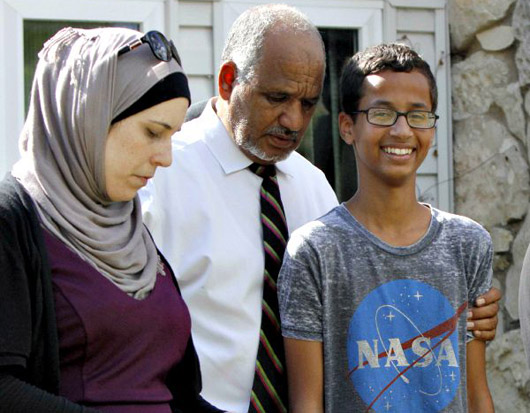
Houston, Oct 22: A Muslim teenager arrested in the US for bringing to school a homemade clock that was mistaken for a bomb is moving to Qatar for studies, his family has said, a day after he met President Barack Obama.

teen

Ahmed Mohamed, 14, a ninth-grader who became an Internet sensation after the incident, has accepted an offer from the Qatar Foundation to study at its Young Innovators Programme.

"This means, that we, as a family, will relocate to Qatar where Ahmed will receive a full scholarship for secondary and undergraduate education," his family said in a statement.

Ahmed's family said the foundation would fund his high school and undergraduate education.

"I really enjoyed my time at Education City, where I met other kids like me who are part of the Young Innovators Program," Ahmed said in a statement about time he spent in Qatar this month.

"Qatar was a cool place to visit. I loved the city of Doha because it's so modern. I saw so many amazing schools there, many of them campuses of famous American universities.

"The teachers were great. I think I will learn a lot and have fun, too."

Ahmed's family said announced its decision to move to Qatar a few hours after Ahmed visited the White House for an astronomy night hosted by Obama.

The Texas boy was arrested on September 14 when he showed a teacher at his school his homemade clock, which the teacher feared was a bomb.

No charges were filed, but his detention provoked widespread accusations of racial profiling, sparking a larger discussion of Islam, immigration and ethnicity.

Comments

Add new comment

  • Coastaldigest.com reserves the right to delete or block any comments.
  • Coastaldigset.com is not responsible for its readers’ comments.
  • Comments that are abusive, incendiary or irrelevant are strictly prohibited.
  • Please use a genuine email ID and provide your name to avoid reject.
News Network
June 19,2020

Bengaluru, Jun 19: COVID-19 cases in Karnataka has breached the 8,000 mark, as the state on Friday reported 337 new cases and ten related fatalities, taking the total number of infections to 8,281 and death toll to 124.

Also, total discharges in the state breached 5,000 mark, with 230 patients getting discharged in a day after recovery.

As of June 19 evening, cumulatively 8,281 COVID-19 positive cases have been confirmed in the state, which includes 124 deaths and 5,210 discharges, the health department said in its bulletin.

It said out of 2,943 active cases, 2,865 patients are in isolation at designated hospitals and are stable, while 78 are in ICU.

The ten dead include- seven from Bengaluru urban, two from Bidar and one from Vijayapura.

Out of the 337 new cases, 93 are returnees from other states, majority of them from neighboring Maharashtra,while 11 are those who returned from other countries.

The remaining cases include contacts of patients earlier tested positive, those with history of SARI and ILI, among others.

Among the districts where the new cases were reported, Bengaluru accounted for 138 cases, followed by Kalaburagi 52, Ballari 37, Hassan 18, Dakshina Kannada 13, Davangere 12, Udupi 11; Bidar 10, six each from Mysuru and Koppal, four each from Yadgir, Kolar and Bengaluru rural, three each from Mandya, Dharwad, Chikkaballapura, Bagalkote and Ramanagara, two each from Tumakuru and Chikkamagaluru, and one each from Belagavi, Uttara Kannada and Shivamogga.

Kalaburagi district tops the list of positive cases, with 1,126 infections, followed by Udupi 1,050 and Bengaluru urban 982.

Among discharges Udupi tops the list with 944 discharges, followed by Kalaburagi 646 and Yadgir 477.

A total of 4,84,060 samples were tested so far, out of which 10,553 were tested on Thursday alone.

According to the bulletin,4,64,338 samples have been reported as negative, and out of them 9,862 were reported negative today.

Comments

Add new comment

  • Coastaldigest.com reserves the right to delete or block any comments.
  • Coastaldigset.com is not responsible for its readers’ comments.
  • Comments that are abusive, incendiary or irrelevant are strictly prohibited.
  • Please use a genuine email ID and provide your name to avoid reject.
News Network
March 15,2020

While it makes perfect sense for IT employees to work from remote locations via video conferencing and collaboration tools seamlessly - especially in the case of tech giants like Google or Microsoft -- workers from the non-IT companies and small and medium enterprises (SMBs) are the worst-hit in India as most of them have little or no clue about how these messaging and collaboration tools work amid the coronavirus pandemic.

Small companies -- from corporate to education verticals -- are scrambling to get their act together as new coronavirus threat has reached their premises, prompting them to send employees home who have age-old laptops, poor network and connectivity with no UPS backups and little knowledge about how to handle group chat and collaboration software like Zoom, Google Hangouts Meet, Microsoft Teams and Flock etc.

Instead of halting operations, however, businesses can choose to shift towards remote working methods with teaching non-IT staff on how to use the latest digital software to connect and work, say industry experts.

The training will take some time and may hamper productivity in the short run but is a win-win situation for the non-tech companies in the long run, in case any such global emergency arises in the future.

According to a latest report by Gartner, 54 per cent of HR leaders have cited that poor technology and/or infrastructure for remote working is the biggest barrier to effective remote working.

Sandy Shen, Senior Director Analyst, Gartner, says that with COVID-19 disrupting the business landscape, CIOs should relook at the digital fulfillment of market demand.

"The value of digital channels, products and operations is immediately obvious to companies everywhere right now. This is a wake-up call for organisations that have placed too much focus on daily operational needs at the expense of investing in digital business and long-term resilience," warned Shen.

Businesses that can shift technology capacity and investments to digital platforms will mitigate the impact of the outbreak and keep their companies running smoothly now, and over the long term.

"Videoconferencing, messaging, collaboration tools and document sharing are just a few examples of technologies that facilitate remote work. Additional bandwidth and network capacity may also be needed, given the increasing number of users and volume of communications," informed Shen.

The IT industry's apex body Nasscom has asked the government to relax norms for a month to allow work-from-home for technology and back-office employees as a measure to deal with the spread of Covid-19 in India.

Networking giant Cisco said that it has seen "significant growth" in the usage of its web conferencing and video-conferencing service Webex in India.

According to Muneer Ahmad, Business Head, ViewSonic India, due to COVID-19 pandemic, the corporate and educational sector is severely getting affected in the country.

"ViewSonic IFP has a cloud-based software which help teachers and corporates to connect through video conferencing to multiple people at the same time and can split the screen into six screens. It can also connect with various tools like Skype, Cisco WebEx, Zoom, Google Hangouts and GoToMeeting," Ahmad told IANS.

Co-working sector has also taken a hit and the industry is looking at several measures to tackle it -- from ensuring supply of juices rich in Vitamin C to supply of disinfectants and giving work from home facilities.

"The scheduled visits of the clients at our co-working offices have been postponed. Few of our clients have cancelled their outstation meetings and have now started audio/video conferencing for virtual meetings," said Nakul Mathur, MD, Avanta India.

According to reports, India has approximately 1,000 co-working locations (as of September 2019) and is the second-largest market for the co-working industry after China.

As India's first licensed B2B Virtual Network Operator, CloudConnect Communications offers a collaborative platform that allows companies to overcome the COVID-19 threat while maintaining seamless business continuity and optimum employee productivity.

"We offer a secure, robust, reliable, scalable and trackable mobile-first unified communication infrastructure that aids remote teleworking so that businesses can continue operating even under any unforeseen circumstances," said Gokul Tandon, Executive Chairman, CloudConnect Communications.


Comments

Add new comment

  • Coastaldigest.com reserves the right to delete or block any comments.
  • Coastaldigset.com is not responsible for its readers’ comments.
  • Comments that are abusive, incendiary or irrelevant are strictly prohibited.
  • Please use a genuine email ID and provide your name to avoid reject.
News Network
February 23,2020

The euphoria over the claim that around 3,000 tonnes of gold reserves, worth Rs 12 trillion, have been discovered in Uttar Pradesh’s Sonbhadra district could not last even 24 hours, with the Geological Survey of India (GSI) clarifying on Saturday there had been no such discovery.

The GSI, headquartered in Kolkata, rebutted the claims of the Uttar Pradesh Directorate of Geology and Mining (UPDGM), and said “miscommunication” must have led to the wrong reporting of facts.

M Sridhar, director general of the GSI, said nobody in the agency gave any such data. He said 52,806 tonnes of gold ore was found in Sonbhadra district during the exploration work in 1998-2000. From this reserve, only 160 kg of gold can be extracted.

“There must have been some miscommunication of facts because of which the gold ore deposits have been overestimated. We have written a letter to Uttar Pradesh (UPDGM), stating the facts. The GSI has not estimated such kind of vast resource of gold deposits in Sonbhadra,” Sridhar said.

ALSO READ: 2,900-tonne gold mine found in Sonbhadra, 4 times that of India's reserves

The UPDGM had said on Friday that gold deposits were found in Son Pahadi and Hardi areas of the district. Sridhar said while gold ore was found in the area during the GSI’s exploration work in 1998-2000, it had told the state government about the discovery in November last year.

Under the new regulation, which came into effect from 2015, the GSI has to inform the state government when ore deposits are discovered. Earlier, no such action was mandatory. In its report, the GSI estimated that only 3.03 gm of gold can be extracted from a tonne of ore. It also clarified that even the extraction amount was tentative and could not be established for certain.

Moreover, Sridhar said the deposits were spread across only 0.5 sq km in forest land, which made the mining of ore economically unviable. “When there are several mines nearby, we can club it into a block and then it makes sense to mine the ore. But in this case, the deposits are too small to make it viable for any company to mine it,” he said. The GSI usually prioritises its exploration work based on the needs of the Centre. While strategic minerals like tin, cobalt, lithium, beryllium, germanium, gallium, indium, tantalum, niobium, selenium, and bismuth are atop the list in GSI exploration, gold is another commodity on its priority list.

According to the World Gold Council, India has reserves of 630 tonnes of gold.

Comments

Add new comment

  • Coastaldigest.com reserves the right to delete or block any comments.
  • Coastaldigset.com is not responsible for its readers’ comments.
  • Comments that are abusive, incendiary or irrelevant are strictly prohibited.
  • Please use a genuine email ID and provide your name to avoid reject.