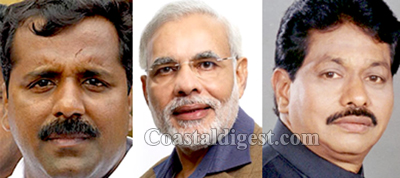
UTK writes to Modi criticizing BJP MP’s attempt to endorse tobacco use in India

[email protected] (CD Network)
April 2, 2015

Mangaluru, Apr 2: Karnataka Health and Family Welfare Minister U T Khader has written to Prime Minister Narendra Modi expressing concern over BJP MP Dilip Gandhi’s insensitive remarks that that there’s not enough Indian data to link tobacco to cancer.

ut modi gandhiIn a letter sent to the Prime Minister, Mr Khader expressed shock over the recommendation put forward by Dilip Gandhi to reexamine the health effects of tobacco on an Indian population in concern with pictorial warnings implementation.

Dilip Gandhi, who head’s Parliamentary panel on subordinate legislation examining the provisions of Cigarettes and Other Tobacco Products Act, 2003 which had sought deferment of the move, earlier stated that there was no Indian study to confirm that use of tobacco products leads to cancer.

“If this report is true, it is disappointing as the health hazards of tobacco are well established worldwide over the decades. The carcinogenic chemicals in tobacco are the same worldwide and do not differ between countries in nature to harm human life. The same is proven well by the International agency for research on cancer- a wing of W.H.O,” said Mr Khader.

It is shocking that a senior MP is so poorly informed about the facts pertaining to harmful effects of tobacco. It also clearly shows the influence of the tobacco industry on the policy maker in a bid to distort science and influence policy. Tobacco is attributable cause for almost 40 % of cancers in India and majority of lung or heart diseases. It is appalling that Dilip Gandhi is challenging the recommendations of W.H.O, United Nations, UICC, CDC, NCI etc with regards to health effects of tobacco. In December 2010, Supreme Court had directed Ministry of Health to constitute an expert committee to study the harmful effects of tobacco. The committee submitted a damming report proving beyond doubt that tobacco is indeed very harmful, said Mr Khader in his letter.

Mr Khader further said: “This poor and unscientific approach by a policy maker can only make way for Acche Din to the tobacco industry, which contributes to highest deaths from NCD in our country. I strongly urge you to take cognizance of the issue and show your commitment for a Swasth Bharat by intervening in this policy measure that has potential to save lives.”

Comments

Add new comment

  • Coastaldigest.com reserves the right to delete or block any comments.
  • Coastaldigset.com is not responsible for its readers’ comments.
  • Comments that are abusive, incendiary or irrelevant are strictly prohibited.
  • Please use a genuine email ID and provide your name to avoid reject.
News Network
August 1,2020

Gadag, Aug 1: A woman in Gadag district of Karnataka mortgaged her 'mangalsutra' to buy a television set for her children following the Karnataka government's decision to continue the classes through TV amid the COVID-19 pandemic.

A resident of Radder Naganur village, Kasturi, who is also a mother of two, purchased a television set against her 'mangalsutra' for Rs 14,000. She bought the TV after her children's school teachers asked them to attend classes via the television set.

Kasturi said, "I can not send the children to the neighbours' house every day and it was necessary for them to study. We had no other option but to buy a TV set."

She said, "Both, my husband and I are daily wage workers and during coronavirus, we do not have work or money."

"I sold my 'mangalsutra' for Rs 20,000 and bought a TV for Rs 14,000," said Kasturi while happily adding, "Now, my kids can study at home itself."

Kasturi's daughter, Surekha said, "We did not have the TV for several months but now when we have it, we will study and get a bigger 'mangalsutra' for my mother."

Comments

Add new comment

  • Coastaldigest.com reserves the right to delete or block any comments.
  • Coastaldigset.com is not responsible for its readers’ comments.
  • Comments that are abusive, incendiary or irrelevant are strictly prohibited.
  • Please use a genuine email ID and provide your name to avoid reject.
News Network
July 25,2020

Bengaluru, Jul 25: The Karnataka government on Saturday announced a waiver of crematorium fees for those who succumb to the COVID-19 infection in Bengaluru and said the city civic body would bear the cost.

It said that from now on, families of the COVID deceased need not pay any fees fixed by the city civic body- Bruhat Bengaluru Mahanagara Palike (BBMP)- across 12 electric crematoriums in the city.

"There were reports in the media about difficulties faced in performing the last rites of those who died due to COVID-19 infections. Aimed at resolving those difficulties, certain decisions have been taken," Revenue Minister R Ashoka said.

He told reporters here that BBMP had fixed Rs 250 as the cremation fee, Rs 100 for the ash collection pot and Rs 900 for the bier (bamboo stretcher on which the body is carried), all of which have been waived for COVID deaths.

"So it will be a waiver of Rs 1,250 per cremation. The BBMP will bear this cost," he added.

Ashoka also announced Rs 500 per body incentive for the personnel who conduct the last rites of COVID victims.

"This is in recognition of their services at a time when family members of the deceased are not ready to touch the body and not ready to take the body in some cases," he said.

Noting that the government has identified 23 acres of land at five places around Bengaluru for burial or cremation of COVID victims, Ashoka locals in all these areas are protesting against it.

Appealing to the people for cooperation during these difficult times, he said the government's intention was to ensure respectful burial or cremation for the deceased.

"Obstructing it is not right, it is not Indian tradition," he said.

Pointing out that it takes almost a day's time for a COVID victim's body to be handed over for burial or cremation, he said "scientifically, according to experts and doctors, the virus will not remain alive for more than three hours.

...Also, bodies are either burnt or buried eight feet below. So there will not be any problem for those living in nearby areas and it will not spread infection. Cooperate with humanity," he said.

"These lands identified are for all religions and communities and once the pandemic subsides, can be used for other deaths as well," he said.

Comments

Add new comment

  • Coastaldigest.com reserves the right to delete or block any comments.
  • Coastaldigset.com is not responsible for its readers’ comments.
  • Comments that are abusive, incendiary or irrelevant are strictly prohibited.
  • Please use a genuine email ID and provide your name to avoid reject.
Agencies
June 17,2020

Riyadh, Jun 17: Saudi Arabia is expected to scale back or call off this year's hajj pilgrimage for the first time in its modern history, observers say, a perilous decision as coronavirus cases spike.

Muslim nations are pressing Riyadh to give its much-delayed decision on whether the annual ritual will go ahead as scheduled in late July.

But as the kingdom negotiates a call fraught with political and economic risks in a tinderbox region, time is running out to organise logistics for one of the world's largest mass gatherings.

A full-scale hajj, which last year drew about 2.5 million pilgrims, appears increasingly unlikely after authorities advised Muslims in late March to defer preparations due to the fast-spreading disease.

"It's a toss-up between holding a nominal hajj and scrapping it entirely," a South Asian official in contact with Saudi hajj authorities said.

A Saudi official said: "The decision will soon be made and announced."

Indonesia, the world's most populous Muslim nation, withdrew from the pilgrimage this month after pressing Riyadh for clarity, with a minister calling it a "very bitter and difficult decision".

Malaysia, Senegal and Singapore followed suit with similar announcements.

Many other countries with Muslim populations -- from Egypt and Morocco to Turkey, Lebanon and Bulgaria -- have said they are still awaiting Riyadh's decision.

In countries like France, faith leaders have urged Muslims to "postpone" their pilgrimage plans until next year due to the prevailing risks.

The hajj, a must for able-bodied Muslims at least once in their lifetime, represents a major potential source of contagion as it packs millions of pilgrims into congested religious sites.

But any decision to limit or cancel the event risks annoying Muslim hardliners for whom religion trumps health concerns.

It could also trigger renewed scrutiny of the Saudi custodianship of Islam's holiest sites -- the kingdom's most powerful source of political legitimacy.

A series of deadly disasters over the years, including a 2015 stampede that killed up to 2,300 worshippers, has prompted criticism of the kingdom's management of the hajj.

"Saudi Arabia is caught between the devil and the deep blue sea," Umar Karim, a visiting fellow at the Royal United Services Institute in London, told AFP.

"The delay in announcing its decision shows it understands the political consequences of cancelling the hajj or reducing its scale."

"Buying time"

The kingdom is "buying time" as it treads cautiously, the South Asian official said.

"At the last minute if Saudi says 'we are ready to do a full hajj', (logistically) many countries will not be in a position" to participate, he said.

Amid an ongoing suspension of international flights, a reduced hajj with only local residents is a likely scenario, the official added.

A decision to cancel the hajj would be a first since the kingdom was founded in 1932.

Saudi Arabia managed to hold the pilgrimage during previous outbreaks of Ebola and MERS.

But it is struggling to contain the virus amid a serious spike in daily cases and deaths since authorities began easing a nationwide lockdown in late May.

In Saudi hospitals, sources say intensive care beds are fast filling up and a growing number of health workers are contracting the virus as the total number of cases has topped 130,000. Deaths surpassed 1,000 on Monday.

To counter the spike, authorities this month tightened lockdown restrictions in the city of Jeddah, gateway to the pilgrimage city of Mecca.

"Heartbroken"

"The hajj is the most important spiritual journey in the life of any Muslim, but if Saudi Arabia proceeds in this scenario it will not only exert pressure on its own health system," said Yasmine Farouk from the Carnegie Endowment for International Peace.

"It could also be widely held responsible for fanning the pandemic."

A cancelled or watered-down hajj would represent a major loss of revenue for the kingdom, which is already reeling from the twin shocks of the virus-induced slowdown and a plunge in oil prices.

The smaller year-round umrah pilgrimage was already suspended in March.

Together, they add $12 billion to the Saudi economy every year, according to government figures.

A negative decision would likely disappoint millions of Muslim pilgrims around the world who often invest their life savings and endure long waiting lists to make the trip.

"I can't help but be heartbroken -- I've been waiting for years," Indonesian civil servant Ria Taurisnawati, 37, told AFP as she sobbed.

"All my preparations were done, the clothes were ready and I got the necessary vaccination. But God has another plan."


Comments

Add new comment

  • Coastaldigest.com reserves the right to delete or block any comments.
  • Coastaldigset.com is not responsible for its readers’ comments.
  • Comments that are abusive, incendiary or irrelevant are strictly prohibited.
  • Please use a genuine email ID and provide your name to avoid reject.