


UTK writes to Modi criticizing BJP MP’s attempt to endorse tobacco use in India

[email protected] (CD Network)
April 2, 2015

Mangaluru, Apr 2: Karnataka Health and Family Welfare Minister U T Khader has written to Prime Minister Narendra Modi expressing concern over BJP MP Dilip Gandhi’s insensitive remarks that that there’s not enough Indian data to link tobacco to cancer.
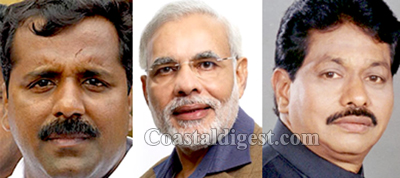
ut modi gandhiIn a letter sent to the Prime Minister, Mr Khader expressed shock over the recommendation put forward by Dilip Gandhi to reexamine the health effects of tobacco on an Indian population in concern with pictorial warnings implementation.

Dilip Gandhi, who head’s Parliamentary panel on subordinate legislation examining the provisions of Cigarettes and Other Tobacco Products Act, 2003 which had sought deferment of the move, earlier stated that there was no Indian study to confirm that use of tobacco products leads to cancer.

“If this report is true, it is disappointing as the health hazards of tobacco are well established worldwide over the decades. The carcinogenic chemicals in tobacco are the same worldwide and do not differ between countries in nature to harm human life. The same is proven well by the International agency for research on cancer- a wing of W.H.O,” said Mr Khader.

It is shocking that a senior MP is so poorly informed about the facts pertaining to harmful effects of tobacco. It also clearly shows the influence of the tobacco industry on the policy maker in a bid to distort science and influence policy. Tobacco is attributable cause for almost 40 % of cancers in India and majority of lung or heart diseases. It is appalling that Dilip Gandhi is challenging the recommendations of W.H.O, United Nations, UICC, CDC, NCI etc with regards to health effects of tobacco. In December 2010, Supreme Court had directed Ministry of Health to constitute an expert committee to study the harmful effects of tobacco. The committee submitted a damming report proving beyond doubt that tobacco is indeed very harmful, said Mr Khader in his letter.

Mr Khader further said: “This poor and unscientific approach by a policy maker can only make way for Acche Din to the tobacco industry, which contributes to highest deaths from NCD in our country. I strongly urge you to take cognizance of the issue and show your commitment for a Swasth Bharat by intervening in this policy measure that has potential to save lives.”

Comments

Add new comment

  • Coastaldigest.com reserves the right to delete or block any comments.
  • Coastaldigset.com is not responsible for its readers’ comments.
  • Comments that are abusive, incendiary or irrelevant are strictly prohibited.
  • Please use a genuine email ID and provide your name to avoid reject.
News Network
April 17,2020

Bengaluru, Apr 17: Karnataka on Thursday inked an agreement with the Sri Sri Ravi Shankar-led Art of Living to rejuvenate water sources and improve groundwater recharge in nine districts.

Rural Development & Panchayat Raj (RDPR) Minister KS Eshwarappa held talks with Ravi Shankar on the project. The partnership seeks to take up works through funds available under the Mahatma Gandhi National Rural Employment Guarantee Act (NREGA).

The project proposes to take up works in Shivamogga, Udupi, Uttara Kannada, Chitradurga, Ballari, Kolar, Yadgir, Kodagu and Tumakuru districts. Under NREGA, works such as construction of check dams, construction of contours, bunds and so on will be commissioned.

Comments

Add new comment

  • Coastaldigest.com reserves the right to delete or block any comments.
  • Coastaldigset.com is not responsible for its readers’ comments.
  • Comments that are abusive, incendiary or irrelevant are strictly prohibited.
  • Please use a genuine email ID and provide your name to avoid reject.
coastaldigest.com news network
May 19,2020

Mangaluru, May 19: An Indian expatriate worker hailing from Karnataka’s Dakshina Kannada district, who was undergoing treatment for covid-19, passed away in Kuwait.

He is survived by his wife, a son, and a daughter. His family resides at Kashimath, Vittal in Bantwal taluk.

According to sources, he was unwell for past one month and had been diagnosed with covid-19 infection.

The last rites were conducted in Kuwait. Under the guidance of the priests of the local church, prayer and other last rituals were performed at his home in Bantwal.

He had visited this hometown last year for the wedding of his daughter, sources said.

Comments

Add new comment

  • Coastaldigest.com reserves the right to delete or block any comments.
  • Coastaldigset.com is not responsible for its readers’ comments.
  • Comments that are abusive, incendiary or irrelevant are strictly prohibited.
  • Please use a genuine email ID and provide your name to avoid reject.
News Network
April 2,2020

The current physical distancing guidelines provided by the World Health Organisation (WHO) and by the US Centers for Disease Control and Prevention (CDC) may not be adequate to curb the coronavirus spread, according to a research which says the gas cloud from a cough or sneeze may help virus particles travel up to 8 metres. The research, published in the Journal of the American Medical Association, noted that the the current guidelines issued by the WHO and CDC are based on outdated models from the 1930s of how gas clouds from a cough, sneeze, or exhalation spread.

Study author, MIT associate professor Lydia Bourouiba, warned that droplets of all sizes can travel 23 to 27 feet, or 7-8 metres, carrying the pathogen.

According to Bourouiba, the current guidelines are based on "arbitrary" assumptions of droplet size, "overly simplified", and "may limit the effectiveness of the proposed interventions" against the deadly pandemic.

 She explained that the old guidelines assume droplets to be one of two categories, small or large, taking short-range semi-ballistic trajectories when a person exhales, coughs, or sneezes.

However based on more recent discoveries, the MIT scientist said, sneezes and coughs are made of a puff cloud that carries ambient air, transporting within it clusters of droplets of a wide range of sizes.

Bourouiba warned that this puff cloud, with ambient air entrapped in it, can offer the droplets moisture and warmth that can prevent it from evaporation in the outer environment.

"The locally moist and warm atmosphere within the turbulent gas cloud allows the contained droplets to evade evaporation for much longer than occurs with isolated droplets," she said.

"Under these conditions, the lifetime of a droplet could be considerably extended by a factor of up to 1000, from a fraction of a second to minutes," the researcher explained in the study.

The MIT scientist, who has researched the dynamics of coughs and sneezes for years, added that these droplets settle along the trajectory of a cough or sneeze contaminating surfaces, with their residues staying suspended in the air for hours.

"Even when maximum containment policies were enforced, the rapid international spread of COVID-19 suggests that using arbitrary droplet size cutoffs may not accurately reflect what actually occurs with respiratory emissions, possibly contributing to the ineffectiveness of some procedures used to limit the spread of respiratory disease," Bourouiba wrote in the study

Comments

Add new comment

  • Coastaldigest.com reserves the right to delete or block any comments.
  • Coastaldigset.com is not responsible for its readers’ comments.
  • Comments that are abusive, incendiary or irrelevant are strictly prohibited.
  • Please use a genuine email ID and provide your name to avoid reject.