


UTK writes to Modi criticizing BJP MP’s attempt to endorse tobacco use in India

[email protected] (CD Network)
April 2, 2015

Mangaluru, Apr 2: Karnataka Health and Family Welfare Minister U T Khader has written to Prime Minister Narendra Modi expressing concern over BJP MP Dilip Gandhi’s insensitive remarks that that there’s not enough Indian data to link tobacco to cancer.
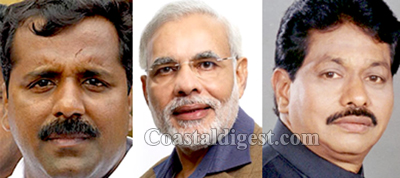
ut modi gandhiIn a letter sent to the Prime Minister, Mr Khader expressed shock over the recommendation put forward by Dilip Gandhi to reexamine the health effects of tobacco on an Indian population in concern with pictorial warnings implementation.

Dilip Gandhi, who head’s Parliamentary panel on subordinate legislation examining the provisions of Cigarettes and Other Tobacco Products Act, 2003 which had sought deferment of the move, earlier stated that there was no Indian study to confirm that use of tobacco products leads to cancer.

“If this report is true, it is disappointing as the health hazards of tobacco are well established worldwide over the decades. The carcinogenic chemicals in tobacco are the same worldwide and do not differ between countries in nature to harm human life. The same is proven well by the International agency for research on cancer- a wing of W.H.O,” said Mr Khader.

It is shocking that a senior MP is so poorly informed about the facts pertaining to harmful effects of tobacco. It also clearly shows the influence of the tobacco industry on the policy maker in a bid to distort science and influence policy. Tobacco is attributable cause for almost 40 % of cancers in India and majority of lung or heart diseases. It is appalling that Dilip Gandhi is challenging the recommendations of W.H.O, United Nations, UICC, CDC, NCI etc with regards to health effects of tobacco. In December 2010, Supreme Court had directed Ministry of Health to constitute an expert committee to study the harmful effects of tobacco. The committee submitted a damming report proving beyond doubt that tobacco is indeed very harmful, said Mr Khader in his letter.

Mr Khader further said: “This poor and unscientific approach by a policy maker can only make way for Acche Din to the tobacco industry, which contributes to highest deaths from NCD in our country. I strongly urge you to take cognizance of the issue and show your commitment for a Swasth Bharat by intervening in this policy measure that has potential to save lives.”

Comments

Add new comment

  • Coastaldigest.com reserves the right to delete or block any comments.
  • Coastaldigset.com is not responsible for its readers’ comments.
  • Comments that are abusive, incendiary or irrelevant are strictly prohibited.
  • Please use a genuine email ID and provide your name to avoid reject.
Media Release
February 14,2020

Veteran journalist P. Sainath has said that the nation is in a crisis. And this crisis is not limited to just the rural area. It has become a national crisis at various areas such as agriculture, education, economy, job creation etc.

He was delivering the endowment lecture on the topic ‘Indian democracy at the post-liberalization and post-truth era’ at Media Manthan 2020 organized by the PG department of journalism and mass communication at St Aloysius College (Autonomous). 

Mr Sainath said that the many policies adopted in the 90s led to India becoming unusually unequal. Referring to the speech Ambedkar had made at the Constituent Assembly while handing over the draft of the Constitution, Mr Sainath said, “Ambedkar had warned about the weakness of Indian democracy that liberty without equality allows the supremacy of a few over the multitude. Liberty, equality and fraternity must be kept together as we cannot have one without the other.” 

Mr Sainath stated that the agrarian crisis was no longer about the loss of productivity, employment or about farmer suicide; it was a societal, civilizational crisis. Commenting on the lopsided policies such as cow-slaughter ban, he explained how cow slaughter ban had adversely affected many industries due to their interdependency. While Muslims who slaughtered cows were rendered helpless, the cattle traders who were mostly OBCs lost their earnings as the cattle prices crashed. An important industry like Kolhapur sandals industry in Maharashtra went bankrupt as a result of the cow slaughter ban in Maharashtra. He said the policymakers had no idea how the rural industries were interconnected. Demonetisation too devastated the rural economy as 98 percent of rural transactions happen through cash. 

Mr Sainath also spoke about the crisis of inequality which affects the Dalits and the Adivasis far more than anyone else as 90 percent of the rural households take home less than Rs 10,000/- per month. “Women are yet another group whose labour is never counted in the gross domestic product. Women and girls globally do unpaid work which amounts to about 12.5 billion working hours per year. Monetarily speaking, this is worth 10.8 trillion dollars,” Mr Sainath added. 

Speaking about the crisis of jobs Mr Sainath said that major companies were laying off employees just to create more profits for the investors and the adoption of artificial intelligence in the industry would further destroy millions of jobs.

Rector of St Aloysius College Institutions Fr Dionysius Vaz SJ, Principal Dr (Fr) Praveen Martis SJ, HOD of Journalism and Mass Communication department Dr (Fr) Melwyn Pinto SJ were present.

‘Veerappan and Vijay Mallya’s business models are interesting!’

Addressing the gathering during his endowment lecture on Friday, Mr Sainath made an interesting comment on the so called ‘revenue model’. “Whenever I visit IIMs and IITs for lectures on my PARI project, the students there ask me what my revenue model for my project is. I tell them that I do not have a revenue model. In fact, journalism does not begin with a revenue model. Gandhiji, Ambedkar, Bhagat Singh were all great journalists. But they did not have a revenue model,” Mr Sainath said.

On a lighter note, he said that the best revenue model that he liked was that of forest brigand Veerappan and liquor baron Vijay Mallya. “Veerappan ruled the forest for forty years and from the top ministers to the villagers he could dictate terms and liver royally. Similarly, Mallya’s revenue model was to steal the banks and run away abroad and live like a king,” Mr Sainath added.

Journalism is not and can never be a business. It is a calling, he opined. While newspaper can be a business, television can be a business, journalism per se cannot be reduced to a business. “Unfortunately today, journalists are recruited on a contract basis and they have no bargaining power; and there are no unions to fight for their cause. Hence, they are at the mercy of the corporate media houses for their survival and are made to write stories that cannot be called journalism,” Mr Sainath said.

Answering a question as to the pressures he faced as a journalist, he said that external pressures from the government or others could be very well handled. It is the internal pressures from once own media house that journalists find it difficult to manage.


Comments

Add new comment

  • Coastaldigest.com reserves the right to delete or block any comments.
  • Coastaldigset.com is not responsible for its readers’ comments.
  • Comments that are abusive, incendiary or irrelevant are strictly prohibited.
  • Please use a genuine email ID and provide your name to avoid reject.
coastaldigest.com news network
February 19,2020

Mangaluru, Feb 19: Social worker Tabassum who has been rendering selfless service to HIV/AIDS affected children through her shelter home 'Snehadeep' at Bejai has been selected for the Annual Award of Mangaluru Press Club for the year 2019.

Tabassum, a resident of Konaje was chosen by a team of judges comprising Prof Balakrishna Gatti, Dr Vasanth Kumar Perla and Dr Nagaveni Manchi.

Comments

Azmath
 - 
Thursday, 20 Feb 2020

The passion of young  Ms Tabassum and Social Working of today, particularly, gives me lot of hope.  It almost feels like the political class wants to bring down India while the people are so hard working and committed to nation building.


Congratulation Miss. Way to go.


PS: Media has been compromised and fake news factories churn out crap daily. Thanks CD for bringing this news to readers.

Shahul Hameed
 - 
Thursday, 20 Feb 2020

CONGRATULATIONS.


Mrs.Tabassum's service for humanity is highly commendable.She looks after HIV & AIDS effected children with compassion like mother without expecting anything in returns.

She is the alumni of JF managed Green View PU womens college at Derealakette.

She deserve for more prestigious awards even like "Padma Shri" for her selfless and sincere services for the society and the nation.

All the best.


Add new comment

  • Coastaldigest.com reserves the right to delete or block any comments.
  • Coastaldigset.com is not responsible for its readers’ comments.
  • Comments that are abusive, incendiary or irrelevant are strictly prohibited.
  • Please use a genuine email ID and provide your name to avoid reject.
News Network
May 29,2020

Bengaluru, May 29: Seven out of ten (72 per cent) workers in Karnataka reported having lost their employment during the COVID-19-induced lockdown, according to findings of a survey by Azim Premji University, in collaboration with ten civil society organisations.

The university said in a statement it conducted "a detailed" phone survey of 5,000 workers across 12 states in the country, to gauge the impact of the COVID-19 lockdown on employment, livelihoods, and access to government relief schemes.

The survey covered self-employed, casual, and regular wage and salaried workers and it released the findings for Karnataka on Thursday.

Seventy-six per cent of urban workers and 66 per cent of rural workers lost their employment, the survey findings said.

For non-agricultural self-employed workers and wage workers, who were still employed, average weekly earnings fell by two-third.

More than four in ten salaried workers (44 per cent) saw either a reduction in their salary or received no salary during the lockdown.

Six out of ten households reported that they did not have enough money to buy even a weeks worth of essential items, according to the survey.

Eight out ten households reported a reduction in food intake, while less than three in ten vulnerable households (27 per cent) in urban Karnataka received any form of cash transfer from the government, it said.

In summary, the disruption in the Karnatakas economy and labour markets is enormous. Livelihoods have been devastated at unprecedented levels during the lockdown.

The recovery from this could be slow and very painful, the statement said.

As a response to the findings of this survey, the team which has conducted the survey suggested a universalisation of the PDS to expand its reach and implementation of expanded rations for at least the next six months.

It suggested cash transfers equal to at least Rs.7000 per month for two months, and proactive steps like expansion of MGNREGA, introduction of urban employment guarantee, and investment in universal basic services, among others.

Comments

Add new comment

  • Coastaldigest.com reserves the right to delete or block any comments.
  • Coastaldigset.com is not responsible for its readers’ comments.
  • Comments that are abusive, incendiary or irrelevant are strictly prohibited.
  • Please use a genuine email ID and provide your name to avoid reject.