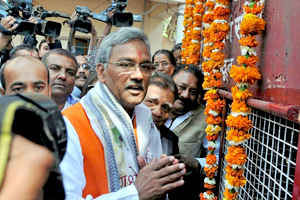
Uttarakhand CM sets up cowshed at official residence

June 9, 2017

Dehradun, Jun 9: Uttarakhand Chief Minister Trivendra Singh Rawat today inaugurated a newly built cowshed at his official residence here, describing cow as a symbol of Indian culture.cowshed

Accompanied by his wife Sunita, Rawat worshipped a cow and its calf kept in the cowshed to mark its opening.

The couple caressed them and offered them a mix of jaggery and gram.

"The cow is a symbol of our culture. Keeping a cow at home gives us great happiness and spiritual peace," he said.

Comments

Add new comment

  • Coastaldigest.com reserves the right to delete or block any comments.
  • Coastaldigset.com is not responsible for its readers’ comments.
  • Comments that are abusive, incendiary or irrelevant are strictly prohibited.
  • Please use a genuine email ID and provide your name to avoid reject.
Agencies
February 10,2020

New Delhi, Fevb 10: Of the countries most at risk of importing coronavirus cases, India ranks 17th, researchers have found on the basis of a mathematical model for the expected global spread of the virus that originated in China's Wuhan area in December 2019.

So far, India has reported three coronavirus positive cases -- all from Kerala.

Among the airports in India, the Indira Gandhi International Airport in New Delhi is most at risk, followed by airports in Mumbai, Kolkata, Bengaluru, Chennai, Hyderabad and Kochi, according to the model.

The new model for predicting global novel coronavirus cases has been developed by researchers from Humboldt University and Robert Koch Institute in Germany.

"The spread of the virus on an international scale is dominated by air travel," said the study.

"Wuhan, the seventh largest city in China with 11 million residents, was the relevant major domestic air transportation hub with many connecting international flights before the city was effectively quarantined on January 23, 2020, and the Wuhan airport was closed. By then the virus had already spread to other Chinese provinces as well as other countries," it added.

The researchers said that it is possible to estimate how likely it is that the virus spreads to other areas by looking at air travel passenger numbers.

"The busier a flight route, the more probable it is that an infected passenger travels this route. Using these probabilistic concepts, we calculate the relative import risk to other airports. When calculating the import risk, we also take into account connecting flights and travel routes that involve multiple destinations," said the study.

The top 10 countries and regions at risk of importing coronavirus cases are: Thailand, Japan, South Korea, Hong Kong, Taiwan, USA, Vietnam, Malaysia, Singapore and Cambodia, according to the model.

While Thailand's national import risk is 2.1%, it is 0.2% for India, found the research.

The foundation of the model is the worldwide air transportation network (WAN) that connects approximately 4,000 airports with more than 25,000 direct connections.

The model accounts for both, the current distribution of confirmed cases in mainland China as well as airport closures that were implemented as a mitigation strategy.

This network theoretic model is based on the concept of effective distance and is an extension of a model introduced in the 2013 paper "The Hidden Geometry of Complex, Network-Driven Contagion Phenomena" published in the journal Science.

The current outbreak of the 2019-nCoV virus started in Wuhan city, Hubei province, China. While the first cases were reported as early as December 8, 2019, the outbreak gained global attention on December 31, 2019, when the World Health Organization was alerted to "several cases of pneumonia" by an unknown virus.

The new virus was soon identified as a novel coronavirus and named 2019-nCOV. It belongs to the family of viruses that include the common cold and viruses such as SARS and MERS. On January 20, 2020, it was confirmed that the coronavirus can be transmitted between humans, greatly increasing the risk of a global spread.

The death toll due to the novel coronavirus outbreak in China has increased to 811 on Sunday, surpassing that of the Severe Acute Respiratory Syndrome (SARS) epidemic in 2003.

Although about 20 countries have confirmed cases, China has accounted for about 99 per cent of those infected. The first foreign victims of the virus both died on Saturday in Wuhan.


Comments

Add new comment

  • Coastaldigest.com reserves the right to delete or block any comments.
  • Coastaldigset.com is not responsible for its readers’ comments.
  • Comments that are abusive, incendiary or irrelevant are strictly prohibited.
  • Please use a genuine email ID and provide your name to avoid reject.
News Network
May 6,2020

New Delhi, May 6: Taking a cue from states, the Centre announced one of the steepest hikes in duties on petrol and diesel in the recent past, by raising it by Rs 10 and Rs 13 per litre, respectively, in a notification issued late on Tuesday.

Retail prices, however, will see no change as the price hike will be absorbed by oil marketing companies against the fall in crude prices.

Road and infrastructure cess was hiked by Rs 8 for petrol and diesel and the special additional excise duty (SAED) was hiked by Rs 2 per litre and Rs 5 per litre, respectively. While the road cess will only go into the Centre’s coffers, the hike on account of SAED will be passed on to states via devolution at 42 per cent. Hence, the states will get only Rs 0.84 per litre in case of petrol and Rs 2.1 in case of diesel.

The decision comes after several states increased the value added tax (VAT) on petrol and diesel making use of the lower price regime. The Delhi government on Tuesday increased VAT on petrol and diesel to 30 per cent each, from 27 and 16.75, respectively. As a result, the price of petrol in Delhi increased by Rs 1.67 to Rs 71.26 a litre and diesel by Rs 7.10 to Rs 69.29 in Delhi on Tuesday.

Amid falling international crude oil prices, the Centre introduced an enabling provision in March to raise excise duty on petrol and diesel by Rs 8 per litre in the Finance Act. The government had on March 14 raised excise duty on petrol and diesel by? 3 per litre each, which was to help raise an additional ?39,000 crore in revenue annually.

This duty hike included Rs 2 a litre increase in SAED and Rs 1 in road and infrastructure cess. It raised SAED to Rs 10 for petrol and Rs 4 for diesel. The limit has now been increased to Rs 18 a litre in case of petrol and Rs 12 in case of diesel by way of amendment of the Eighth Schedule of the Finance Act.

Economists said the move would impact retail inflation by over half a percentage point at least. “With lower consumption, there was loss of revenue for Centre and states, who earn Rs 6 trillion annually or Rs 50,000 crore monthly from fuel. Amid lockdown in April, the collection must have come down to just Rs 5,000 crore, and this will hold for May.

This means that Centre and states have lost 20 per cent of annual revenue from fuel. Hence, they have hiked duties to recover losses,” said Madan Sabnavis, chief economist, CARE Ratings. He added that the hike will impact inflation by at least 0.6-0.7 percentage points.

According to industry experts, an estimate of the additional government revenue cannot be made as the consumption of petrol and diesel has dropped to 40 per cent of what it was before the lockdown. The duty hike comes following a drop in international crude oil prices in April, owing to lower consumption figures globally. At 11.50 pm on Tuesday, Brent was priced at $30.67 a barrel, while West Texas Intermediate (WTI) crude was seen at $24.36 a barrel. On Monday, the Indian basket of crude oil was priced at $23.38 a barrel, after touching a 15-year low last month.

Comments

Add new comment

  • Coastaldigest.com reserves the right to delete or block any comments.
  • Coastaldigset.com is not responsible for its readers’ comments.
  • Comments that are abusive, incendiary or irrelevant are strictly prohibited.
  • Please use a genuine email ID and provide your name to avoid reject.
News Network
April 5,2020

Thiruvananthapuram, April 5: Kerala Health Minister KK Shailaja on Sunday said that the state's preparations for containment of COVID-19 were satisfactory and added that PCR tests were going on in nine laboratories, in which upwards of eight thousand samples have been tested so far.

"Our strategy for the containment of COVID-19 is satisfactory. We are yielding good results from our strategy for tracing, isolation, testing & treatment. PCR test is going on in 9 laboratories. We have tested more than 8000 samples so far," Shailaja told ANI here.

She further said that the state government wanted to implement Rapid test in Kerala and added that they had ample PPEs and N95 masks.

"We want to implement Rapid Test in Kerala. Yesterday, we got 2000 kits; Right now, we have sufficient PPEs and N95 masks. If the number of COVID19 cases increases in the coming weeks then we will need more equipment," Shailaja said.

Keeping up with the need of the hour, the new administrative block of Kasaragod Medical College will soon be converted into a COVID-19 hospital for providing better treatment facilities to the coronavirus patients.

A team constituting 26 doctors and medical staff of the Government Medical College, Thiruvananthapuram will join the efforts of converting the new administrative block into a COVID-19 Hospital in Kasaragod on Sunday.

The total number of COVID-19 positive cases rose to 3,374 in India on Sunday, as per the data provided by the Ministry of Health and Family Welfare.

Comments

Add new comment

  • Coastaldigest.com reserves the right to delete or block any comments.
  • Coastaldigset.com is not responsible for its readers’ comments.
  • Comments that are abusive, incendiary or irrelevant are strictly prohibited.
  • Please use a genuine email ID and provide your name to avoid reject.