



Vatican signs historic accord with Palestine

June 26, 2015

Vatican City, Jun 26: The Vatican on Friday signed a historic first accord with Palestine, two years after officially recognizing it as a state.vatican
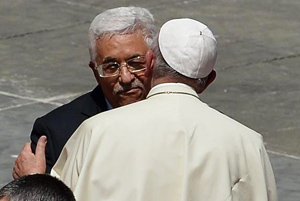
The accord, a treaty covering the activities of he Church in the parts of the holy land under Palestinian control, was the first since the Vatican recognized Palestine as a state in February 2013.

The product of 15 years of discussions, the agreement was finalized in principle last month and bitterly condemned then by Israel as a setback for the peace process.

Palestinian foreign minister Riad Al-Maliki, said at Friday's signing ceremony that it would "not have been possible without the blessing of Pope Francis for our efforts to reach it."

The minister said the "historic" accord enshrined Palestine's special status as the birthplace of Christianity and the cradle of the monotheistic religions (Christianity, Islam, Judaism).

Paul Gallagher, the British archbishop who is the Vatican's de facto foreign minister, signed the accord on behalf of the Holy See in the presence of guests including Vera Baboun, the mayor of Bethlehem, the Palestinian town considered to be the birthplace of Jesus Christ.

Gallagher said the accord's provisions to ensure the rights of Christians should serve as a model for other Arab and Muslim states in their relations with Christian minorities facing increasing persecution in the Middle East. He said it was "indicative of the progress made by the Palestinian Authority in recent years, and above all of the level of international support (for recognition)."

"In this context, it is my hope that the present agreement may in some way be a stimulus to bringing a definitive end to the long-standing Israeli-Palestinian conflict, which continues to cause suffering for both Parties. I also hope that the much desired two-State solution may become a reality as soon as possible. The peace process can move forward only if it is directly negotiated between the parties, with the support of the international community," Gallagher said.

"This certainly requires courageous decisions, but it will also offer a major contribution to peace and stability in the region."

The Vatican's recognition of the state of Palestine followed a November 2012 vote in favour of recognition by the UN general assembly.

The Palestinian authority considers the Vatican one of 136 countries to have recognised Palestine as a state, although the number is disputed and several recognitions by what are now European Union member states date back to the Soviet era.

The Vatican has had diplomatic relations with Israel since 1993 but has yet to conclude an accord on the Church's rights in the Jewish state which has been under discussion since 1999.

Comments

Add new comment

  • Coastaldigest.com reserves the right to delete or block any comments.
  • Coastaldigset.com is not responsible for its readers’ comments.
  • Comments that are abusive, incendiary or irrelevant are strictly prohibited.
  • Please use a genuine email ID and provide your name to avoid reject.
News Network
May 24,2020

Beijing, May 24: The Chinese virology institute in the city where COVID-19 first emerged has three live strains of bat coronavirus on-site, but none match the new contagion wreaking chaos across the world, its director has said.

Scientists think COVID-19 -- which first emerged in Wuhan and has killed some 340,000 people worldwide -- originated in bats and could have been transmitted to people via another mammal.

But the director of the Wuhan Institute of Virology told state broadcaster CGTN that claims made by US President Donald Trump and others that the virus could have leaked from the facility were "pure fabrication".

"Now we have three strains of live viruses... But their highest similarity to SARS-CoV-2 only reaches 79.8 percent," she said, referring to the coronavirus strain that causes COVID-19.

US demands immediate start to WHO review

The United States called on the World Health Organisation on Friday to begin working immediately on investigating the source of the novel coronavirus, as well as its handling of the response to the pandemic.

One of their research teams, led by Professor Shi Zhengli, has been researching bat coronaviruses since 2004 and focused on the "source tracing of SARS", the strain behind another virus outbreak nearly two decades ago.

"We know that the whole genome of SARS-CoV-2 is only 80 percent similar to that of SARS. It's an obvious difference," she said.

"So, in Professor Shi's past research, they didn't pay attention to such viruses which are less similar to the SARS virus."

Conspiracy rumours that the biosafety lab was involved in the outbreak swirled online for months before Trump and US Secretary of State Mike Pompeo brought the theory into the mainstream by claiming that there is evidence the pathogen came from the institute.

The lab has said it received samples of the then-unknown virus on December 30, determined the viral genome sequence on January 2 and submitted information on the pathogen to the WHO on January 11.

Wang said in the interview that before it received samples in December, their team had never "encountered, researched or kept the virus."

"In fact, like everyone else, we didn't even know the virus existed," she said. "How could it have leaked from our lab when we never had it?"

The World Health Organization said Washington had offered no evidence to support the "speculative" claims.

In an interview with Scientific American, Shi said the SARS-CoV-2 genome sequence did not match any of the bat coronaviruses her laboratory had previously collected and studied.

Comments

Add new comment

  • Coastaldigest.com reserves the right to delete or block any comments.
  • Coastaldigset.com is not responsible for its readers’ comments.
  • Comments that are abusive, incendiary or irrelevant are strictly prohibited.
  • Please use a genuine email ID and provide your name to avoid reject.
News Network
March 3,2020

Mar 3: Just hours after the ending of a week-long “reduction” in violence that was crucial for Donald Trump’s peace deal in Afghanistan, the Taliban struck again: On Monday, they killed three people and injured about a dozen at a football match in Khost province. This resumption of violence will not surprise anyone actually invested in peace for that troubled country. The point of the U.S.-Taliban deal was never peace. It was to try and cover up an ignominious exit for the U.S., driven by an election-bound president who feels no responsibility toward that country or to the broader region.

Seen from South Asia, every point we know about in the agreement is a concession by Trump to the Taliban. Most importantly, it completes a long-term effort by the U.S. to delegitimize the elected government in Kabul — and, by extension, Afghanistan’s constitution. Afghanistan’s president is already balking at releasing 5,000 Taliban prisoners before intra-Afghan talks can begin — a provision that his government did not approve.

One particularly cringe-worthy aspect: The agreement refers to the Taliban throughout  as “the Islamic Emirate of Afghanistan that is not recognized by the United States as a state and is known as the Taliban.” This unwieldy nomenclature validates the Taliban’s claim to be a government equivalent to the one in Kabul, just not the one recognised at the moment by the U.S. When read together with the second part of the agreement, which binds the U.S. to not “intervene in [Afghanistan’s] domestic affairs,” the point is obvious: The Taliban is not interested in peace, but in ensuring that support for its rivals is forbidden, and its path to Kabul is cleared.

All that the U.S. has effectively gotten in return is the Taliban’s assurance that it will not allow the soil of Afghanistan to be used against the “U.S. and its allies.” True, the U.S. under Trump has shown a disturbing willingness to trust solemn assurances from autocrats; but its apparent belief in promises made by a murderous theocratic movement is even more ridiculous. Especially as the Taliban made much the same promise to an Assistant Secretary of State about Osama bin Laden while he was in the country plotting 9/11.

Nobody in the region is pleased with this agreement except for the Taliban and their backers in the Pakistani military. India has consistently held that the legitimate government in Kabul must be the basic anchor of any peace plan. Ordinary Afghans, unsurprisingly, long for peace — but they are, by all accounts, deeply skeptical about how this deal will get them there. The brave activists of the Afghan Women’s Network are worried that intra-Afghan talks will take place without adequate representation of the country’s women — who have, after all, the most to lose from a return to Taliban rule.

But the Pakistani military establishment is not hiding its glee. One retired general tweeted: “Big victory for Afghan Taliban as historic accord signed… Forced Americans to negotiate an accord from the position of parity. Setback for India.” Pakistan’s army, the Taliban’s biggest backer, longs to re-install a friendly Islamist regime in Kabul — and it has correctly estimated that, after being abandoned by Trump, the Afghan government will have sharply reduced bargaining power in any intra-Afghan peace talks. A deal with the Taliban that fails also to include its backers in the Pakistani military is meaningless.

India, meanwhile, will not see this deal as a positive for regional peace or its relationship with the U.S. It comes barely a week after Trump’s India visit, which made it painfully clear that shared strategic concerns are the only thing keeping the countries together. New Delhi remembers that India is not, on paper, a U.S. “ally.” In that respect, an intensification of terrorism targeting India, as happened the last time the U.S. withdrew from the region, would not even be a violation of Trump’s agreement. One possible outcome: Over time the government in New Delhi, which has resolutely sought to keep its ties with Kabul primarily political, may have to step up security cooperation. Nobody knows where that would lead.

The irresponsible concessions made by the U.S. in this agreement will likely disrupt South Asia for years to come, and endanger its own relationship with India going forward. But worst of all, this deal abandons those in Afghanistan who, under the shadow of war, tried to develop, for the first time, institutions that work for all Afghans. No amount of sanctimony about “ending America’s longest war” should obscure the danger and immorality of this sort of exit.

Comments

Add new comment

  • Coastaldigest.com reserves the right to delete or block any comments.
  • Coastaldigset.com is not responsible for its readers’ comments.
  • Comments that are abusive, incendiary or irrelevant are strictly prohibited.
  • Please use a genuine email ID and provide your name to avoid reject.
News Network
February 6,2020

Washington, Feb 6: The US has expressed concern over the current situation of religious freedom in India and raised the issue with Indian officials, a senior State Department official has said.

The remarks came in the wake of widespread protests held across India against the Citizenship Amendment Act (CAA).

The senior State Department official, on condition of anonymity, said that he has met with officials in India about what is taking place in the nation and expressed concern.

"We are concerned about what's taking place in India. I have met with the Indian foreign minister. I've met with the Indian ambassador (to express my concern)," the official, who was recently in India, told reporters on Wednesday.

The US has also "expressed desire first to try to help and work through some of these issues", the official said as Secretary of State Mike Pompeo launched a 27-nation International Religious Freedom Alliance.

"To me, the initial step we try to do in most places is say what can we do to be of help you work through an issue to where there's not religious persecution. That's the first step, is just saying can we work with you on this," the official said.

India maintains that the Indian Constitution guarantees fundamental rights to all its citizens, including its minority communities.

It is widely acknowledged that India is a vibrant democracy where the Constitution provides protection of religious freedom, and where democratic governance and rule of law further promote and protect fundamental rights, a senior official of the Ministry of External Affairs has said.

According to the CAA, members of Hindu, Sikh, Buddhist, Jain, Parsi and Christian communities who have come from Pakistan, Bangladesh and Afghanistan till December 31, 2014 following religious persecution there will get Indian citizenship.

The Indian government has been emphasising that the new law will not deny any citizenship rights, but has been brought to protect the oppressed minorities of neighbouring countries and give them citizenship.

Defending the CAA, Prime Minister Narendra Modi last month said that the law is not about taking away citizenship, it is about giving citizenship.

"We must all know that any person of any religion from any country of the world who believes in India and its Constitution can apply for Indian citizenship through due process. There's no problem in that," he said.

Comments

Add new comment

  • Coastaldigest.com reserves the right to delete or block any comments.
  • Coastaldigset.com is not responsible for its readers’ comments.
  • Comments that are abusive, incendiary or irrelevant are strictly prohibited.
  • Please use a genuine email ID and provide your name to avoid reject.