


Veerappa Moily hints at 'RSS-lobby' behind Raghuram Rajan's exit

June 19, 2016

Bengaluru, June 19: Blaming the adverse environment created by the BJP-led regime at the Centre for Reserve Bank of India (RBI) Governor Raghuram Rajan's decision to not continue with his current post after the end of his tenure in September, former union minister Veerappa Moily on Saturday hinted at the RSS being involved in the entire matter.M-Veerappa
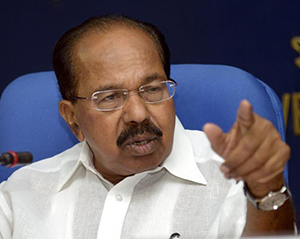
Moily criticised the saffron outfit for having embarrassed Rajan and said the latter was needed to steer the economy in times of global economic uncertainty.

"The reason is well known to him. But the manner in which some of these BJP leaders, including the commerce minister and one of the important BJP leaders Subramanian Swamy, and also the Nagpur RSS camp was lobbying against him, was the most unpleasant thing that happened in the country," Moily told ANI.

The senior Congress leader further said the present regime did not deserve a person of Rajan's stature to be working with them.

"Under the present regime, they do not deserve a person of his stature. He is a global person. We are endowed to him, he took all steps to keep the inflation down. They shouldn't have embarrassed him. His desire not to continue was compelled because of environment created by the BJP regime," Moily said.

"Under the present (economic) scenario, he was very much desired as he would have definitely taken the economy forward. It's a loss for country's economy," he added.

BJP leader Subramanian Swamy had last month triggered speculation by asking the Centre to deny Rajan a second term, saying his hawkish policies have ruined the Indian economy.

Swamy had in his letter to Prime Minister Narendra Modi accused Rajan of 'harming the nation's economy' and claimed that the latter was acting more as a disrupter of the Indian economy than the person, who wants the Indian economy to improve.

Moily said that Prime Minister Narendra Modi or Finance Minister Arun Jaitley should have made an attempt to curb elements in the BJP levelling false allegations against Rajan, including Swamy.

"The Prime Minister or the Finance Minister should have curbed these elements who are unnecessarily making allegations and charges against Raghuram Rajan," he said.

When asked specifically about Swamy's remarks on Rajan, the senior Congress leader said, "Swamy's allegations are baseless and he doesn't know much about the economy. NDA is out to disrupt economy of the country."

Meanwhile, Swamy welcomed Rajan's decision to leave his post, saying he was not even going to be offered a second term in the first place.

Swamy told ANI that Rajan made this decision in order to save his self respect.

"Was he getting a second term in the first place? How do we know that he was getting a second term? I have no information that he was getting a second term. So if he says he wants to go and wants to save his self respect, I have no problem. Let them pretend that he is giving up and going but as long as he goes, it's good," Swamy said on Saturday.

Earlier today, Rajan announced that he would return to the academic world at the end of his term on September 4, 2016, adding he will always be available to serve his country when needed and asserted that his 'successor' would take the nation to new heights.

Rajan is currently on leave from the Chicago Booth School of Business where he holds the post of Distinguished Service Professor of Finance.

"The approaching end of my three-year term and of my leave at the University of Chicago was, therefore, a good time to reflect on how much we had accomplished. I am confident my successor will take us to new heights with your help. I will still be working with you for the next couple of months, but let me thank all of you in the RBI family in advance for your dedicated work and unflinching support. It has been a fantastic journey together!" the statement said.

Comments

KhasaiKhaane
 - 
Monday, 20 Jun 2016

Guys, Chaiwala is a PM... now he will obviously try to appease his colleagues - Dhoodwala, Subziwala, Golgappe wala, Kinarewala,...
and not to forget - PanWala (Rajnath Singh)

MMS - \#MoNa becoming PM will be the biggest disaster for the country\"
Now we know why and we will see more..!"

Add new comment

  • Coastaldigest.com reserves the right to delete or block any comments.
  • Coastaldigset.com is not responsible for its readers’ comments.
  • Comments that are abusive, incendiary or irrelevant are strictly prohibited.
  • Please use a genuine email ID and provide your name to avoid reject.
coastaldigest.com news network
May 28,2020

Mangaluru/Udupi, May 28: Coastal Karnataka witnessed further spike in covid-19 cases today with 27 people testing positive for coronavirus in Udupi and six in Dakshina Kannada. 

Among 27 coronavirus patients in Udupi 18 are males and 9 females. Among them 24 have come from Maharashtra, two from Telangana and one from Kerala. All of them were under quarantine.

As many as 147 confirmed cases of coronavirus have been reported so far in the district, including a death. Three have recovered, and 143 are active.

In Dakshina Kannada, 2 females aged 18 and 62, and four males aged 25, 36, 50 and 61, are the ones to be tested positive. All the six persons to test positive are Maharashtra returnees.

With this, the number of cases in DK has increased to 87, out of which 51 are currently active. As many as 29 persons have recovered and been discharged, and seven deaths have occurred so far.

Comments

Add new comment

  • Coastaldigest.com reserves the right to delete or block any comments.
  • Coastaldigset.com is not responsible for its readers’ comments.
  • Comments that are abusive, incendiary or irrelevant are strictly prohibited.
  • Please use a genuine email ID and provide your name to avoid reject.
Ram Puniyani
January 14,2020

In the beginning of January 2020 two very disturbing events were reported from Pakistan. One was the attack on Nankana Sahib, the holy shrine where Sant Guru Nanak was born. While one report said that the place has been desecrated, the other stated that it was a fight between two Muslim groups. Prime Minister of Pakistan Imran Khan condemned the incident and the main accused Imran Chisti was arrested. The matter related to abduction and conversion of a Sikh girl Jagjit Kaur, daughter of Pathi (One who reads Holy Guru Granth Sahib in Gurudwara) of the Gurudwara. In another incident one Sikh youth Ravinder Singh, who was out on shopping for his marriage, was shot dead in Peshawar.

While these condemnable attacks took place on the Sikh minority in Pakistan, BJP was quick enough to jump to state that it is events like this which justify the Citizenship Amendment Act (CAA). Incidentally CAA is the Act which is discriminatory and relates to citizenship with Religion, which is not as per the norms of Indian constitution. There are constant debates and propaganda that population of Hindus has come down drastically in Pakistan and Bangla Desh. Amit Shah, the Home minister stated that in Pakistan the population of Hindus has come down from 23% at the time of partition to 3.7% at present. And in Bangla Desh it has come down from 22% to present 8%.

While not denying the fact that the religious minorities are getting a rough deal in both these countries, the figures which are presented are totally off the mark. These figures don’t take into consideration the painful migrations, which took place at the time of partition and formation of Bangla Desh later. Pakistan census figures tell a different tale. Their first census was held in 1951. As per this census the overall percentage of Non Muslim in Pakistan (East and West together) was 14.2%, of this in West Pakistan (Now Pakistan) it was 3.44 and in Eat Pakistan it was 23.2. In the census held in Pakistan 1998 it became 3.72%. As far as Bangla Desh is concerned the share of Non Muslims has gone down from 23.2 (1951) to 9.6% in 2011.

The largest minority of Pakistan is Ahmadis, (https://minorityrights.org/country/pakistan/) who are close to 4 Million and are not recognised as Muslims in Pakistan. In Bangla Desh the major migrations of Hindus from Bangla Desh took place in the backdrop of Pakistan army’s atrocities in the then East Pakistan.

As far as UN data on refugees in India it went up by 17% between 2016-2019 and largest numbers were from Tibet and Sri Lanka.  (https://www.un.org/en/development/desa/population/migration/publication…)

The state of minorities is in a way the index of strength of democracy. Most South Asian Countries have not been able to sustain democratic values properly. In Pakistan, the Republic began with Jinnah’s classic speech where secularism was to be central credo of Pakistan. This 11th August speech was in a way what the state policy should be, as per which people of all faiths are free to practice their religion. Soon enough the logic of ‘Two Nation theory” and formation of Pakistan, a separate state for Muslim took over. Army stepped in and dictatorship was to reign there intermittently. Democratic elements were suppressed and the worst came when Zia Ul Haq Islamized the state in collusion with Maulanas. The army was already a strong presence in Pakistan. The popular formulation for Pakistan was that it is ruled by three A’s, Army, America and Allah (Mullah).

Bangla Desh had a different trajectory. Its very formation was a nail in the coffin of ‘two nation theory’; that religion can be the basis of a state. Bangla Desh did begin as a secular republic but communal forces and secular forces kept struggling for their dominance and in 1988 it also became Islamic republic. At another level Myanmar, in the grip of military dictatorship, with democratic elements trying to retain their presence is also seeing a hard battle. Democracy or not, the army and Sanghas (Buddhist Sang has) are strong, in Myanmar as well. The most visible result is persecution of Rohingya Muslims.

Similar phenomenon is dominating in Sri Lanka also where Budhhist Sanghas and army have strong say in the political affairs, irrespective of which Government is ruling. Muslim and Christian minorities are a big victim there, while Tamils (Hindus, Christians etc.) suffered the biggest damage as ethnic and religious minorities. India had the best prospect of democracy, pluralism and secularism flourishing here. The secular constitution, the outcome of India’s freedom struggle, the leadership of Gandhi and Nehru did ensure the rooting of democracy and secularism in a strong way.

India so far had best democratic credentials amongst all the south Asian countries. Despite that though the population of minorities rose mainly due to poverty and illiteracy, their overall marginalisation was order of the day, it went on worsening with the rise of communal forces, with communal forces resorting to identity issues, and indulging in propaganda against minorities.

While other South Asian countries should had followed India to focus more on infrastructure and political culture of liberalism, today India is following the footsteps of Pakistan. The retrograde march of India is most visible in the issues which have dominated the political space during last few years. Issues like Ram Temple, Ghar Wapasi, Love Jihad, Beef-Cow are now finding their peak in CAA.

India’s reversal towards a polity with religion’s identity dominating the political scene was nicely presented by the late Pakistani poetess Fahmida Riaz in her poem, Tum bhi Hum Jaise Nikle (You also turned out to be like us). While trying to resist communal forces has been an arduous task, it is becoming more difficult by the day. This phenomenon has been variously called, Fundamentalism, Communalism or religious nationalism among others. Surely it has nothing to do with the religion as practiced by the great Saint and Sufi traditions of India; it resorts mainly to political mobilization by using religion as a tool.

Comments

Ashi
 - 
Tuesday, 14 Jan 2020

If Malaysia implement similar NRC/CAA, India and China are the loser.

Add new comment

  • Coastaldigest.com reserves the right to delete or block any comments.
  • Coastaldigset.com is not responsible for its readers’ comments.
  • Comments that are abusive, incendiary or irrelevant are strictly prohibited.
  • Please use a genuine email ID and provide your name to avoid reject.
News Network
January 30,2020

Bengaluru, Jan 30: The BJP government of Karnataka has given green signal to the proposal of hiking milk prices by Rs 2 per litre.

The new prices will come into effect from February 1. Seeking revision of prices, the Karnataka Milk Federation (KMF) had submitted a proposal last week to the state government. Alongside the revision of milk prices, the state government has also hiked the prices of curd by Rs 2 per liter.

The sudden hike in the prices of milk, curd is likely to have a cascading effect on the milk related beverages such as coffee, tea, and milkshakes with hoteliers and eateries mulling to increase the prices of coffee and tea following the hike in prices.

Sources in the state government revealed to DH that out of Rs 2, farmers will be getting a lion’s share as their accounts will be credited with Rs 1. Another 40 paise will be given to the farmers towards the insurances of their livestock.

Another 40 paise will go to the milk salesmen in the form of commission. The remaining 20 paise will be distributed among the workforce at the milk cooperative unions as an additional incentive.

Comments

Add new comment

  • Coastaldigest.com reserves the right to delete or block any comments.
  • Coastaldigset.com is not responsible for its readers’ comments.
  • Comments that are abusive, incendiary or irrelevant are strictly prohibited.
  • Please use a genuine email ID and provide your name to avoid reject.