


Veerappa Moily hints at 'RSS-lobby' behind Raghuram Rajan's exit

June 19, 2016

Bengaluru, June 19: Blaming the adverse environment created by the BJP-led regime at the Centre for Reserve Bank of India (RBI) Governor Raghuram Rajan's decision to not continue with his current post after the end of his tenure in September, former union minister Veerappa Moily on Saturday hinted at the RSS being involved in the entire matter.M-Veerappa
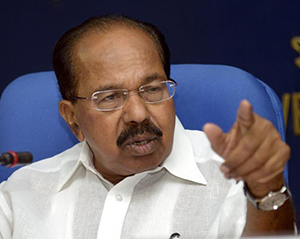
Moily criticised the saffron outfit for having embarrassed Rajan and said the latter was needed to steer the economy in times of global economic uncertainty.

"The reason is well known to him. But the manner in which some of these BJP leaders, including the commerce minister and one of the important BJP leaders Subramanian Swamy, and also the Nagpur RSS camp was lobbying against him, was the most unpleasant thing that happened in the country," Moily told ANI.

The senior Congress leader further said the present regime did not deserve a person of Rajan's stature to be working with them.

"Under the present regime, they do not deserve a person of his stature. He is a global person. We are endowed to him, he took all steps to keep the inflation down. They shouldn't have embarrassed him. His desire not to continue was compelled because of environment created by the BJP regime," Moily said.

"Under the present (economic) scenario, he was very much desired as he would have definitely taken the economy forward. It's a loss for country's economy," he added.

BJP leader Subramanian Swamy had last month triggered speculation by asking the Centre to deny Rajan a second term, saying his hawkish policies have ruined the Indian economy.

Swamy had in his letter to Prime Minister Narendra Modi accused Rajan of 'harming the nation's economy' and claimed that the latter was acting more as a disrupter of the Indian economy than the person, who wants the Indian economy to improve.

Moily said that Prime Minister Narendra Modi or Finance Minister Arun Jaitley should have made an attempt to curb elements in the BJP levelling false allegations against Rajan, including Swamy.

"The Prime Minister or the Finance Minister should have curbed these elements who are unnecessarily making allegations and charges against Raghuram Rajan," he said.

When asked specifically about Swamy's remarks on Rajan, the senior Congress leader said, "Swamy's allegations are baseless and he doesn't know much about the economy. NDA is out to disrupt economy of the country."

Meanwhile, Swamy welcomed Rajan's decision to leave his post, saying he was not even going to be offered a second term in the first place.

Swamy told ANI that Rajan made this decision in order to save his self respect.

"Was he getting a second term in the first place? How do we know that he was getting a second term? I have no information that he was getting a second term. So if he says he wants to go and wants to save his self respect, I have no problem. Let them pretend that he is giving up and going but as long as he goes, it's good," Swamy said on Saturday.

Earlier today, Rajan announced that he would return to the academic world at the end of his term on September 4, 2016, adding he will always be available to serve his country when needed and asserted that his 'successor' would take the nation to new heights.

Rajan is currently on leave from the Chicago Booth School of Business where he holds the post of Distinguished Service Professor of Finance.

"The approaching end of my three-year term and of my leave at the University of Chicago was, therefore, a good time to reflect on how much we had accomplished. I am confident my successor will take us to new heights with your help. I will still be working with you for the next couple of months, but let me thank all of you in the RBI family in advance for your dedicated work and unflinching support. It has been a fantastic journey together!" the statement said.

Comments

KhasaiKhaane
 - 
Monday, 20 Jun 2016

Guys, Chaiwala is a PM... now he will obviously try to appease his colleagues - Dhoodwala, Subziwala, Golgappe wala, Kinarewala,...
and not to forget - PanWala (Rajnath Singh)

MMS - \#MoNa becoming PM will be the biggest disaster for the country\"
Now we know why and we will see more..!"

Add new comment

  • Coastaldigest.com reserves the right to delete or block any comments.
  • Coastaldigset.com is not responsible for its readers’ comments.
  • Comments that are abusive, incendiary or irrelevant are strictly prohibited.
  • Please use a genuine email ID and provide your name to avoid reject.
Ram Puniyani
February 10,2020

Noam Chomsky is one of the leading peace workers in the world. In the wake of America’s attack on Vietnam, he brought out his classic formulation, ‘manufacturing consent’. The phrase explains the state manipulating public opinion to have the public approve of it policies—in this case, the attack of the American state on Vietnam, which was then struggling to free itself from French colonial rule.

In India, we are witness to manufactured hate against religious minorities. This hatred serves to enhance polarisation in society, which undermines India’s democracy and Constitution and promotes support for a Hindu nation. Hate is being manufactured through multiple mechanisms. For example, it manifests in violence against religious minorities. Some recent ghastly expressions of this manufactured hate was the massive communal violence witnessed in Mumbai (1992-93), Gujarat (2002), Kandhamal (2008) and Muzaffarnagar (2013). Its other manifestation was in the form of lynching of those accused of having killed a cow or consumed beef. A parallel phenomenon is the brutal flogging, often to death, of Dalits who deal with animal carcasses or leather.

Yet another form of this was seen when Shambhulal Regar, indoctrinated by the propaganda of Hindu nationalists, burned alive Afrazul Khan and shot the video of the heinous act. For his brutality, he was praised by many. Regar was incited into the act by the propaganda around love jihad. Lately, we have the same phenomenon of manufactured hate taking on even more dastardly proportions as youth related to Hindu nationalist organisations have been caught using pistols, while police authorities look on.

Anurag Thakur, a BJP minster in the central government recently incited a crowd in Delhi to complete his chant of what should happen to ‘traitors of the country...” with a “they should be shot”. Just two days later, a youth brought a pistol to the site of a protest at Jamia Millia Islamia university and shouted “take Azaadi!” and fired it. One bullet hit a student of Jamia. This happened on 30 January, the day Nathuram Godse had shot Mahatma Gandhi in 1948. A few days later, another youth fired near the site of protests against the CAA and NRC at Shaheen Bagh. Soon after, he said that in India, “only Hindus will rule”.

What is very obvious is that the shootings by those associated with Hindu nationalist organisations are the culmination of a long campaign of spreading hate against religious minorities in India in general and against Muslims in particular. The present phase is the outcome of a long and sustained hate campaign, the beginning of which lies in nationalism in the name of religion; Muslim nationalism and Hindu nationalism. This sectarian nationalism picked up the communal view of history and the communal historiography which the British introduced in order to pursue their ‘divide and rule’ policy.

In India what became part of “social common sense” was that Muslim kings had destroyed Hindu temples, that Islam was spread by force, and that it is a foreign religion, and so on. Campaigns, such as the one for a temple dedicated to the Hindu god Rama to be built at the site where the Babri masjid once stood, further deepened the idea of a Muslim as a “temple-destroyer”. Aurangzeb, Tipu Sultan and other Muslim kings were tarnished as the ones who spread Islam by force in the subcontinent. The tragic Partition, which was primarily due to British policies, and was well-supported by communal streams also, was entirely attributed to Muslims. The Kashmir conflict, which is the outcome of regional, ethnic and other historical issues, coupled with the American policy of supporting Pakistan’s ambitions of regional hegemony, (which also fostered the birth of Al-Qaeda), was also attributed to the Muslims.

With recurring incidents of communal violence, these falsehoods went on going deeper into the social thinking. Violence itself led to ghettoisation of Muslims and further broke inter-community social bonds. On the one hand, a ghettoised community is cut off from others and on the other hand the victims come to be presented as culprits. The percolation of this hate through word-of-mouth propaganda, media and re-writing of school curricula, had a strong impact on social attitudes towards the minorities.

In the last couple of decades, the process of manufacturing hate has been intensified by the social media platforms which are being cleverly used by the communal forces. Swati Chaturvedi’s book, I Am a Troll: Inside the Secret World of the BJP’s Digital Army, tells us how the BJP used social media to spread hate. Whatapp University became the source of understanding for large sections of society and hate for the ‘Other’, went up by leaps and bounds. To add on to this process, the phenomenon of fake news was shrewdly deployed to intensify divisiveness.

Currently, the Shaheen Bagh movement is a big uniting force for the country; but it is being demonised as a gathering of ‘anti-nationals’. Another BJP leader has said that these protesters will indulge in crimes like rape. This has intensified the prevalent hate.

While there is a general dominance of hate, the likes of Shambhulal Regar and the Jamia shooter do get taken in by the incitement and act out the violence that is constantly hinted at. The deeper issue involved is the prevalence of hate, misconceptions and biases, which have become the part of social thinking.

These misconceptions are undoing the amity between different religious communities which was built during the freedom movement. They are undoing the fraternity which emerged with the process of India as a nation in the making. The processes which brought these communities together broadly drew from Gandhi, Bhagat Singh and Ambedkar. It is these values which need to be rooted again in the society. The communal forces have resorted to false propaganda against the minorities, and that needs to be undone with sincerity.

Combating those foundational misconceptions which create hatred is a massive task which needs to be taken up by the social organisations and political parties which have faith in the Indian Constitution and values of freedom movement. It needs to be done right away as a priority issue in with a focus on cultivating Indian fraternity yet again.

Comments

Add new comment

  • Coastaldigest.com reserves the right to delete or block any comments.
  • Coastaldigset.com is not responsible for its readers’ comments.
  • Comments that are abusive, incendiary or irrelevant are strictly prohibited.
  • Please use a genuine email ID and provide your name to avoid reject.
News Network
July 20,2020

Bengaluru, Jul 20: Janata Dal (Secular) leader HD Kumaraswamy has urged the Karnataka government to stop putting warning signboards in front of COVID-19 patients' houses alleging that they are leading to "social discrimination and untouchability" in the present times.

"A local government warning signboards in front of the homes of COVID-19 infected people is leading to neo-social discrimination and untouchability in the new age. Even after infection, the individual and family should live with dignity. The government should immediately stop the practice of placing signboards," Kumaraswamy's first tweet read.

"Instead of placing them in front of their homes and creating untouchability, send health workers to their homes to create courage and awareness. They should be told not to leave the house. There is no such degrading practice left behind. I would like to ask Chief Minister Karnataka BS Yediyurappa to pay attention to this," he added.

The former chief minister further said that threatening to cancel the licenses of medical colleges for refusing treatment to patients would not solve the problem and urged the government to take them into confidence instead of rebuking them.

"Refusing treatment is the fault of any hospital. But for the same reason, threatening to cancel government medical college licenses is not right. There is no profit in this emergency of health. MCI also has the power to revoke the licenses of medical colleges. Remember not the government," he said.

"In this case, the government should look to the Medical Colleges to get their services in order to get them to trust them instead of getting angry. Let them focus on meeting their needs. I insist on a collective fight against the coronavirus through this," he further added.

The COVID-19 count in Karnataka reached 63,772 on Sunday, including 39,370 active cases and 23,065 cured and discharged patients.

Comments

Add new comment

  • Coastaldigest.com reserves the right to delete or block any comments.
  • Coastaldigset.com is not responsible for its readers’ comments.
  • Comments that are abusive, incendiary or irrelevant are strictly prohibited.
  • Please use a genuine email ID and provide your name to avoid reject.
News Network
July 21,2020

Bengaluru, Jul 21: The total number of Covid-19 cases in Karnataka breached the 70,000 mark on Tuesday as the state reported 3,649 fresh infections, while 61 fatalities took the death toll to 1,464, the health department said.

The day also saw 1,664 patients getting discharged after recovery. Out of 3,649 fresh cases reported on Tuesday, a whopping 1,714 were from Bengaluru urban alone. As of July 21 evening, cumulatively 71,069 Covid-19 cases have been confirmed in Karnataka, which includes 1,464 deaths and 25,459 discharges, the health department said in its bulletin.

It said that out of the 44,140 active cases, 43,557 patients are in isolation at designated hospitals and are stable, while 583 are in Intensive Care Units.

Twenty-two out of 61 deaths reported on Tuesday are from Bengaluru urban, followed by five each from Dakshina Kannada, Mysuru and Dharwad, four each from Kolar and Belagavi, three each from Hassan, Tumakuru and Haveri, Bidar 2, and one each from Chikkaballapura, Chikkamagaluru, Chamarajanagara, Gadag and Vijayapura.

Most of the deceased either had a history of Severe Acute Respiratory Infection (SARI) or Influenza-like illness (ILI). Out of 3,649 cases tested positive on Tuesday, contacts of the large number of the cases are still under tracing.

Among the districts where new cases were reported, Bengaluru urban accounted for 1,714, Ballari 193, Dakshina Kannada 149, Mysuru 135, Yadgir 117, Uttara Kannada 109, Hassan 107, Kolar 103, followed by others.

Bengaluru urban district topped the list of positive cases, with 34,943 infections, followed by Dakshina Kannada 3,829 and Kalaburagi 2,966. Among discharges Bengaluru urban was on top with 7,476 discharges, followed by Kalabuagi 1,834 and Udupi 1,731.

A total of 10,64,734 samples were tested so far, out of which 43,904 were tested on Tuesday alone, the bulletin said. It said that 19,328 of the 43,904 samples tested today were rapid antigen tests.

Comments

Add new comment

  • Coastaldigest.com reserves the right to delete or block any comments.
  • Coastaldigset.com is not responsible for its readers’ comments.
  • Comments that are abusive, incendiary or irrelevant are strictly prohibited.
  • Please use a genuine email ID and provide your name to avoid reject.