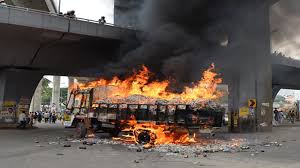
Vehicle transporting meat torched in Belagavi

January 23, 2017

Belagavi, Jan 23: Tension prevailed for a while on Kanabargi Road here after a goods vehicle transporting cattle meat was set on fire by unidentified miscreants on Sunday evening.

fireAccording to sources, the meat was being illegally transported to a processing unit at Auto Nagar here from Gokak. Around five to six youths stopped the vehicle, poured kerosene over it and set it on fire. The front portion of the Tata Ace goods vehicle was completely damaged.

As soon as the incident was reported, Police Commissioner T G Krishna Bhat, Deputy Commissioner of Police (Crime&Traffic) Amarnath Reddy and other senior officials visited the spot. Fire and Emergency Service personnel too rushed there and doused the fire. The police said they were yet to trace the miscreants and ascertain the reason behind the act. The Mal-Maruti police have registered a case.

Comments

Muhibullah Sheikji
 - 
Wednesday, 25 Jan 2017

The miscreants are none but from sangh parivar terror organisation. Look out for them and arrest under goonda act.

Add new comment

  • Coastaldigest.com reserves the right to delete or block any comments.
  • Coastaldigset.com is not responsible for its readers’ comments.
  • Comments that are abusive, incendiary or irrelevant are strictly prohibited.
  • Please use a genuine email ID and provide your name to avoid reject.
News Network
April 2,2020

The current physical distancing guidelines provided by the World Health Organisation (WHO) and by the US Centers for Disease Control and Prevention (CDC) may not be adequate to curb the coronavirus spread, according to a research which says the gas cloud from a cough or sneeze may help virus particles travel up to 8 metres. The research, published in the Journal of the American Medical Association, noted that the the current guidelines issued by the WHO and CDC are based on outdated models from the 1930s of how gas clouds from a cough, sneeze, or exhalation spread.

Study author, MIT associate professor Lydia Bourouiba, warned that droplets of all sizes can travel 23 to 27 feet, or 7-8 metres, carrying the pathogen.

According to Bourouiba, the current guidelines are based on "arbitrary" assumptions of droplet size, "overly simplified", and "may limit the effectiveness of the proposed interventions" against the deadly pandemic.

 She explained that the old guidelines assume droplets to be one of two categories, small or large, taking short-range semi-ballistic trajectories when a person exhales, coughs, or sneezes.

However based on more recent discoveries, the MIT scientist said, sneezes and coughs are made of a puff cloud that carries ambient air, transporting within it clusters of droplets of a wide range of sizes.

Bourouiba warned that this puff cloud, with ambient air entrapped in it, can offer the droplets moisture and warmth that can prevent it from evaporation in the outer environment.

"The locally moist and warm atmosphere within the turbulent gas cloud allows the contained droplets to evade evaporation for much longer than occurs with isolated droplets," she said.

"Under these conditions, the lifetime of a droplet could be considerably extended by a factor of up to 1000, from a fraction of a second to minutes," the researcher explained in the study.

The MIT scientist, who has researched the dynamics of coughs and sneezes for years, added that these droplets settle along the trajectory of a cough or sneeze contaminating surfaces, with their residues staying suspended in the air for hours.

"Even when maximum containment policies were enforced, the rapid international spread of COVID-19 suggests that using arbitrary droplet size cutoffs may not accurately reflect what actually occurs with respiratory emissions, possibly contributing to the ineffectiveness of some procedures used to limit the spread of respiratory disease," Bourouiba wrote in the study


Comments

Add new comment

  • Coastaldigest.com reserves the right to delete or block any comments.
  • Coastaldigset.com is not responsible for its readers’ comments.
  • Comments that are abusive, incendiary or irrelevant are strictly prohibited.
  • Please use a genuine email ID and provide your name to avoid reject.
coastaldigest.com news network
July 20,2020

Lucknow, Jul 20: Dr Azizuddin Sheikh, who was fighting COVID-19 as a front line worker, passed away after contracting coronavirus in Uttar Pradesh. He is survived by a wife and three small children. 

40-year-old Dr Azizuddin, who hailed from Rajasthan, was serving as a paediatrician at Avanti Bai Hospital and Duffein Hospital, Lucknow for past few years. He had also worked in the Middle Eastern countries. 

When a large number of doctors preferred to stay home following the covid-19 outbreak, Dr Azizudin was working 16 to 17 hours battling the pandemic. 

According to sources, he tested positive for the covid-19 last month. “After the reports came positive, he had to call the concerned authorities many times to take him to the hospital,” recalled his family members.

He was first admitted to Lok Bandhu Hospital and was later shifted to KGMU after his condition deteriorated. Later he was taken to SGPGIMS.
 
“Despite following all the guidelines and taking every precaution while treating coronavirus patients, he tested positive for the covid-19. It’s a shock for all of us,” he said.

He used to console his family members and instill confidence among them, said one of his relatives. 

A local newspaper quoted his friends as saying that he was very dedicated in serving people that he used to take minimal possible fees from his patients. When the family asked him to increase consultation fees his reply would be, “They are poor people, how will they afford”?

After his death, one of his patients Alok Singh wrote about an incident. “When I asked doctor Sahib why he charges so less, his answer was I have to answer Allah. The truth that he has left us will always be the reason for our grief.”

Comments

Add new comment

  • Coastaldigest.com reserves the right to delete or block any comments.
  • Coastaldigset.com is not responsible for its readers’ comments.
  • Comments that are abusive, incendiary or irrelevant are strictly prohibited.
  • Please use a genuine email ID and provide your name to avoid reject.
Abu Muhammad | coastaldigest.com
January 16,2020

Even as the Muslims of undivided Dakshina Kannada district broke out of the “spiral of silence” and made history by leading an unprecedented protest against CAA, NPR and NRC as well as the categorial mistreatment of non-saffronites at the hands of the police across the country, mainstream media turned a blind eye to the spectacle at the Shah Garden Maidan in Mangaluru’s Adyar where about two lakh patriots with tricolor in their hands converged to assert themselves on January 15th, 2020, a date which will be remembered by the people of coastal Karnataka forever.

The largest gathering in the history of Mangaluru was absolutely peaceful, law-abiding and respectful. While the slogans of ‘Azaadi’ were reverberating in the atmosphere, the protesters were seen making way for vehicles and passersby, taking care of women and helping elderly citizens on the highway adjacent to the ground. Though the organisers and most of the participants were Muslims, they collectively identified themselves as “We, the people of India”.

The district administration and the police department hadn’t imagined or even dreamt of such a mammoth gathering after blocking the highway and banning public transport from 9 am to 9 pm. Many opine that this action was taken only to discourage the concerned from participating in the protest and to create fear in the hearts of the people who are yet to process the unjustifiable deaths of two innocent citizens in an unwarranted police firing a few weeks ago.

What has since surprised the protesters most is the mainstream media’s blatant attempt to downplay the significance of this largest ever gathering. Shockingly, it could not make it to the front pages of any of the state-level Kannada daily newspapers except city-based Vaartha Bharathi. In the absence of The Hindu, which had announced a holiday on account of Makar Sankranti, most of the English newspapers too pitilessly buried the historic event in their inner pagers. National TV channels too were evidently reluctant to cover the event until NDTV started telecasting the news of the protest.

This uneasy relationship between the media and minorities in coastal Karnataka has long existed, but the non-coverage of the huge protest of Jan 15 marks a quantum leap beyond the media’s traditional pro-Sangh Parivar stance and biases –– which in the past had often demonised non-saffronites –– to now completely ignore and suppress the people’s voice. This media bias has naturally evoked a sharp response from netizens, who took to social media to issue clarion calls to boycott the mainstream media forever.

Cleanliness Drive

Most major protest meets and rallies –– both religious and political –– leave behind tonnes of garbage, especially water bottles, placards and buntings. However, the organisers of the Jan 15 protest meet led by example by launching a cleanliness drive in the area soon after the protesters left the venue peacefully. The drive continued on Jan 16 too. (Ironically, amidst this ongoing cleanliness drive, a local news portal captured photos of a few plastic bottles scattered along the road at Adyar and published a report accusing the event organisers and participants of polluting the area!)

Comments

Add new comment

  • Coastaldigest.com reserves the right to delete or block any comments.
  • Coastaldigset.com is not responsible for its readers’ comments.
  • Comments that are abusive, incendiary or irrelevant are strictly prohibited.
  • Please use a genuine email ID and provide your name to avoid reject.