


Venkatesh Prasanna arrests two more suspects in Malleswaram blast case

[email protected] (News Network)
March 23, 2016

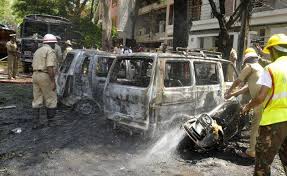
Bengaluru, Mar 23: The Central Crime Branch police has arrested two persons on terror charges from Tamil Nadu in connection with the Malleswaram blast that took place on April 17, 2013.
blastA police team, headed by Assistant Commissioner of Police Venkatesh Prasanna, brought the accused — Syed Ali Ansar and Nasir Mustak Pasha, natives of Tiruvallur near Chennai — to the city.

A senior CCB police officer said the accused were arrested on the charges of having supplied explosives. The special team was sent to Chennai, based on a tip off. The accused were produced before a court and taken into police custody for seven days for interrogation.

Fourteen accused were arrested earlier by Tamil Nadu and Bengaluru police and the city police has filed a chargesheet on the case. Among them, Panna Ismail, Bilal Malik and Fukruddin were arrested by the Tamil Nadu police at Puttur, Andhra Pradesh. The chargesheet was submitted to the First Additional Chief Metropolitan Magistrate Court here in October 2013.

The chargesheet contained 7,445-pages of three volumes; 260 witnesses were examined and 201 documents collated.

Seventeen people, including 11 policemen and a college student, were injured when the blast occurred near the BJP's office in Malleswaram. The explosive was fixed to a motorcycle with ammonium nitrate while the motorcycle itself was used as a projectile to cause destruction.

Names of the accused in the chargesheet: Basheer (30), Kichan Buhari (38), Sait Azgar Ali ( 29), Rehamathulla, Valayil Hakeem (32), Syed Suleman (24), Suleman (31), Zulfikar Ali (24), Mohammed Salin (30), Panna Ismail (38), Bilal Malik (25), Fakruddin (38), Pravai Basha and Ali Khan Kutti.

Aslo Read: Mistaken as abductor, ACP Venkatesh Prasanna briefly detained by TN police

Comments

Naren kotian
 - 
Wednesday, 23 Mar 2016

please dont arrest , encounter these terrorists .. we cannot see india turning into another west bank , where migrant arabs settler creating terror in israel and now in belgium , few months back in paris . jai bharath mata ... hara hara modi ... hahaha

Mohammed SS
 - 
Wednesday, 23 Mar 2016

The same way they are arresting Muslim Boys by mistake on terror allegation, unfortunately there is no release their innocence reveled after many years of jail

Add new comment

  • Coastaldigest.com reserves the right to delete or block any comments.
  • Coastaldigset.com is not responsible for its readers’ comments.
  • Comments that are abusive, incendiary or irrelevant are strictly prohibited.
  • Please use a genuine email ID and provide your name to avoid reject.
Agencies
July 8,2020

The Central Board of Secondary Education (CBSE) has rationalised by up to 30 per cent the syllabus for classes 9 to 12 for the academic year 2020-21 to reduce course load on students amid the COVID-19 crisis, Union HRD Minister Ramesh Pokhriyal 'Nishank' announced on Tuesday.

The curriculum has been rationalised while retaining the core elements, the Human Resource Development said.

Among the chapters dropped after the rationalisation exercise are lessons on democracy and diversity, demonetisation, nationalism, secularism, India's relations with its neighbours and growth of local governments in India, among others.

"Looking at the extraordinary situation prevailing in the country and the world, CBSE was advised to revise the curriculum and reduce course load for the students of classes 9 to 12.

"To aid the decision, a few weeks back I also invited suggestions from all educationists on the reduction of syllabus for students and I am glad to share that we received more than 1.5K suggestions. Thank you, everyone, for the overwhelming response," Nishank tweeted.

"Considering the importance of learning achievement, it has been decided to rationalise syllabus up to 30 per cent by retaining the core concepts," he added.

The Union minister said the changes made in the syllabi have been finalised by the respective course committees with the approval of the curriculum committee and the Governing Body of the Board.

"The heads of schools and teachers have been advised by the board to ensure that the topics that have been reduced are also explained to the students to the extent required to connect different topics. However, the reduced syllabus will not be part of the topics for internal assessment and year-end board examination.

"Alternative academic calendar and inputs from the NCERT on transacting the curriculum using different strategies shall also be part of the teaching pedagogy in the affiliated schools," a senior official of the HRD ministry said.

For classes 1 to 8, the National Council of Education Research and Training (NCERT) has already notified an alternative calendar and learning outcomes.

According to the updated curriculum, among the chapters deleted from class 10 syllabus are-- democracy and diversity, gender, religion and caste, popular struggles and movement, challenges to democracy

For class 11, the deleted portions included chapters on federalism, citizenship, nationalism, secularism, growth of local governments in India.

Similarly, class 12 students will not be required to study chapters on India's relations with its neighbours, changing nature of India's economic development, social movements in India and demonetisation, among others.

Universities and schools across the country have been closed since March 16 when the central government announced a nationwide classroom shutdown as one of the measures to contain the COVID-19 outbreak.

A nationwide lockdown was announced on March 24, which came into effect the next day. While the government has eased several restrictions, schools and colleges continue to remain closed.

Comments

Add new comment

  • Coastaldigest.com reserves the right to delete or block any comments.
  • Coastaldigset.com is not responsible for its readers’ comments.
  • Comments that are abusive, incendiary or irrelevant are strictly prohibited.
  • Please use a genuine email ID and provide your name to avoid reject.
Agencies
February 4,2020

Lucknow, Feb 4: Even as anti-NRC protests continue to rage across the country, the Lucknow University has queered the pitch by demanding citizenship proof from RTI applicants.

The Lucknow University (LU) refused to provide the information sought by the people who filed the Right to Information (RTI) unless they furnished the proof that they were Indian citizens.

Alok Chantia, one of the RTI applicants who was refused information by the varsity, said that he had lodged a complaint with the vice-chancellor of the varsity but even then he could not get the desired information.

"It is shocking how the university has twisted the RTI law as per its whims and fancy. It does not have any authority to do so," said the RTI applicant.

Chantia, also a faculty member at a degree college here, had sought details of appointment of teachers for self-financed courses and their pay scale.

"It is possible that some applicants who may not be familiar with the provisions of the RTI, may have furnished proof of their citizenship to the varsity to get the information but that cannot become a rule," he pointed out.

When contacted, university officials admitted that such a practice had been going on in the varsity for the past few years.

"This practice started during the tenure of the former vice-chancellor S.P. Singh and still continues," said a senior varsity official.

Comments

Add new comment

  • Coastaldigest.com reserves the right to delete or block any comments.
  • Coastaldigset.com is not responsible for its readers’ comments.
  • Comments that are abusive, incendiary or irrelevant are strictly prohibited.
  • Please use a genuine email ID and provide your name to avoid reject.
News Network
May 15,2020

Marriages will have to shed decadence as the state government, in an advisory, has restricted the number of guests to 50 and barred consumption of liquor at such events. 

The advisory was issued in anticipation that the COVID-19 lockdown will be eased in a phased manner. 

The advisory, issued by the Department of Health & Family Welfare, states that events can be held in a “suitable public place with good natural ventilation (no air condition).”

For latest updates on coronavirus outbreak, click here
All guests must have the Arogya Setu app on their phones and the contact details all marriage attendees should be maintained. 

No person from a containment zone will be allowed to attend the event, and persons aged above 65 years, pregnant women and children below 10 years are not permitted. 

Sanitizers are to be provided at the entry and at “appropriate” places. Thermal screening is a must at the entry point of the venue. The scanner should be held 3-15 cm away from a person’s forehead. “Anyone found having a fever (37.5 degree centigrade or 99.5 farenheit), cold, cough, difficulty in breathing shall not be permitted to attend the event and immediately referred to seek medical advice,” the advisory said. 

Besides prohibition on consumption of alcohol, the advisory said paan, gutka and tobacco will not be allowed. 

Face masks are compulsory and all persons should maintain a physical distance of more than one metre. The venue shall be clean and hygienic, with a prohibition on spitting in public places.

A nodal person should be identified to oversee the arrangements, the advisory said.

Comments

Add new comment

  • Coastaldigest.com reserves the right to delete or block any comments.
  • Coastaldigset.com is not responsible for its readers’ comments.
  • Comments that are abusive, incendiary or irrelevant are strictly prohibited.
  • Please use a genuine email ID and provide your name to avoid reject.