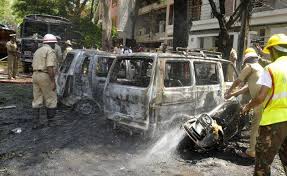
Venkatesh Prasanna arrests two more suspects in Malleswaram blast case

[email protected] (News Network)
March 23, 2016

Bengaluru, Mar 23: The Central Crime Branch police has arrested two persons on terror charges from Tamil Nadu in connection with the Malleswaram blast that took place on April 17, 2013.

blastA police team, headed by Assistant Commissioner of Police Venkatesh Prasanna, brought the accused — Syed Ali Ansar and Nasir Mustak Pasha, natives of Tiruvallur near Chennai — to the city.

A senior CCB police officer said the accused were arrested on the charges of having supplied explosives. The special team was sent to Chennai, based on a tip off. The accused were produced before a court and taken into police custody for seven days for interrogation.

Fourteen accused were arrested earlier by Tamil Nadu and Bengaluru police and the city police has filed a chargesheet on the case. Among them, Panna Ismail, Bilal Malik and Fukruddin were arrested by the Tamil Nadu police at Puttur, Andhra Pradesh. The chargesheet was submitted to the First Additional Chief Metropolitan Magistrate Court here in October 2013.

The chargesheet contained 7,445-pages of three volumes; 260 witnesses were examined and 201 documents collated.

Seventeen people, including 11 policemen and a college student, were injured when the blast occurred near the BJP's office in Malleswaram. The explosive was fixed to a motorcycle with ammonium nitrate while the motorcycle itself was used as a projectile to cause destruction.

Names of the accused in the chargesheet: Basheer (30), Kichan Buhari (38), Sait Azgar Ali ( 29), Rehamathulla, Valayil Hakeem (32), Syed Suleman (24), Suleman (31), Zulfikar Ali (24), Mohammed Salin (30), Panna Ismail (38), Bilal Malik (25), Fakruddin (38), Pravai Basha and Ali Khan Kutti.

Aslo Read: Mistaken as abductor, ACP Venkatesh Prasanna briefly detained by TN police

Comments

Naren kotian
 - 
Wednesday, 23 Mar 2016

please dont arrest , encounter these terrorists .. we cannot see india turning into another west bank , where migrant arabs settler creating terror in israel and now in belgium , few months back in paris . jai bharath mata ... hara hara modi ... hahaha

Mohammed SS
 - 
Wednesday, 23 Mar 2016

The same way they are arresting Muslim Boys by mistake on terror allegation, unfortunately there is no release their innocence reveled after many years of jail

Add new comment

  • Coastaldigest.com reserves the right to delete or block any comments.
  • Coastaldigset.com is not responsible for its readers’ comments.
  • Comments that are abusive, incendiary or irrelevant are strictly prohibited.
  • Please use a genuine email ID and provide your name to avoid reject.
News Network
March 24,2020

Bangalore , Mar 24: Bizom, India's leading retail intelligence platform, announced free subscription of its retailer app and tele-ordering solutions for consumer businesses in India and other emerging economies. Both solutions enable retailers to send their orders directly to the brand.
In COVID-19 times of social distancing and prophylactic measures, brands are conscious about the safety of their salespersons. Also, retailers don't want travelling salespeople to enter their premises. Consequently, many retail stores are facing stockout situations of fast-moving product categories. Bizom's self-ordering solutions help brands to avoid stockouts of their products.
Bizom trends, which analyses consumption and demand for consumer brands, showed how a near-complete shutdown during the Janta Curfew followed panic buying in early March. The asymmetrical demand and a lack of salespeople for order-taking are driving the industry towards social-distancing-based store-stocking mechanisms.
Bizom provides social-distancing-based store-stocking solutions for consumer businesses. They include the Bizom Retailer App and the Bizom Tele-ordering.
The Bizom Retailer App enables self-ordering for a brand's key retail outlets and can be implemented in under two weeks. The mobile app, a B2B shopping app, is a simple installation for retailers. It lists and groups the brand's products as per its product categories. The app's interface is no different from that of leading e-commerce apps. All the user has to do is select the preferred SKUs and add them to their shopping carts.
The app also allows brands to customize the app to meet the requirements of their continually changing product categories. For instance, if an SKU runs out of stock, the brand can disable the given SKU from the app.
With the Bizom Retailer App, brands can take orders directly from retailers instead of the traditional order-taking approach, which requires high-touch from a salesperson. Some of the key features of the app are, the ability to provide product information directly through retailers including SKUs, competitor comparison and pricing.
It also enables self-ordering from the retailer to maintain the flow of products as per demand, enables scheme rollout information through a notification on the app rather than through salespeople, tracks delivery of goods to the retailer and enables incentive payments to retailers directly rather than through distributor claims.
With Bizom Tele-ordering, as the sales teams go remote, the tele-ordering solution will become useful for brands who want to get salespeople to take orders from retailers, remotely. It ensures continued service to outlets despite not being physically present in the market.
Here, salespeople can discuss product requirements with retailers and enter orders based on specific outlet types (grocery, chemist etc.), outlet class (Class A, Class B etc.) or based on their beat or as per a distributor.
The key features of the Bizom Tele-ordering solution are, its ability to help salespeople collect orders from retailers remotely and enter it for fulfilment into Bizom using a tool, the flexibility offered to salespeople for remote servicing of retailers as per outlet type, beat, distributor area etc., secondary schemes get applied automatically, variable discounts will get applied as applicable at an SKU level.
"At Bizom, we are conscious of our responsibility to help brands run faster during these COVID-19 times. Our solutions of Bizom Retailer App and Bizom Tele-ordering have been built to ensure that brands can leverage this situation of low direct touch with retailers to enable a better way of working, remotely. I am trying to help brands go live in a few days so that they, in turn, can serve consumers better during these testing times," said Lalit Bhise, CEO, Bizom.

Comments

Add new comment

  • Coastaldigest.com reserves the right to delete or block any comments.
  • Coastaldigset.com is not responsible for its readers’ comments.
  • Comments that are abusive, incendiary or irrelevant are strictly prohibited.
  • Please use a genuine email ID and provide your name to avoid reject.
News Network
May 5,2020

Dubai, May 5: Tickets on repatriation flights from UAE to India, which start on May 7, could be costlier than regular airfare, and adding to the financial woes of those flying back. Nearly 200,000 Indians in the UAE have registered on the website seeking to return home.

“A one-way repatriation ticket to Delhi will cost approximately Dh1,400-Dh1,650 - this would earlier have cost between Dh600-Dh700 [during these months],” said Jamal Abdulnazar, CEO of Cozmo Travel. “A one-way repatriation flight ticket to Kerala would cost approximately Dh1,900-Dh2,300.”

This can be quite a burden, as a majority of those taking these flights have either lost their jobs or are sending back their families because of uncertainty on the work front. To now have to pay airfare that is nearly on par with those during peak summer months is quite a blow.

Sources said that officials in Indian diplomatic missions have already initiated calls to some expats, telling them about likely ticket fares and enquiring about their willingness to travel.

Although many believed repatriation would be government-sponsored, Indian authorities have clarified that customers would have to pay for the tickets themselves. Those who thought they were entitled to free repatriation might back out of travel plans for now.

Fact of life

But aviation and travel industry sources say higher rates cannot be escaped since social distancing norms have to be strictly enforced at all times. That would limit the number of passengers on each of these flights.

“One airline can carry only limited passengers - therefore, multiple airlines are likely to get the approval to operate repatriation flights,” said Abdulnazar. “Also, airports will have to maintain safe distance for passengers to queue up at immigration and security counters.

“Therefore, it is recommended that multiple carriers fly into multiple Indian airports for repatriation to be expedited.”

The Indian authorities, so far, have not taken the easy decision to get its private domestic airlines into the rescue act. Gulf News tried speaking to the leading players, but they declined to provide any official statements. So far, only Air India, the national airline, has been commissioned to operate the flights.

Air India finds itself in the driver's seat when it comes to operating India's repatriation flights. To date, there is no confirmation India's private airlines will be allowed to join in.

UAE carriers ready to help out

UAE’s Emirates airline, Etihad, flydubai and Air Arabia are likely to also operate repatriation flights to India after Air India implements the first phase of services.

“We are fully supporting governments and authorities across the flydubai network with their repatriation efforts, helping them to make arrangements for their citizens to return home,” said a flydubai spokesperson.

“We will announce repatriation flights as and when they are confirmed, recognising this is an evolving situation whilst the flight restrictions remain in place.”

An AirArabia spokesperson said the airline is ready to operate repatriation flights when the government tells them to.

Travel agencies likely to benefit

Apart from operating non-scheduled commercial flights, the Indian government is also deploying naval ships to bring expat Indians back. Sources claim the ships are to ferry passengers who cannot afford the repatriation airfares.

Even then, considering the sheer numbers who will want to get on the flights, travel agencies are likely to see a surge in bookings since airline websites alone may not cope with the demand set off in such a short span.

Learn from Gulf governments

In instances when they carried out their own repatriation flights, some GCC governments paid the ticket fares to fly in their citizens. Those citizens who did not have the ready funds could approach their diplomatic mission and aid would be given on a case-to-case basis.

Should Indians wait for normal services to resume?

Industry sources say that those Indians wanting to fly back and cannot afford the repatriation flights should wait for full services to resume once the COVID-19 pandemic settles.

But can those who lost their jobs or seen steep salary cuts stay on without adding to their costs? And is there any guarantee that when flight services resume, ticket rates would be lower than on the repatriation trips.

As such, normal travel is expected to pick up only after the repatriation exercise to several countries is completed. UAE-based travel agencies are not seeing any bookings for summer, which is traditionally the peak holiday season.

“Majority want to stay put unless full confidence is restored,” said Abdulnazar. “I expect full normalcy to be restored not until March 2021.

“People have also taken a hit to their income. Without disposable income, you will curtail your travel.”

What constitutes normalcy?

Airfares are expected to remain high, given the need to keep the middle seats empty to practise safe distance onboard.

“We expect holiday travel to resume by October or November - but, the travel sentiment will not go back to pre-COVID-19 levels anytime soon,” said Manvendra Roy, Vice-President – Commercial at holidayme, an online travel agency. “The need to keep the middle seat vacant will add 30-40 per cent pricing pressure per seat from an airline perspective.

“This will make holidays more expensive.”

As for business travel, it will take some time to recover. Corporate staff are now used to getting work done via conference calls. “Companies will also curtail their travel expenditure since their income has taken a hit,” said Abdulnazar.


Comments

Add new comment

  • Coastaldigest.com reserves the right to delete or block any comments.
  • Coastaldigset.com is not responsible for its readers’ comments.
  • Comments that are abusive, incendiary or irrelevant are strictly prohibited.
  • Please use a genuine email ID and provide your name to avoid reject.
News Network
April 28,2020

Bengaluru, Apr 28: A CRPF jawan has been arrested in Karnataka for allegedly defying the COVID-19 lockdown norms with the paramilitary force taking strong exception to his 'ill treatment', following which an inquiry has been ordered by the state police.

State DGP Praveen Sood has ordered inquiry into the incident, which has triggered a row after a video of it went viral.

In the clip, some police constables are purportedly seen hitting CRPF soldier Sachin Sawant with sticks in Belagavi.

According to the information shared on social media, Sawant was washing his bike when a police team reached the spot and started beating him up for not wearing a mask during the lockdown.

Taking a serious view of the 'ill-treatment' meted out to its Cobra Commando, the CRPF has written a letter to the Karnataka police demanding an investigation into the matter.

In a letter to the DGP of Karnataka, the additional Director general of police of CRPF Sanjay Arora said Sawant was cleaning his bike when a skirmish happened between him and the police over not wearing the mask.

Arora wrote, "Sawant was manhandled and ill-treated, before his family members and paraded to the police station barefoot, where he was kept in chains and handcuff.

From the scrutiny of a viral video on social media, it is apparent that the conduct of police personnel was not citizen centric."

The CRPF ADGP also said the 'unpleasant' situation could have been avoided if the Karnataka police had taken CRPF hierarchy into confidence before making the arrest.

In response, Sood ordered an inquiry into the matter.

He tweeted that IGP Belagavi has been asked to conduct a probe into the incident involving CRPF constable. Action will be taken against guilty after receipt of report, he said.

According to sources, Home Minister Basavaraj Bommai has directed the state police chief to conduct a detailed inquiry into the incident.

Denouncing the arrest, Karnataka Irrigation Minister Ramesh Jarkiholi has sought the release of the CRPF jawan.

"It was wrong on the part of the constables to ill treat CRPF jawan and an inquiry be conducted against the erring policemen," said jarkiholi in a press release.

However, Superintendent of Police of Belagavi district, Laxman Nimbargi defended the arrest of Sawant.

Comments

Add new comment

  • Coastaldigest.com reserves the right to delete or block any comments.
  • Coastaldigset.com is not responsible for its readers’ comments.
  • Comments that are abusive, incendiary or irrelevant are strictly prohibited.
  • Please use a genuine email ID and provide your name to avoid reject.