


Venkatesh Prasanna arrests two more suspects in Malleswaram blast case

[email protected] (News Network)
March 23, 2016

Bengaluru, Mar 23: The Central Crime Branch police has arrested two persons on terror charges from Tamil Nadu in connection with the Malleswaram blast that took place on April 17, 2013.
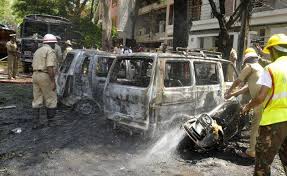
blastA police team, headed by Assistant Commissioner of Police Venkatesh Prasanna, brought the accused — Syed Ali Ansar and Nasir Mustak Pasha, natives of Tiruvallur near Chennai — to the city.

A senior CCB police officer said the accused were arrested on the charges of having supplied explosives. The special team was sent to Chennai, based on a tip off. The accused were produced before a court and taken into police custody for seven days for interrogation.

Fourteen accused were arrested earlier by Tamil Nadu and Bengaluru police and the city police has filed a chargesheet on the case. Among them, Panna Ismail, Bilal Malik and Fukruddin were arrested by the Tamil Nadu police at Puttur, Andhra Pradesh. The chargesheet was submitted to the First Additional Chief Metropolitan Magistrate Court here in October 2013.

The chargesheet contained 7,445-pages of three volumes; 260 witnesses were examined and 201 documents collated.

Seventeen people, including 11 policemen and a college student, were injured when the blast occurred near the BJP's office in Malleswaram. The explosive was fixed to a motorcycle with ammonium nitrate while the motorcycle itself was used as a projectile to cause destruction.

Names of the accused in the chargesheet: Basheer (30), Kichan Buhari (38), Sait Azgar Ali ( 29), Rehamathulla, Valayil Hakeem (32), Syed Suleman (24), Suleman (31), Zulfikar Ali (24), Mohammed Salin (30), Panna Ismail (38), Bilal Malik (25), Fakruddin (38), Pravai Basha and Ali Khan Kutti.

Aslo Read: Mistaken as abductor, ACP Venkatesh Prasanna briefly detained by TN police

Comments

Naren kotian
 - 
Wednesday, 23 Mar 2016

please dont arrest , encounter these terrorists .. we cannot see india turning into another west bank , where migrant arabs settler creating terror in israel and now in belgium , few months back in paris . jai bharath mata ... hara hara modi ... hahaha

Mohammed SS
 - 
Wednesday, 23 Mar 2016

The same way they are arresting Muslim Boys by mistake on terror allegation, unfortunately there is no release their innocence reveled after many years of jail

Add new comment

  • Coastaldigest.com reserves the right to delete or block any comments.
  • Coastaldigset.com is not responsible for its readers’ comments.
  • Comments that are abusive, incendiary or irrelevant are strictly prohibited.
  • Please use a genuine email ID and provide your name to avoid reject.
News Network
March 28,2020

Bengaluru, Mar 28: Sun Tsu, in 'The Art of War' speaks of a skilful general who can subdue his enemy without any fighting. This constitutes the ultimate triumph which is referred to as stratagem. Today, we would need one such when we are faced with the '21-day corona challenge' for India.
Nearly four weeks back, Dr Jyothsna Rao, Dr Gururaj Rao and I sat across the OPD in the afternoon at HCG Bengaluru discussing our ongoing cancer immunology research. While on this topic, we drifted into the discussion on the coronavirus. During this engaging discussion, we wondered the similarity of the enigma between the virus and cancer. I paused to ask Dr Jyothsna and Dr Guru - how we wish we could do something against this virus.
Dr Jyothsna is a PhD from NCBS and had worked under Dr Ralph Steinman, physician and researcher from Rockefeller University, who won the Nobel Prize for his discovery of the dendritic cell and its role in adaptive immunity in 2011. Dr Gururaj is a molecular and cell biologist who did his PhD at the Chapel Hill, University of North Carolina and is the Director of iCrest.
Jyothsna while hearing our perplexing conversation on the covid intervened, "Yes, surely. I think we should take a break from cancer and focus on the innate and adaptive immunity role in COVID-19."
Thus began this sincere attempt to relook the human immune system from the eyes of the COVID-19.
We have 10 types of immune cells at the least which are widely dispersed in millions across the body. When our body is invaded by a foreign organism (bacteria, fungi or virus), these cells work with each other to destroy the invader.
Now, the question is - how do the immune cells talk to each other? They use small-molecule substances called cytokines (cyto means cells; kine means movement). There are many cytokines that are involved in work on the immune system. The most relevant for viruses are interferons.
Interferons (IFN) as the name reflects have an ability to interfere with the viral activity and stop their multiplication. These specialised signal proteins are released by our cells in response to a viral attack to forewarn other cells. They help build the antiviral proteins within the cells to kill the virus as it tries to invade the new cells.
Historically, interferons are a group of cytokines known to be potent antiviral agents against viruses and a hallmark cytokine induced by the host upon viral infections. Interferons possess unique immunoregulatory activities and are signature cytokines released by (TH1) T immune cells, which are crucial in viral infections.
As the outbreak of COVID-19 grapples us, an urgent need for finding strategies to combat the virus is growing. Coronaviruses (CoVs) are a group of RNA viruses. In patients infected with coronavirus, it was indicated that the activation of the IFN does not occur until 48 hours post-infection. Thus the delayed IFN-related antiviral response by the healthy cells leads to coronavirus evade the immune response.
Numerous studies have presented the success in defeating CoVs by the direct administration of IFNs. In a combination as a concoction, it was shown to synergistically inhibit the virus replication in vitro.
Moreover, it is understood that the earlier induction of IFNs in children although they have a less developed immune system could be the reason behind the children being least affected.
The key to success in reducing the disease fatality might be the stimulation of the immune responses to trigger IFN production at the very early stages of the disease, which might be done through the administration of IFN. Despite the evidence for the efficacy of IFNs in treating CoV-induced infections, the proper dosing and ideal timing for such interventions needs to be verified in clinical trials.
For the later stages of the diseases in advance stages where patients are on ventilator and have developed respiratory distress, we propose to utilise the mesenchymal cells derived from donor bone marrow that have been known to treat acute respiratory syndrome. Mesenchymal cells are known to possess anti-inflammatory activity and thus used often in autoimmune diseases.
With this scientific background, we have activated T cells from healthy donors, in a cGMP facility at iCrest - HCG hospital with an enriched cocktail of cytokines rich in Interferons. Injections of this cocktail we believe will result in a surge of cytokines in the body of the infected person and will boost his ability to fight the virus in the early phases. We are in the initial phases of this study and hope to be ready in the coming weeks with meaningful data on its potential utility.
Currently, it awaits government approvals (Union and state) and we have applied to central drugs authority for their initial evaluation and further directions.
As my Guru often expounded the philosophy of 'Seva' - the goal of education is knowledge, the end goal of knowledge is service. In this attempt to serve our fellow humans at this brink of unprecedented crisis, medical fraternity stands with you and promises to do our best for your safety.
We assure to exhaust every bit of our spirit in this fight against coronavirus. We have lost the sight of shores and travelled thus far, but that is the mandatory first step to cross the ocean. Are we going to succeed in this battle, is something only time will answer. 

Comments

Add new comment

  • Coastaldigest.com reserves the right to delete or block any comments.
  • Coastaldigset.com is not responsible for its readers’ comments.
  • Comments that are abusive, incendiary or irrelevant are strictly prohibited.
  • Please use a genuine email ID and provide your name to avoid reject.
News Network
January 20,2020

Mangaluru, Jan 20: A teenage girl drowned after a boat in which she was traveling in capsized in the river Netravati at Uliya Hoige, Ullal, police said on Monday.

Meanwhile, four other girls who were also traveling on the same boat were rescued by the locals, the police added. The mishap happened on Sunday.

The deceased has been identified as 18-year-old Renita, a resident of Miyapadavu.

Comments

Add new comment

  • Coastaldigest.com reserves the right to delete or block any comments.
  • Coastaldigset.com is not responsible for its readers’ comments.
  • Comments that are abusive, incendiary or irrelevant are strictly prohibited.
  • Please use a genuine email ID and provide your name to avoid reject.
News Network
February 29,2020

Bengaluru, Feb 28: Bengaluru Police Commissioner Bhaskar Rao on Friday said that Section 144 will be imposed near Vidhana Soudha for Budget session starting from March 2.

"Section 144 of the CrPC (prohibits assembly of more than 4 people in an area) will be imposed in the area around Vidhana Soudha from March 2 to March 31 ahead of the Budget session,"Bhaskar Rao said.

The police said that they have intelligence inputs of protests near Vidhana Soudha.

Comments

Add new comment

  • Coastaldigest.com reserves the right to delete or block any comments.
  • Coastaldigset.com is not responsible for its readers’ comments.
  • Comments that are abusive, incendiary or irrelevant are strictly prohibited.
  • Please use a genuine email ID and provide your name to avoid reject.