VHP Dharma Sabha in Ayodhya | We want entire land for temple, says Champat Rai

Agencies
November 25, 2018

Ayodhya, Nov 25: VHP’s ‘dharma Sabha” commenced in the temple town Sunday afternoon with senior leader Champat Rai declaring that no formula dividing the disputed land will be acceptable for temple construction.

Addressing the sabha after the inauguration marked by chanting of mantras and lighting of lamp, the international general secretary Champat Rai said “We want the entire land for temple construction...no formula dividing the land is acceptable.”

Though Mr. Rai did not spell out the details, his assertions are considered to be in reference to the Allahabad High court verdict dividing the land into three parts.

The Allahabad High Court had ruled by a majority verdict that the disputed land in Ayodhya be divided equally into three parts among Hindus and Muslims and that the place where the makeshift temple of Lord Ram exists belongs to Hindus.

In their separate judgements on the sensitive 60-year old title dispute on Ramjanambhoomi-Babri Masjid structure, Justices S U Khan and Sudhir Agarwal said that the area under the central dome of the three-domed structure where Lord Ram’s idol exists belongs to Hindus. Mr. Rai also said that the delay in the temple construction is not a good sign.

The dharma sabha site wore a festive look with placards, saffron flags and buntings with the head gear of enthusiastic Ram bhakts all over.

The VHP which has claimed that 3 lakh people will be participating in the sabha has made elaborate arrangements including for food and medical facilities.

While hoardings of VHP stalwart late Ashok Singhal were set up at various places, devotees were seen blowing conch shells to express their enthusiasm for the dharma Sabha.

Comments

Mohammed
 - 
Sunday, 25 Nov 2018

Nice to see Nange Punge Bhikaries

Ganga SS
 - 
Sunday, 25 Nov 2018

Also construct a big Bar and Restaurent beside the temple 

Add new comment

  • Coastaldigest.com reserves the right to delete or block any comments.
  • Coastaldigset.com is not responsible for its readers’ comments.
  • Comments that are abusive, incendiary or irrelevant are strictly prohibited.
  • Please use a genuine email ID and provide your name to avoid reject.
News Network
June 25,2020

India has jumped past 4.5 lakh coronavirus cases and 14,476 people have succumbed to the viral infection so far. In this backdrop, speaking to IANS in an exclusive interview, AIIMS Director Randeep Guleria said India is also vulnerable to second wave of coronavirus and people should continue to follow social distancing, wearing mask and other precautions, after cases begin to decline.

He added that in order to contain the outbreak of Covid-19, a limited lockdown in hotspots, where volume of cases is very high, may be considered along with a micro-plan to prevent leakage of cases from these areas to other non-containment areas. Excerpts of the interview are below:

Q: Reports say China and South Korea are witnessing a second wave of coronavirus infection, what is this second wave, is India also vulnerable to this?

A: When cases come down significantly, people tend to drop their guard against the viral infection, and this leads to the second wave (which means a sudden increase in the number of cases). After cases begin to decline, people should continue to follow the precautions -- continue to maintain social distancing and wear masks regularly. See what happened in Singapore, it was struck by a second wave of coronavirus. Look, what happened in the 1918 pandemic, people dropped their guard and the second wave of viral infection struck back. If people do not follow social distancing then the spike in cases is apparent. We need to take these precautions at least for one year. India is also vulnerable to this second wave.

Q: If Covid-19 cases continue to rise rapidly, do you think we need another lockdown in areas where volume of cases are very high?

A: A large volume of cases is concentrated in specific areas like hotspots, and in order to maintain things in order, we may need a limited lockdown in these areas. This should be followed by a micro-plan which entails extensive testing of people and also extensive contact tracing of people who have got in touch with positive people. Need to ensure there is no leakage of cases from these areas. People from these areas should not mix with others in non-containment areas. This will aid in containing the outbreak of the virus. People who have developed symptoms should get themselves tested, especially in the containment areas.

Q: With more than 4.5 lakh cases and close to 14,500 deaths, do you think India has reached its peak and a decline in cases is prominent?

A: The cases will continue to increase for some time. The doubling time of cases has also increased. But, the cases will also begin to flatten. Though, it is difficult to give an exact time period in this viral infection, it seems, the growth in cases will flatten in the end of July or beginning of August. A decline will come to this viral infection, but it does not mean that people should drop their guard. As a measure, we need to decrease community participation and citizens should continue to follow social distancing. People should get themselves tested. All these efforts will help in preventing people from contracting this virus. These precautions will also prevent us from the second wave, and we must continue to take precautions. The virus has not gone away, it is still lurking.

Q: India has crossed the 4.5 lakh coronavirus cases so far, although our recovery rate is good, but still 10,000 to 15,000 cases are reported daily. Why do cases continue to spiral, what is the reason?

A: We have to remember a few things -- the bulk of cases are in 10 cities, nearly 70 per cent, and if we take into account cases per million population, the number is not very high, as compared with countries including countries in Europe. Many European countries put together still do not add up to the Indian population. Do not compare India to countries like Italy, Spain etc. We need to focus on hotspots, which contribute to between 70 -80 per cent of cases, and we have to identify cases in these areas at an early stage. The population density is very high in these cities. People in lower socio-economic status are highly vulnerable to the viral infection, as many live together in small spaces and there is a lot of mixing of people happening there. Look at the market places, people are not following social distancing and not wearing masks. In fact, many are in close vicinity of each other.


Comments

Add new comment

  • Coastaldigest.com reserves the right to delete or block any comments.
  • Coastaldigset.com is not responsible for its readers’ comments.
  • Comments that are abusive, incendiary or irrelevant are strictly prohibited.
  • Please use a genuine email ID and provide your name to avoid reject.
News Network
February 1,2020

Feb 1: The Congress on Saturday expressed hope that the Union Budget would provide relief to the salaried class through tax cuts and invest in rural India besides providing a healing touch to the common man and industry facing “hardship” since demonetisation.

Congress chief spokesperson Randeep Surjewala said the last budget led to crashing consumption levels, soaring unemployment and falling GDP. “Budget 2019= Consumption crashed, Unemployment soared, Farm distress surged, Incomes declined, Investments slumped, Public spending fell, GDP nose dived!,” Surjewala tweeted. “Yet, Modiji gave Corporate Tax Cuts of Rs 1,45,000 crore. Let Budget 2020 give tax cuts to Salaried Class and invest in Rural India,” he said

Rajasthan Chief Minister Ashok Gehlot hoped the budget fulfils expectations of the common people. “Budget 2020 is the time for NDA government to provide a healing touch to common people and industries facing hardships since noteban. Hope the budget fulfils expectations of common people and provide relief across sections,” Gehlot said.

Comments

Add new comment

  • Coastaldigest.com reserves the right to delete or block any comments.
  • Coastaldigset.com is not responsible for its readers’ comments.
  • Comments that are abusive, incendiary or irrelevant are strictly prohibited.
  • Please use a genuine email ID and provide your name to avoid reject.
Agencies
August 9,2020

Pathanamthitta, Aug 9 : An orange alert has been issued in Kerala's Pathanamthitta district as the water level in Pamba dam is now flowing at 983.05 metres and it is likely to reach 983.50 metres within an hour.

A red alert will be declared at 984.5 metres and dam will open when the water level reaches 985 metres.

"The water level in Pamba dam is 983.05 metres now and is likely to reach 983.50 metres within an hour. So, the second alert- orange alert has been issued. A red alert will be declared at 984.5 metres and dam will open when it reaches 985 metres," said Pathanamthitta District Collector.

Meanwhile, a portion of the Shiva Temple in Aluva continues to remain submerged. However, the water level in the Periyar River is receding gradually and more part of the temple is above the water level now. 

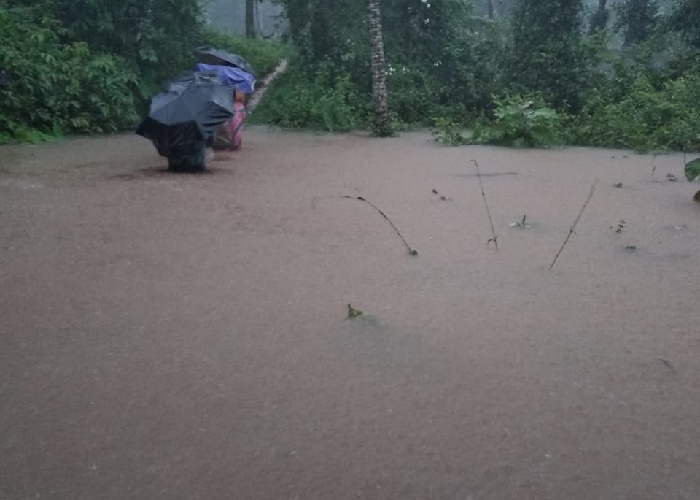
As Kerala has been receiving heavy rain for the past few days, severe waterlogging affects traffic movement at Mannuthy bypass in Thrissur on Saturday.

On Friday, the India Meteorological Department (IMD) had issued a red alert in Kozhikode district. It had also predicted rainfall in different parts of the state.

Due to heavy downpour, a massive landslide had occurred in Idukki district recently. The death toll in Idukki landslide has risen to 26, Kerala Chief Minister Pinarayi Vijayan said on Saturday.

The Chief Minister said that monsoon fury continues to be severe in the state.

Comments

Add new comment

  • Coastaldigest.com reserves the right to delete or block any comments.
  • Coastaldigset.com is not responsible for its readers’ comments.
  • Comments that are abusive, incendiary or irrelevant are strictly prohibited.
  • Please use a genuine email ID and provide your name to avoid reject.