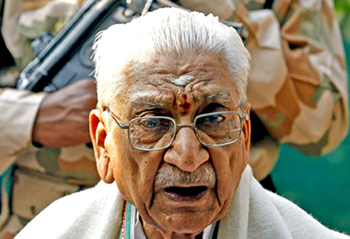
VHP leader Ashok Singhal dies at 89

November 17, 2015

VHPNew Delhi, Nov 17: Ashok Singhal, the 89-year-old patron of the Vishwa Hindu Parishad, died in a hospital at Gurgaon today. He was admitted in Medanta Hospital on November 13 following a prolonged illness.

Singhal was suffering from respiratory problems for over a month now. He was earlier admitted to Medanta on October 20 after his condition deteriorated in Allahabad and was flown in to the National Capital in an air ambulance.

Keeping in view Singhal’s failing health, the VHP had cancelled its 18-day Chaturved Swahakar Yajna that was slated to start at Delhi’s Birla Mandir from November 16, as well as its Diwali Milan programme.

Comments

Add new comment

  • Coastaldigest.com reserves the right to delete or block any comments.
  • Coastaldigset.com is not responsible for its readers’ comments.
  • Comments that are abusive, incendiary or irrelevant are strictly prohibited.
  • Please use a genuine email ID and provide your name to avoid reject.
News Network
May 9,2020

New Delhi, May 9: The Finance Ministry on Friday announced relief to those who have been facing difficulty with their residency status in India under section 6 of the Income-tax Act due to lockdown and suspension of international flights owing to COIVD-19 outbreak, as they have had to prolong their stay in India.

According to a Central Board of Direct Taxes (CBDT) release, Finance Minister Nirmala Sitharaman today allowed discounting of prolonged stay period in India for the purpose of determining residency status after considering various representations received from people who had to prolong their stay in India due to lockdown and suspension of international flights.

They expressed concern that they will be required to file tax returns as Indian residents and not as NRIs after 120 days of stay.

The Finance Ministry stated that the lockdown continues during the financial year 2020-21 and it is not yet clear when international flight operations would resume, a circular excluding the period of stay of these individuals up to the date of resumption of international flight operations shall be issued for determination of the residential status for the financial year 2020-21.

A circular also said that in order to avoid genuine hardship in such cases, the CBDT has decided that for the purposes of determining the residential status under section 6 of the Act during the previous year 2019-20 in respect of an individual who has come to India on a visit before March 22, 2020 and:

(a) has been unable to leave India on or before March 31, 2020, his period of stay in India from March 22, 2020 to March 31, 2020 shall not be taken into account; or

(b) has been quarantined in India on account of novel coronavirus (Covid-19) on or after March 1, 2020 and has departed on an evacuation flight on or before March 31, 2020 or has been unable to leave India on or before March 31, 2020, his period of stay from the beginning of his quarantine to his date of departure or March 31, 2020, as the case may be, shall not be taken into account; or

(c) has departed on an evacuation flight on or before March 31, 2020, his period of stay in India from March 22, 2020 to his date of departure shall not be taken into account."

The release said there are number of individuals who had come on a visit to India during the previous year 2019-20 for a particular duration and intended to leave India before the end of the previous year for maintaining their status as non-resident or not ordinary resident in India.

"However, due to declaration of the lockdown and suspension of international flights owing to outbreak of COVID-19, they are required to prolong their stay in India. The status of an individual whether he is resident in India or a non-resident or not ordinarily resident, is dependent, inter-alia, on the period for which the person is in India during a year," it said.

Comments

Add new comment

  • Coastaldigest.com reserves the right to delete or block any comments.
  • Coastaldigset.com is not responsible for its readers’ comments.
  • Comments that are abusive, incendiary or irrelevant are strictly prohibited.
  • Please use a genuine email ID and provide your name to avoid reject.
coastaldigest.com news network
July 26,2020

Bengaluru, Jul 26: The government of Karnataka has urged the Muslims to celebrate Eid al-Adha in a simple manner and follow all guidelines amid mounting cases of covid-19.

The festival, also known as Bakrid, will be celebrated on July 31 in coastal districts of Karnataka and on August 1 in other parts of Karnataka. 

In an order, A B Ibrahim, secretary of the department of minority welfare, Hajj and Waqf has prohibited offering Eid prayers in open grounds (Eidgahs) in the wake of pandemic.

Eid prayers can be offered in mosques by following all the necessary precautionary measures including maintaining physical distance. The congregation should not exceed 50 worshippers. If they number exceeds, they should be divided into three groups. 

However, except for mosques, no other places should be used for offering congregational prayer. 

Besides, all those who attend Eid prayers at mosque should compulsorily wear face masks. Entry is banned for people who are above the age of 60 years and below the age of 10. At least six feet distance needs to be maintained while offering prayer.

Thermal scanning needs to be done before entering the mosque. Hands need to be washed in soap or sanitizer. No one should touch the holy books in the mosque. Hand shaking and embracing to greet will also not be allowed. If any strangers are seen, their movement should be monitored.

Comments

Add new comment

  • Coastaldigest.com reserves the right to delete or block any comments.
  • Coastaldigset.com is not responsible for its readers’ comments.
  • Comments that are abusive, incendiary or irrelevant are strictly prohibited.
  • Please use a genuine email ID and provide your name to avoid reject.
News Network
February 23,2020

The euphoria over the claim that around 3,000 tonnes of gold reserves, worth Rs 12 trillion, have been discovered in Uttar Pradesh’s Sonbhadra district could not last even 24 hours, with the Geological Survey of India (GSI) clarifying on Saturday there had been no such discovery.

The GSI, headquartered in Kolkata, rebutted the claims of the Uttar Pradesh Directorate of Geology and Mining (UPDGM), and said “miscommunication” must have led to the wrong reporting of facts.

M Sridhar, director general of the GSI, said nobody in the agency gave any such data. He said 52,806 tonnes of gold ore was found in Sonbhadra district during the exploration work in 1998-2000. From this reserve, only 160 kg of gold can be extracted.

“There must have been some miscommunication of facts because of which the gold ore deposits have been overestimated. We have written a letter to Uttar Pradesh (UPDGM), stating the facts. The GSI has not estimated such kind of vast resource of gold deposits in Sonbhadra,” Sridhar said.

ALSO READ: 2,900-tonne gold mine found in Sonbhadra, 4 times that of India's reserves

The UPDGM had said on Friday that gold deposits were found in Son Pahadi and Hardi areas of the district. Sridhar said while gold ore was found in the area during the GSI’s exploration work in 1998-2000, it had told the state government about the discovery in November last year.

Under the new regulation, which came into effect from 2015, the GSI has to inform the state government when ore deposits are discovered. Earlier, no such action was mandatory. In its report, the GSI estimated that only 3.03 gm of gold can be extracted from a tonne of ore. It also clarified that even the extraction amount was tentative and could not be established for certain.

Moreover, Sridhar said the deposits were spread across only 0.5 sq km in forest land, which made the mining of ore economically unviable. “When there are several mines nearby, we can club it into a block and then it makes sense to mine the ore. But in this case, the deposits are too small to make it viable for any company to mine it,” he said. The GSI usually prioritises its exploration work based on the needs of the Centre. While strategic minerals like tin, cobalt, lithium, beryllium, germanium, gallium, indium, tantalum, niobium, selenium, and bismuth are atop the list in GSI exploration, gold is another commodity on its priority list.

According to the World Gold Council, India has reserves of 630 tonnes of gold.

Comments

Add new comment

  • Coastaldigest.com reserves the right to delete or block any comments.
  • Coastaldigset.com is not responsible for its readers’ comments.
  • Comments that are abusive, incendiary or irrelevant are strictly prohibited.
  • Please use a genuine email ID and provide your name to avoid reject.