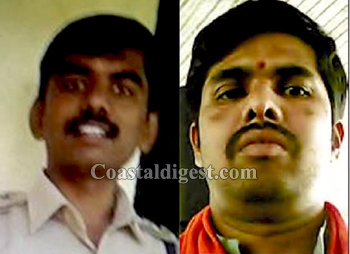
VHP?leader named in DySP suicide case to be booked under Goonda Act

[email protected] (News Network)
July 14, 2016

VHP

Bengaluru, Jul 14: Vishwa Hindu Parishat (VHP) leader and alleged kidnapper Praveen Khandya, who is a prime suspect in the suicide of Chikkamagalur Deputy Superintendent of Police (DySP) Kallappa Handibag will be booked under the Goonda Act.

Chief Minister Siddaramaiah told Legislative Assembly that as many as 32 different cases are pending against Khandya, one of the five suspects in the case.

“The government now has sufficient evidence to book him under the Goonda Act (the Karnataka Prevention of Dangerous Activities of Bootleggers, Drug-Offenders, Gamblers, Goondas, Immoral Traffic Offenders, Slum-Grabbers and Video or Audio Pirates Act),” he said.

“Death of Kallappa is unfortunate. It is not proper to compare Kallappa's suicide case with that of the other DySP M?K?Ganapathi. The government will not shield anybody.

The CID is already investigating the case. Based on the CID?report, appropriate action will be taken against all those involved, he added. Siddaramaiah assured the Opposition that the government will examine the possibility of offering a job on compassionate grounds to Kallappa's wife. But there is no provision to give compensation to the kin of officers who commit suicide, he pointed out.

Comments

Rajesh Sequira
 - 
Thursday, 14 Jul 2016

Save our country from this breed of terrorists.

True commentator
 - 
Thursday, 14 Jul 2016

below are the qualification to become a leader of VHP

- Bootlegger, drug offending, Gambling, Goondaism, Immoral traffic offending, Slum grabbing etc., etc.,.....

Then what about its followers.

Add new comment

  • Coastaldigest.com reserves the right to delete or block any comments.
  • Coastaldigset.com is not responsible for its readers’ comments.
  • Comments that are abusive, incendiary or irrelevant are strictly prohibited.
  • Please use a genuine email ID and provide your name to avoid reject.
Agencies
May 8,2020

Washington D.C., May 8: The prime time for brain development in a child's life is the first year, where the infant spends most of the time asleep. It is the time when neural connections form and sensory memories are encoded.

However, when sleep is disrupted, as occurs more often among children with autism, brain development may be affected, too.

New research led by the University of Washington finds that sleep problems in a baby's first 12 months may not only precede an autism diagnosis but also may be associated with altered growth trajectory in a key part of the brain, the hippocampus.

The study, which was published in the American Journal of Psychiatry, researchers report that in a sample of more than 400 taken of 6- to 12-month-old infants, those who were later diagnosed with autism were more likely to have had difficulty falling asleep.

It also states that this sleep difficulty was associated with altered growth trajectories in the hippocampus.

"The hippocampus is critical for learning and memory, and changes in the size of the hippocampus have been associated with poor sleep in adults and older children.

As many as 80 per cent of the children with autism spectrum disorder have sleep problems," said Annette Estes, director of the UW Autism Center and senior author of the study.

"In our clinical experience, parents have a lot of concerns about their children's sleep, and in our work on early autism intervention, we observed that sleep problems were holding children and families back," added Estes, who is also a UW professor of speech and hearing sciences.

"It could be that altered sleep is part-and-parcel of autism for some children. One clue is that behavioural interventions to improve sleep don't work for all children with autism, even when their parents are doing everything just right. This suggests that there may be a biological component to sleep problems for some children with autism," said Estes.

To consider links among sleep, brain development, and autism, researchers at the IBIS Network looked at MRI scans of 432 infants, surveyed parents about sleep patterns, and measured cognitive functioning using a standardized assessment.

At the outset of the study, infants were classified according to their risk for developing autism: Those who were at higher risk of developing autism -- about two-thirds of the study sample -- had an older sibling who had already been diagnosed.

Infant siblings of children with autism have a 20 per cent chance of developing autism spectrum disorder -- a much higher risk than children in the general population.

In the current study, 127 of the 432 infants were identified as "low risk" at the time the MRI scans were taken because they had no family history of autism.

They later evaluated all the participants at 24 months of age to determine whether they had developed autism. Of the roughly 300 children originally considered "high familial risk," 71 were diagnosed with autism spectrum disorder at that age.

Problems with sleep were more common among the infants later diagnosed with an autism spectrum disorder, as were larger hippocampi. No other subcortical brain structures were affected, including the amygdala, which is responsible for certain emotions and aspects of memory, or the thalamus, a signal transmitter from the spinal cord to the cerebral cortex.

The authors note that while parents reported more sleep difficulties among infants who developed autism compared to those who did not, the differences were very subtle and only observed when looking at group averages across hundreds of infants.

Sleep patterns in the first years of life change rapidly as infants transition from sleeping around the clock to a more adult-like sleep/wake cycle. Until further research is completed, Estes said, it is not possible to interpret challenges with sleep as an early sign of increased risk for autism.


Comments

Add new comment

  • Coastaldigest.com reserves the right to delete or block any comments.
  • Coastaldigset.com is not responsible for its readers’ comments.
  • Comments that are abusive, incendiary or irrelevant are strictly prohibited.
  • Please use a genuine email ID and provide your name to avoid reject.
News Network
June 2,2020

Bengaluru, Jun 2: Karnataka Chief Minister B S Yediyurappa on Monday claimed 70 per cent of the people of the country want Narendra Modi to not only complete the current term, but also want him as the Prime Minister for the next term.

He also called PM Modi "iron leader" for scrapping Article 370 that terminated special status to Jammu and Kashmir.

"70 per cent of the people of this nation want Narendra Modiji not only to complete this term, but also want him as the Prime Minister for the next term, so that he can find solution to the problems faced by this country. This is the aspiration of the young India," he said.

Mr Yediyurappa said PM Modi has successfully completed one year of the second term and the country is surging ahead in the path of progress under his "exceptional and far-sighted leadership."

"The Prime Minister is leading the country forward towards development with his Sab Ka Saath, Sab Ka Vikas, Sab Ka Vishwas principle and inclusive schemes," he said, adding that PM Modi is spearheading the cause of building a "strong and self-reliant Bharath."

Speaking to reporters in the backdrop of the one year of the Modi government''s second term in office, the chief minister said Modi is recognised as an exceptional leader not only in India, but also at the global level, through his mantra - Vasudaiva Kutumbakam.

Mr Yediyurappa termed the PM "iron leader" for scrapping Article 370 that terminated special status to Jammu and Kashmir, and formation of Jammu- Kashmir and Ladakh as Union Territories.

He listed the key decisions of the BJP-led central government such as banning the practice of triple talaq among Muslims, the Vande Bharath Mission, the Citizenship Amendment Act, one country-one ration card scheme, new Motor Vehicle Act, besides also "finding solution to Ram Mandir issue" , among others.

Mr Yediyurappa said PM Modi's decision has played a decisive role in dealing with the COVID-19 situation in India. He has competently handled a huge challenge of combating the coronavirus in a country with a population of 130 crore.

"He implemented the most stringent lockdown restrictions in the world to control the spread of COVID-19 and achieved remarkable success," he said, and lauded the Rs 20 lakh crore package that has been announced to revive the economy amid the pandemic.

"Modiji also supported the State during the devastating floods last year.....the state government is determined to develop Karnataka deriving inspiration from our Prime Minister''s efficiency."

Comments

Add new comment

  • Coastaldigest.com reserves the right to delete or block any comments.
  • Coastaldigset.com is not responsible for its readers’ comments.
  • Comments that are abusive, incendiary or irrelevant are strictly prohibited.
  • Please use a genuine email ID and provide your name to avoid reject.
coastaldigest.com news network
May 29,2020

Mangaluru, May 29: Several non-resident Kannadigas from various Gulf countries including Kingdom of Saudi Arabia on Thursday, May 28, interacted with Dakshina Kannada MP Nalin Kumar Kateel through a video conference and urged him to allow the Kannadigas stranded in the Middle East to return by facilitating the operation of repatriation flights.

The development comes amidst reports that lack of preparedness on parts of the local authorities in Karnataka compelling the Centre to delay the operation of flights from Middle East to Mangaluru and Bengaluru airports.

“We have never forgotten you. We will take necessary steps for your safe return to the homeland as soon as possible,” assured Mr Kateel after paying heed to the complaints of non-resident Kannadigas.

The video conference was organised by Ravi Shetty, ex president of Kannada Sangha Qatar.

Praveen Kumar Shetty, president, Karnataka NRI Forum of UAE, Sarvottam Shetty of UAE Karnataka Sangha, Avikshit Rai, Ravi Shetty, former president of Qatar Kannada Sangha, Santosh Shetty of Riyadh Karnataka NRI Forum, Zakariya Jokatte, president of Dammam Karnataka NRI Forum, Mohammad Mansoor, president of Bahrain Indian Overseas Congress, NS Shetty Kuwait, Pradeep Shetty of Kannada Sangha Bahrain, Karunakar Rao, Shashidhar Shetty Oman, Rajesh of Kuwait Kannada Sangha, Ramesh Bhandari, M E Muloor and Sunil Kulkarni among others participated in the video conference.

Comments

Add new comment

  • Coastaldigest.com reserves the right to delete or block any comments.
  • Coastaldigset.com is not responsible for its readers’ comments.
  • Comments that are abusive, incendiary or irrelevant are strictly prohibited.
  • Please use a genuine email ID and provide your name to avoid reject.