Vikas College brings out handbook for Class 10 students to ‘Score More’

[email protected] (CD Network, Photos by Suresh)
January 17, 2015

Mangaluru, Jan 17: In view of the recent revision in the SSLC syllabus textbooks from the state syllabus to that recommended by National Council of Educational Research and Training (NCERT) for Class 10 students, academic staff of Vikas P U College, Mangaluru have jointly compiled a handbook to help the students prepare well for their final board examinations.

The handbook ‘Score More’ is a compilation of all chapters from the four core subjects – Physics, Chemistry, Biology and Mathematics in textbooks of Class 10.

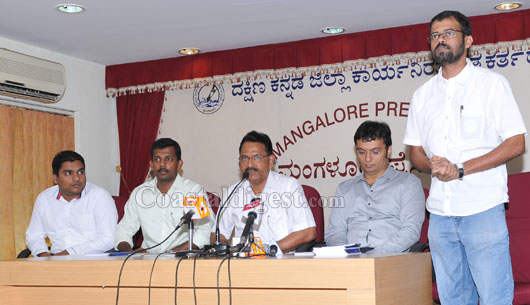
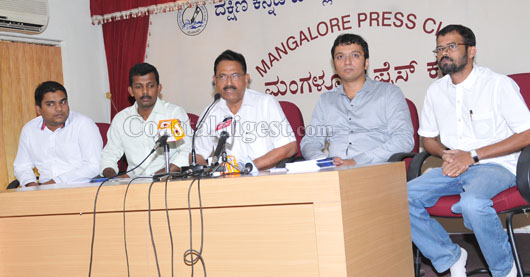
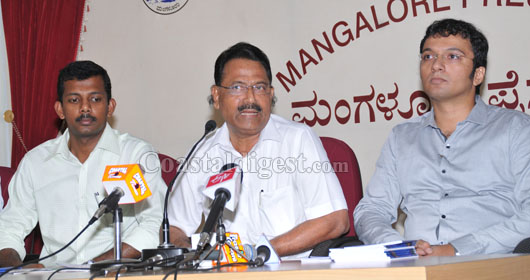
Releasing the book at a press conference here on Saturday, Chairman of Vikas Education Trust and former minister Krishna Palemar said that the book aimed at reducing the stress caused among students due to the sudden change in syllabus in textbooks prepared for Class 10. This handbook is prepared with the important sections of chapters in a capsule format and makes studying simpler for students during their preparation for board exams, he said.

He said that the compiled book would be distributed free of cost at the campus premises for SSLC students. A total of 10,000 copies have been printed in the first phase, which will be distributed to few schools in the district as well as other districts in the state, he said, adding that the handbook would be printed for Kannada-medium students based on the demand.

He informed that the handbook could be collected from the college campus by SSLC students free of cost before February 28. Dean of Academics Jinu, Ananth Prabhu, Sharath and Yathin Shetty were present on the occasion.

Vikas college 1

Vikas college 2

Vikas college 3

Vikas college 4

Comments

Add new comment

  • Coastaldigest.com reserves the right to delete or block any comments.
  • Coastaldigset.com is not responsible for its readers’ comments.
  • Comments that are abusive, incendiary or irrelevant are strictly prohibited.
  • Please use a genuine email ID and provide your name to avoid reject.
Ram Puniyani
February 10,2020

Noam Chomsky is one of the leading peace workers in the world. In the wake of America’s attack on Vietnam, he brought out his classic formulation, ‘manufacturing consent’. The phrase explains the state manipulating public opinion to have the public approve of it policies—in this case, the attack of the American state on Vietnam, which was then struggling to free itself from French colonial rule.

In India, we are witness to manufactured hate against religious minorities. This hatred serves to enhance polarisation in society, which undermines India’s democracy and Constitution and promotes support for a Hindu nation. Hate is being manufactured through multiple mechanisms. For example, it manifests in violence against religious minorities. Some recent ghastly expressions of this manufactured hate was the massive communal violence witnessed in Mumbai (1992-93), Gujarat (2002), Kandhamal (2008) and Muzaffarnagar (2013). Its other manifestation was in the form of lynching of those accused of having killed a cow or consumed beef. A parallel phenomenon is the brutal flogging, often to death, of Dalits who deal with animal carcasses or leather.

Yet another form of this was seen when Shambhulal Regar, indoctrinated by the propaganda of Hindu nationalists, burned alive Afrazul Khan and shot the video of the heinous act. For his brutality, he was praised by many. Regar was incited into the act by the propaganda around love jihad. Lately, we have the same phenomenon of manufactured hate taking on even more dastardly proportions as youth related to Hindu nationalist organisations have been caught using pistols, while police authorities look on.

Anurag Thakur, a BJP minster in the central government recently incited a crowd in Delhi to complete his chant of what should happen to ‘traitors of the country...” with a “they should be shot”. Just two days later, a youth brought a pistol to the site of a protest at Jamia Millia Islamia university and shouted “take Azaadi!” and fired it. One bullet hit a student of Jamia. This happened on 30 January, the day Nathuram Godse had shot Mahatma Gandhi in 1948. A few days later, another youth fired near the site of protests against the CAA and NRC at Shaheen Bagh. Soon after, he said that in India, “only Hindus will rule”.

What is very obvious is that the shootings by those associated with Hindu nationalist organisations are the culmination of a long campaign of spreading hate against religious minorities in India in general and against Muslims in particular. The present phase is the outcome of a long and sustained hate campaign, the beginning of which lies in nationalism in the name of religion; Muslim nationalism and Hindu nationalism. This sectarian nationalism picked up the communal view of history and the communal historiography which the British introduced in order to pursue their ‘divide and rule’ policy.

In India what became part of “social common sense” was that Muslim kings had destroyed Hindu temples, that Islam was spread by force, and that it is a foreign religion, and so on. Campaigns, such as the one for a temple dedicated to the Hindu god Rama to be built at the site where the Babri masjid once stood, further deepened the idea of a Muslim as a “temple-destroyer”. Aurangzeb, Tipu Sultan and other Muslim kings were tarnished as the ones who spread Islam by force in the subcontinent. The tragic Partition, which was primarily due to British policies, and was well-supported by communal streams also, was entirely attributed to Muslims. The Kashmir conflict, which is the outcome of regional, ethnic and other historical issues, coupled with the American policy of supporting Pakistan’s ambitions of regional hegemony, (which also fostered the birth of Al-Qaeda), was also attributed to the Muslims.

With recurring incidents of communal violence, these falsehoods went on going deeper into the social thinking. Violence itself led to ghettoisation of Muslims and further broke inter-community social bonds. On the one hand, a ghettoised community is cut off from others and on the other hand the victims come to be presented as culprits. The percolation of this hate through word-of-mouth propaganda, media and re-writing of school curricula, had a strong impact on social attitudes towards the minorities.

In the last couple of decades, the process of manufacturing hate has been intensified by the social media platforms which are being cleverly used by the communal forces. Swati Chaturvedi’s book, I Am a Troll: Inside the Secret World of the BJP’s Digital Army, tells us how the BJP used social media to spread hate. Whatapp University became the source of understanding for large sections of society and hate for the ‘Other’, went up by leaps and bounds. To add on to this process, the phenomenon of fake news was shrewdly deployed to intensify divisiveness.

Currently, the Shaheen Bagh movement is a big uniting force for the country; but it is being demonised as a gathering of ‘anti-nationals’. Another BJP leader has said that these protesters will indulge in crimes like rape. This has intensified the prevalent hate.

While there is a general dominance of hate, the likes of Shambhulal Regar and the Jamia shooter do get taken in by the incitement and act out the violence that is constantly hinted at. The deeper issue involved is the prevalence of hate, misconceptions and biases, which have become the part of social thinking.

These misconceptions are undoing the amity between different religious communities which was built during the freedom movement. They are undoing the fraternity which emerged with the process of India as a nation in the making. The processes which brought these communities together broadly drew from Gandhi, Bhagat Singh and Ambedkar. It is these values which need to be rooted again in the society. The communal forces have resorted to false propaganda against the minorities, and that needs to be undone with sincerity.

Combating those foundational misconceptions which create hatred is a massive task which needs to be taken up by the social organisations and political parties which have faith in the Indian Constitution and values of freedom movement. It needs to be done right away as a priority issue in with a focus on cultivating Indian fraternity yet again.


Comments

Add new comment

  • Coastaldigest.com reserves the right to delete or block any comments.
  • Coastaldigset.com is not responsible for its readers’ comments.
  • Comments that are abusive, incendiary or irrelevant are strictly prohibited.
  • Please use a genuine email ID and provide your name to avoid reject.
News Network
July 15,2020

Bengaluru, Jul 15: As on Wednesday, Bengaluru witnessed its first day of lockdown after rising number of Corona cases in the city. In a latest development, popular Kannada actor Dhruva Sarja and his wife Prerana Sarja have tested positive for COVID-19 sending shockwaves in the indutry.

Dhruva Sarja is the nephew of Arjun Sarja and younger brother of Chiranjeevi Sarja who passed away last month after suffering a massive heart attack.

The actor has requested people, who came in contact with them, to get tested immediately.

"My wife and I have both been tested positive for COVID-19 with mild symptoms and hence chosen to get ourselves hospitalised. I'm sure we'll be back all fine! All those who were in close proximity with us please get yourselves tested and remain safe," he tweeted.

In recent times, Mandya MP and popular actress Sumalatha Ambereesh too tested positive, now Dhruva Sarja is the second notable celebrity from Sandalwood to have tested positive for COVID-19.

A source close to the actor's family says that "During Chiranjeevi's funeral last month, some sections of people who had attended had also tested positive, as social distancing rules were not followed by those who attended the funeral. But now, the family has quarantined and there is no cause for worry. Dhruva has also requested all his primary contact to come forward voluntarily and get tested."

Comments

Add new comment

  • Coastaldigest.com reserves the right to delete or block any comments.
  • Coastaldigset.com is not responsible for its readers’ comments.
  • Comments that are abusive, incendiary or irrelevant are strictly prohibited.
  • Please use a genuine email ID and provide your name to avoid reject.
coastaldigest.com news network
February 14,2020

Bengaluru, Feb 14: In a major embarrassment to the police, the Karnataka High Court has termed as illegal the prohibitory orders imposed under Section 144 of CrPC by the City Police Commissioner in December 2019 in the light of the anti-Citizenship Amendment Act (CAA) protests in Bengaluru.

The orders were passed “without application of mind” and without following due procedures, the court noted. Giving reasons for upholding the arguments of the petitioners that there was no application of mind by the Police Commissioner (Bhaskar Rao) before imposing restrictions, a division bench of the High Court said he had not recorded the reasons, except reproducing the contents of letters addressed to him by the Deputy Commissioners of Police (DCPs). 

The state government had contended that prohibitory orders were passed based on reports submitted by the DCPs who expressed apprehension about anti-social elements creating law and order problems and damaging public property by taking advantage of the anti-CAA protests.  

The High Court bench said the Police Commissioner should have conducted inquiry as stated by the Supreme Court to check the reasons cited by the DCPs who submitted identical reports. Except for this, there were no facts laid out by the Police Commissioner, the court said.

“There is complete absence of reasons. If the order indicated that the Police Commissioner was satisfied by the apprehension of DCPs, it would have been another matter,” it said.  

“The apex court has held that it must record the reasons for imposition of restrictions and there has to be a formation of opinion by the district magistrate. Only then can  the extraordinary powers conferred on the district magistrate can be exercised. This procedure was not followed. Hence, exercise of power under Section 144 by the commissioner, as district magistrate, was not at all legal”, the bench said. 

“We hold that the order dated December 18, 2019 is illegal and cannot stand judicial scrutiny in terms of the apex court’s orders in the Ramlila Maidan case and Anuradha Bhasin case,” the HC bench said while upholding the arguments of Prof Ravivarma Kumar, who appeared for some of the petitioners.   

Partly allowing a batch of public interest petitions questioning the imposition of prohibitory orders and cancelling the permission granted for protesters in the city, the bench of Chief Justice Abhay Shreeniwas Oka and Justice Hemant Chandangoudar observed that, unfortunately, in the present case, there was no indication of application of mind in passing prohibitory orders.

The bench said the observation was confined to this order only and it cannot be applicable in general. If there is a similar situation (necessitating imposition of restrictions), the state is not helpless, the court said.

Comments

Add new comment

  • Coastaldigest.com reserves the right to delete or block any comments.
  • Coastaldigset.com is not responsible for its readers’ comments.
  • Comments that are abusive, incendiary or irrelevant are strictly prohibited.
  • Please use a genuine email ID and provide your name to avoid reject.