


Violent passengertied to seat' on India bound Dubai flight

January 6, 2017

New Delhi, Jan 6: A 'violent' passenger on a New Delhi bound flight from Dubai was restrained by cabin crew earlier this week.
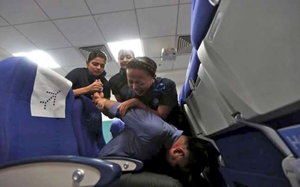
violentOn Tuesday, Indigo flight 6E 024 - that had taken off from Dubai airport - witnessed an unruly passenger after he refused to follow the in flight security rules, sources told Indiatoday.in

He even allegedly threatened the crew, the sources added.

As things got out of hand, the chief pilot instructed the passenger to be overpowered. In an unprecedented situation he was tied down to his seat.

Upon arrival at Indira Gandhi international airport in New Delhi, CISF police force detained the man who was later handed over to Delhi Police that is investigating the matter.

According to Delhi Police sources, the passenger underwent an alcohol test to ascertain whether he has been under influence of alcohol or not. The report is awaited.

Such incidents of unruly passengers seem to have grown in recent years, both in India and around the world.

In December last year, a Jet Airways Mumbai-Bhopal flight was delayed after a group of passengers, who were part of a marriage party virtually hijacked the flight. The flight was reportedly over-booked due to a technical glitch, the website reported.

In 2016, a Compass Airlines flight headed to Los Angeles had to make an emergency landing in Tucson after a passenger made a threat to the flight crew. The man reportedly was unruly on the flight and would not sit down.

In another 2015 incident, a passenger who created a ruckus for almost six hours onboard an Emirates flight from Dubai to Melbourne had to be restrained, the airline said in a statement on Monday.

According to the statement the unruly passenger was also reportedly assaulted a passenger.

Last year in December, Korean Air said it would let its crew use stun guns more aggressively and put more male staff aboard flights to clamp down on violent passengers, after an incident involving an unruly passenger.

(Image for illustration purpose only)

Comments

shaji
 - 
Sunday, 8 Jan 2017

May be he is a family member of Naren Kotian, who had planned to welcome him in the airport. Naren has many family members like him.

SYED
 - 
Saturday, 7 Jan 2017

May be a Saffron terror and RSS Sympathiser, CHADDI....who else can behave in inhuman way? hehehehehehe

Dodanna
 - 
Friday, 6 Jan 2017

The way and attitude only rss back desh drohi terrorist group will behave like this and not a sincere peace loving INDIAN.

Jai Hind !

Wonder Kotian
 - 
Friday, 6 Jan 2017

\ Gangasar\" bound business chelas understand how the power of Gangasar works once it gets inside if it is out of area or Inside Flight no problem, Crocked Criminals like snake land hidden person worried from RSS Goonda Criminals doing all these types of Arrogant, thats why all these type of criminals are hiding outside Hindustan.
Jai hoo Siddaramanna."

Naren kotian
 - 
Friday, 6 Jan 2017

May be a jihadi and Isis sympathiser ...who else can behave in inhuman way ? Hahaha

Shamshuddin mohammed
 - 
Friday, 6 Jan 2017

The photo which shows that it's indigo airlines office not exact incident happened place ..

Add new comment

  • Coastaldigest.com reserves the right to delete or block any comments.
  • Coastaldigset.com is not responsible for its readers’ comments.
  • Comments that are abusive, incendiary or irrelevant are strictly prohibited.
  • Please use a genuine email ID and provide your name to avoid reject.
News Network
January 11,2020

Mangaluru, Jan 11: Reacting to the recent video clippings provided to the media by former chief minister HD Kumaraswamy in connection with the December 19 unrest in Mangaluru, city Police Commissioner Dr PS Harsha on Saturday said that the video has to be seen in a proper sequence to come to a conclusion on the happenings of that day.

Releasing videos in bits and pieces on social media or any platform will not help disclose the truth, said Harsha.

Comments

Add new comment

  • Coastaldigest.com reserves the right to delete or block any comments.
  • Coastaldigset.com is not responsible for its readers’ comments.
  • Comments that are abusive, incendiary or irrelevant are strictly prohibited.
  • Please use a genuine email ID and provide your name to avoid reject.
News Network
July 23,2020

Bengaluru, July 23: The High Court of Karnataka has directed the state government to formulate Standard Operating Procedure (SOP) for child protection, particularly for cases of child pornography and child missing.

A division bench comprising Chief Justice Abhay Shreeniwas Oka and Justice M Nagaprasanna passed a detailed order and asked the state government to submit compliance within three months.

The division bench passed the order on two PILs, including a suo motu litigation registered in 2018. The PILs were registered to ensure effective implementation of the directions of the Supreme Court on the Juvenile Justice (Care and Protection of Children) Act, 2015 (JJ Act).

The bench observed that in normal courses, courts do not issue writ of mandamus to the legislature on rule-making aspects. However, when the failure of the state is demonstrated under exceptional circumstances, courts can issue directions. The bench directed the state government to expedite the rule-making process to ensure proper implementation of the JJ Act.

The bench expressed displeasure on the insensitive police investigation in cases of child pornography. “The police machinery did not show the sensitivity expected from it while dealing with cases of alleged child pornography. Therefore, it will be appropriate if the state issues SOP or guidelines for dealing with cases of child pornography so that proper investigation is carried out in such cases. As we are directing the formation of SOP for dealing with child pornography cases, the state is also directed to formulate guidelines on child missing cases,” the bench said.

The bench had been issuing several directions since 2018 and has also been monitoring police investigations. The court observed that while the state government has incorporated several directions, some issues still remain unaddressed.

The bench directed the government to have dedicated staff for the Directorate of Integrated Child Protection Scheme considering the sensitive nature of work.

On working of Juvenile Justice Boards (JJB), the court asked the Registrar General of the Karnataka High Court to issue directions to the principal magistrates of all the JJBs in the state to sit on all working days for a minimum of six hours a day. 

The high court directed the state to exercise the rule-making powers for obtaining an annual report from the State Commission for Protection of Child Rights.

Comments

Add new comment

  • Coastaldigest.com reserves the right to delete or block any comments.
  • Coastaldigset.com is not responsible for its readers’ comments.
  • Comments that are abusive, incendiary or irrelevant are strictly prohibited.
  • Please use a genuine email ID and provide your name to avoid reject.
Agencies
May 8,2020

Washington D.C., May 8: The prime time for brain development in a child's life is the first year, where the infant spends most of the time asleep. It is the time when neural connections form and sensory memories are encoded.

However, when sleep is disrupted, as occurs more often among children with autism, brain development may be affected, too.

New research led by the University of Washington finds that sleep problems in a baby's first 12 months may not only precede an autism diagnosis but also may be associated with altered growth trajectory in a key part of the brain, the hippocampus.

The study, which was published in the American Journal of Psychiatry, researchers report that in a sample of more than 400 taken of 6- to 12-month-old infants, those who were later diagnosed with autism were more likely to have had difficulty falling asleep.

It also states that this sleep difficulty was associated with altered growth trajectories in the hippocampus.

"The hippocampus is critical for learning and memory, and changes in the size of the hippocampus have been associated with poor sleep in adults and older children.

As many as 80 per cent of the children with autism spectrum disorder have sleep problems," said Annette Estes, director of the UW Autism Center and senior author of the study.

"In our clinical experience, parents have a lot of concerns about their children's sleep, and in our work on early autism intervention, we observed that sleep problems were holding children and families back," added Estes, who is also a UW professor of speech and hearing sciences.

"It could be that altered sleep is part-and-parcel of autism for some children. One clue is that behavioural interventions to improve sleep don't work for all children with autism, even when their parents are doing everything just right. This suggests that there may be a biological component to sleep problems for some children with autism," said Estes.

To consider links among sleep, brain development, and autism, researchers at the IBIS Network looked at MRI scans of 432 infants, surveyed parents about sleep patterns, and measured cognitive functioning using a standardized assessment.

At the outset of the study, infants were classified according to their risk for developing autism: Those who were at higher risk of developing autism -- about two-thirds of the study sample -- had an older sibling who had already been diagnosed.

Infant siblings of children with autism have a 20 per cent chance of developing autism spectrum disorder -- a much higher risk than children in the general population.

In the current study, 127 of the 432 infants were identified as "low risk" at the time the MRI scans were taken because they had no family history of autism.

They later evaluated all the participants at 24 months of age to determine whether they had developed autism. Of the roughly 300 children originally considered "high familial risk," 71 were diagnosed with autism spectrum disorder at that age.

Problems with sleep were more common among the infants later diagnosed with an autism spectrum disorder, as were larger hippocampi. No other subcortical brain structures were affected, including the amygdala, which is responsible for certain emotions and aspects of memory, or the thalamus, a signal transmitter from the spinal cord to the cerebral cortex.

The authors note that while parents reported more sleep difficulties among infants who developed autism compared to those who did not, the differences were very subtle and only observed when looking at group averages across hundreds of infants.

Sleep patterns in the first years of life change rapidly as infants transition from sleeping around the clock to a more adult-like sleep/wake cycle. Until further research is completed, Estes said, it is not possible to interpret challenges with sleep as an early sign of increased risk for autism.

Comments

Add new comment

  • Coastaldigest.com reserves the right to delete or block any comments.
  • Coastaldigset.com is not responsible for its readers’ comments.
  • Comments that are abusive, incendiary or irrelevant are strictly prohibited.
  • Please use a genuine email ID and provide your name to avoid reject.