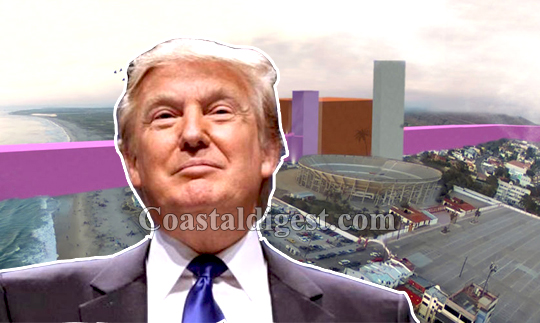
'Wasn't kidding,' says Trump as US begins designing Mexican border wall

February 9, 2017

Washington, Feb 9: President Donald Trump on Wednesday said that the US is in the process of designing the wall on its southern border with Mexico.

trumpwall

“The wall is getting designed right now. A lot of people say, ‘Oh, oh, Trump was only kidding with the wall.' I wasn't kidding. I don't kid. I don't kid,” Trump told conference of County Sheriffs at the White House.

The wall, a major poll promise, is essential to stop the flow of illegal immigrants and drug pouring into the country from across the border, he said.

“I watch this, and they say I was kidding. Nah, I don't kid. I don't kid about things like that, I can tell you. No, we will have a wall. It will be a great wall and it will do a lot of – it'll be a big help,” he said.

“Just ask Israel about walls. Do walls work? Just ask Israel. They work, if it's properly done. It's time to dismantle the gangs terrorising our citizens. It is time to ensure every young American can be raised in an environment of decency, dignity, love and support,” he said.

Comments

shaji
 - 
Thursday, 9 Feb 2017

Its shame that Trump is appreciating terror policy of Israel. The Wall construction by Terrorist state of Israel is illegal. It is built on occupied territory. Instead of denouncing atrocities and terror by terrorist state of Israel, Trump is appreciating it. Its really shame. This shows how much this hate monger loves terror.

Add new comment

  • Coastaldigest.com reserves the right to delete or block any comments.
  • Coastaldigset.com is not responsible for its readers’ comments.
  • Comments that are abusive, incendiary or irrelevant are strictly prohibited.
  • Please use a genuine email ID and provide your name to avoid reject.
News Network
January 23,2020

Beijing, Jan 23: China is putting on lockdown a city of 11 million people considered the epicenter of the new coronavirus outbreak that has killed 17 and infected nearly 600 people, as health authorities around the world work to prevent a global pandemic.

The previously unknown coronavirus strain is believed to have emerged late last year from illegally traded wildlife at an animal market in the central Chinese city of Wuhan. Cases have been detected as far away as the United States, stoking fears the virus is already spreading worldwide.

Wuhan's local government said it would shut down all urban transport networks and suspend outgoing flights from the city as of 10 a.m. (0200 GMT) Thursday, state media reported, adding that the government is urging citizens to not leave the city in the absence of special circumstances.

Contrasting with its secrecy over the 2002-03 Severe Acute Respiratory Syndrome (SARS), which killed nearly 800 people, China's communist government has this time given regular updates to try to avoid panic as millions of people travel for the Chinese Lunar New Year holiday.

Chinese authorities have confirmed 571 cases and 17 deaths as of end-Wednesday, state television reported on Thursday. There are eight other known cases around the world - Thailand has confirmed four cases, while the United States, Taiwan, South Korea and Japan have each reported one.

Vice Premier Sun Chunlan said during a visit to Wuhan that authorities needed to be open about the spread of the virus and their efforts to contain it, the official Xinhua news agency reported on Thursday, comments likely to reassure global health experts.

After a meeting at its Geneva headquarters on Wednesday, the World Health Organization (WHO) said it would decide on Thursday whether to declare the outbreak a global health emergency, which would step up the international response.

If it does so, it will be the sixth international public health emergency to be declared in the last decade.

WHO Director-General Tedros Adhanom Ghebreyesus told reporters in Geneva that China's actions so far were "very strong" but called in Beijing to take "more and significant measures to limit or minimise the international spread".

"We stressed to them that by having a strong action not only they will control the outbreak in their country but they will also minimise the chances of this outbreak spreading internationally. So they recognise that," he said.

A senior U.S. State Department official also called on China to "play a bigger role in global health so they taking more and significant measures to limit or minimise the international spread".

"The lack of transparency in the past, especially with SARS ... gives us concern that that may be the case here," the official said, adding however that there were "positive signs that they have taken action in Wuhan".

Fears of a pandemic initially spooked markets but they regained their footing on Wednesday, with investors citing the robust response from authorities as reassuring.

VIRUS SPREADING

The outbreak began in Wuhan, a major transportation hub as well as central China's main industrial and commercial centre, and has now spread to other major population centers including Beijing, Shanghai and Hong Kong.

There is no known cure for the virus. Symptoms include fever, difficulty in breathing and cough, similar to many other respiratory illnesses, and can cause pneumonia.

Chinese authorities are still investigating the origins of the virus, though they confirmed the outbreak began at a market in Wuhan with illegal wildlife transactions and that it can spread from one person to another via respiratory transmission. Among confirmed patients are 15 medical workers, further adding to worries about a possible global pandemic.

Many Chinese were canceling trips, buying face masks, avoiding public places such as cinemas and shopping centers, and even turning to an online plague simulation game as a way to cope.

Airports globally stepped up screening passengers from China and the European Centre for Disease Control and Prevention (ECDC) said in a risk assessment that further global spread of the virus was likely.

Britain joined other countries including Australia in advising citizens against all but essential travel to Wuhan.


Comments

Add new comment

  • Coastaldigest.com reserves the right to delete or block any comments.
  • Coastaldigset.com is not responsible for its readers’ comments.
  • Comments that are abusive, incendiary or irrelevant are strictly prohibited.
  • Please use a genuine email ID and provide your name to avoid reject.
News Network
May 6,2020

May 6: In a first, a Pakistani Hindu youth has become the first person from the minority community to join the Pakistan Air Force.

Rahul Dev has been recruited as a General Duty Pilot Officer, the Pakistan Air Force (PAF) said in a tweet.

Dev hails from Tharparkar district of Sindh province.

Sharing the picture of the young man, the PAF recently tweeted, "Good news during #COVID19 tense situation. Thar rocked again...Congratulations #RahulDev who hails from very remote village of Tharparkar has been selected as GD Pilot in #PAF."

Though Dev's exact age is not known, those inducted in PAF at his level are often around 20.

The official Radio Pakistan on Wednesday said it is "for the first time in Pakistan's history" that a Hindu youth has been recruited as a general duty pilot officer in PAF.

The Express Tribune in a report published on Wednesday said the induction showed that the PAF was breaking barriers.

Last year, Kainat Junaid became the first woman from Khyber-Pakthunkhwa province to have been selected for fighter pilot training.

Junaid not only secured the top position in PAF's test for General Duty Pilot, but also became Pakistan’s first female fighter pilot to serve the country alongside her father.

Her father Ahmed Junaid is a Squadron Leader in the PAF.

Comments

Add new comment

  • Coastaldigest.com reserves the right to delete or block any comments.
  • Coastaldigset.com is not responsible for its readers’ comments.
  • Comments that are abusive, incendiary or irrelevant are strictly prohibited.
  • Please use a genuine email ID and provide your name to avoid reject.
Agencies
June 24,2020

Seoul, Jun 24: North Korea on Wednesday said leader Kim Jong Un suspended a planned military retaliation against South Korea, possibly slowing the pressure campaign it has waged against its rival amid stalled nuclear negotiations with the Trump administration.

Last week, the North had declared relations with the South as fully ruptured, destroyed an inter-Korean liaison office in its territory and threatened unspecified military action to censure Seoul for a lack of progress in bilateral cooperation and for activists floating anti-Pyongyang leaflets across the border.

Analysts say North Korea, after weeks deliberately raising tensions, may be pulling away just enough to make room for South Korean concessions.

Pyongyang's official Korean Central News Agency said Kim presided by video conference over a meeting Tuesday of the ruling Workers' Party's Central Military Commission, which decided to postpone plans for military action against the South brought up by the North's military leaders.

KCNA didn't specify why the decision was made. It said other discussions included bolstering the country's "war deterrent".

Yoh Sang-key, spokesman of South Korea's Unification Ministry, said Seoul was "closely reviewing" the North's report but didn't further elaborate.

Yoh also said it was the first report in state media of Kim holding a video conferencing meeting, but he didn't provide a specific answer when asked whether that would have something to do with the coronavirus.

The North says there hasn't been a single COVID-19 case on its territory, but the claim is questioned by outside experts.

Kim Dong-yub, an analyst from Seoul's Institute for Far Eastern Studies, said it's likely that the North is waiting for further action from the South to salvage ties from what it sees as a position of strength, rather than softening its stance on its rival.

"What's clear is that the North said (the military action) was postponed, not cancelled," said Kim, a former South Korean military official who participated in inter-Korean military negotiations.

Other experts say the North would be seeking something major from the South, possibly a commitment to resume operations at a shuttered joint factory park in Kaesong, which was where the liaison office was located, or restart South Korean tours to the North's Diamond Mountain resort.

Those steps are prohibited by the international sanctions against the North over its nuclear weapons programme.

The public face of the North's recent bashing of the South has been Kim Yo Jong, the powerful sister of leader Kim Jong Un, who has been confirmed as his top official on inter-Korean affairs.

Issuing harsh statements through state media, she had said the North's demolishing of the liaison office would be just the first in a series of retaliatory action against the enemy South and that she would leave it to the North's military to come up with the next steps.

The General Staff of the North's military has said it would send troops to the mothballed inter-Korean cooperation sites in Kaesong and Diamond Mountain and restart military drills in frontline areas.

Such steps would nullify a set of deals the Koreas reached during a flurry of diplomacy in 2018 that prohibited them from taking hostile action against each other.

Also condemning the South over North Korean refugees floating anti-Pyongyang leaflets across the border, the North said Monday it printed 12 million of its own propaganda leaflets to be dropped over the South in what would be its largest ever anti-Seoul leafleting campaign.

It wasn't immediately clear whether Kim's decision to hold back military action would affect the country's plans for leafleting. The North's military had said it would open border areas on land and sea and provide protection for civilians involved in the leafleting campaigns.

The North has a history of dialling up pressure against the South when it fails to get what it wants from the United States. The North's recent steps came after months of frustration over Seoul's unwillingness to defy US-led sanctions and restart the inter-Korean economic projects that would breathe life into its broken economy.

Nuclear negotiations between Pyongyang and Washington largely stalled after Kim's second summit with President Donald Trump last year in Vietnam, where the Americans rejected North Korea's demands for major sanctions relief in exchange for a partial surrender of its nuclear capabilities.

Comments

Add new comment

  • Coastaldigest.com reserves the right to delete or block any comments.
  • Coastaldigset.com is not responsible for its readers’ comments.
  • Comments that are abusive, incendiary or irrelevant are strictly prohibited.
  • Please use a genuine email ID and provide your name to avoid reject.