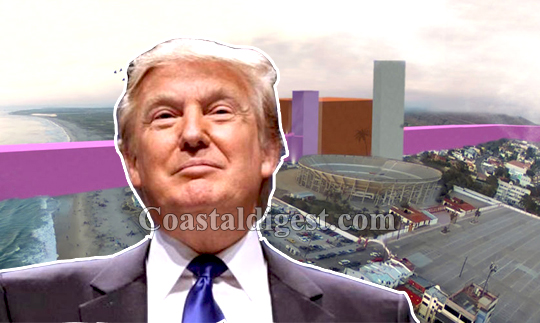
'Wasn't kidding,' says Trump as US begins designing Mexican border wall

February 9, 2017

Washington, Feb 9: President Donald Trump on Wednesday said that the US is in the process of designing the wall on its southern border with Mexico.

trumpwall

“The wall is getting designed right now. A lot of people say, ‘Oh, oh, Trump was only kidding with the wall.' I wasn't kidding. I don't kid. I don't kid,” Trump told conference of County Sheriffs at the White House.

The wall, a major poll promise, is essential to stop the flow of illegal immigrants and drug pouring into the country from across the border, he said.

“I watch this, and they say I was kidding. Nah, I don't kid. I don't kid about things like that, I can tell you. No, we will have a wall. It will be a great wall and it will do a lot of – it'll be a big help,” he said.

“Just ask Israel about walls. Do walls work? Just ask Israel. They work, if it's properly done. It's time to dismantle the gangs terrorising our citizens. It is time to ensure every young American can be raised in an environment of decency, dignity, love and support,” he said.

Comments

shaji
 - 
Thursday, 9 Feb 2017

Its shame that Trump is appreciating terror policy of Israel. The Wall construction by Terrorist state of Israel is illegal. It is built on occupied territory. Instead of denouncing atrocities and terror by terrorist state of Israel, Trump is appreciating it. Its really shame. This shows how much this hate monger loves terror.

Add new comment

  • Coastaldigest.com reserves the right to delete or block any comments.
  • Coastaldigset.com is not responsible for its readers’ comments.
  • Comments that are abusive, incendiary or irrelevant are strictly prohibited.
  • Please use a genuine email ID and provide your name to avoid reject.
News Network
June 18,2020

Washington, Jun 18: US Defence officials are concerned over China's use of COVID-19 situation to gain stakes in strategically important companies of United States as the impact of novel coronavirus has left several companies in dire need of capital.

Amid the pandemic, it getting hard for the defence department to keep an eye on national security and help protect smaller companies down the chain, CNN reported.

"We are paying close attention to any indicators that China is leveraging Covid-19 to take advantage of a situation where defence companies need capital more than ever," a defence official told CNN.

In April, Ellen Lord, undersecretary of defence for acquisition and sustainment said it is paying close attention to 'adversaries' against the 'economic warfare' with the United States.

"We have to be very, very careful about the focused efforts some of our adversaries have to really undergo sort of economic warfare with us, which has been going on for some time," Ellen Lord, undersecretary of defence for acquisition and sustainment was quoted as saying by CNN.

US Committee on Foreign Investment protects its interest against hostile countries gaining ownership in strategically important companies. But the pandemic is changing the definition of national security concerns to include drugs, protective gear and medical supplies.

"These are now national security needs and we probably should have been thinking about it a long time ago in terms of biowarfare that we should have a trusted industrial base or a set of trusted allies -- the UK, or NATO allies or Japan or Korea -- who are trusted in that regard," Bill Greenwalt, a former Pentagon official.

Give the threat posed by foreign acquisition, Pentagon has been offering tools to help small US businesses defend themselves against adversarial investment and conducting background checks with other government agencies to ensure transparency.

US President Donald Trump's trade adviser Peter Navarro recently told CNN if Trump wins reelection, Washington DC will likely take offshore supply chains as national security priorities.

"If we fail to do that in the face of this crisis, we will have failed this country and all future generations of Americans," Navarro said.

The US State Department has also warned US allies to "avoid economic overreliance on China" and "guard their critical infrastructure" from China's influence.

Chad P Bown, a senior fellow at the Peterson Institute for International Economics, pointed to recent China's economic coercion of Australia on the political matter saying, "this is how China operates and everybody knows it."

Comments

Add new comment

  • Coastaldigest.com reserves the right to delete or block any comments.
  • Coastaldigset.com is not responsible for its readers’ comments.
  • Comments that are abusive, incendiary or irrelevant are strictly prohibited.
  • Please use a genuine email ID and provide your name to avoid reject.
News Network
May 20,2020

Washington, May 20: Once dubbed as historic by him, US President Donald Trump on Tuesday said he now feels ‘differently’ about the trade deal he signed with China earlier this year.

He said this while once again venting out his frustration with the Beijing leadership, accusing it of letting coronavirus spread.

Till Tuesday, over 92,000 Americans have died and 1.5 million tested positive for coronavirus that has globally killed around 320,000 people.

The US and China had signed a deal in January to end their 22-month-long trade war during which the two countries slapped tit-for-tat tariff hikes on products worth nearly half a trillion USD.

Under it, Beijing agreed to increase its purchase of US goods by USD 200 billion in 2020-2021.

“I feel differently now about that deal than I did three months ago,” Trump told reporters during a Cabinet meeting at the White House.

“We will see what all happens, but it's been a very disappointing situation. A very disappointing thing happened with China because the plague flowed in and that wasn't supposed to happen and it could have been stopped," he said.

Trump said he was very excited when the trade deal with China was signed.

“But once the virus came in, once the plague, as I called it, came in, I said how did they let that happen? And how come it didn't go into other sections of China? Why did they block it from leaving Wuhan? But they didn't block it from going to the rest of the world, including the United States. Why is that? Beijing doesn't have it. Other places don't have it,” he said.

Trump did not respond to questions on retaliation against China.

Meanwhile, top American senators continued to press the administration that rules of engagement with China needs to change post-coronavirus.

“As we know, they unleashed this virus on America and the world with their classic communist cover-up, deception, continued propaganda campaign, costing now over 90,000 American lives, 35 million Americans losing their jobs so far,” Senator Martha McSally said during a Congressional hearing.

“We don’t know who patient zero is, they destroyed samples, they silenced doctors, they kicked out journalists, they impacted international travel to seed this and their reckless behaviour continues to be the root of all this,” she said.

As a result of coronavirus, the American economy has been thrown into recession; more than 36 million people have lost their job – the worst ever after last century’s great depression.

Many of the US states have now started opening up, after taking necessary precautions.

By conservative estimates, it will take several quarters for the economy to be back on track.

Trump in the last a few weeks has exuded confidence that the economy will be back on track next year.

Comments

Add new comment

  • Coastaldigest.com reserves the right to delete or block any comments.
  • Coastaldigset.com is not responsible for its readers’ comments.
  • Comments that are abusive, incendiary or irrelevant are strictly prohibited.
  • Please use a genuine email ID and provide your name to avoid reject.
News Network
February 24,2020

Beijing, Feb 24: The lockdown of Guo Jing's neighbourhood in Wuhan -- the city at the heart of China's new coronavirus epidemic -- came suddenly and without warning.

Unable to go out, the 29-year-old is now sealed inside her compound where she has to depend on online group-buying services to get food.

"Living for at least another month isn't an issue," Guo told news agency, explaining that she had her own stash of pickled vegetables and salted eggs.

But what scares her most is the lack of control -- first, the entire city was sealed off, and then residents were limited to exiting their compound once every three days.

Now even that has been taken away.

Guo is among some 11 million residents in Wuhan, a city in central Hubei province that has been under effective quarantine since January 23 as Chinese authorities race to contain the epidemic.

Since then, its people have faced a number of tightening controls over daily life as the death toll from the virus swelled to over 2,500 in China alone.

But the new rules this month barring residents from leaving their neighbourhoods are the most restrictive yet -- and for some, threaten their livelihoods.

"I still don't know where to buy things once we've finished eating what we have at home," said Pan Hongsheng, who lives with his wife and two children.

Some neighbourhoods have organised group-buying services, where supermarkets deliver orders in bulk.

But in Pan's community, "no one cares".

"The three-year-old doesn't even have any milk powder left," Pan told news agency, adding that he has been unable to send medicine to his in-laws -- both in their eighties -- as they live in a different area.

"I feel like a refugee."

The "closed management of neighbourhoods is bound to bring some inconvenience to the lives of the people", Qian Yuankun, vice secretary of Hubei's Communist Party committee, said at a press briefing last week.

Authorities on Monday allowed healthy non-residents of the city to leave if they never had contact with patients, but restrictions remained on those who live in Wuhan.

Demand for group-buying food delivery services has rocketed with the new restrictions, with supermarkets and neighbourhood committees scrambling to fill orders.

Most group-buying services operate through Chinese messaging app WeChat, which has ad-hoc chat groups for meat, vegetables, milk -- even "hot dry noodles", a famous Wuhan dish.

More sophisticated shops and compounds have their own mini-app inside WeChat, where residents can choose packages priced by weight before orders are sent in bulk to grocery stores.

In Guo's neighbourhood, for instance, a 6.5-kilogramme (14.3-pound) set of five vegetables, including potatoes and baby cabbage, costs 50 yuan ($7.11).

"You have no way to choose what you like to eat," Guo said. "You cannot have personal preferences anymore."

The group-buying model is also more difficult for smaller communities to adopt, as supermarkets have minimum order requirements for delivery.

"To be honest, there's nothing we can do," said Yang Nan, manager of Lao Cun Zhang supermarket, which requires a minimum of 30 orders.

"We only have four cars," she said, explaining that the store did not have the staff to handle smaller orders.

Another supermarket told AFP it capped its daily delivery load to 1,000 orders per day.

"Hiring staff is difficult," said Wang Xiuwen, who works at the store's logistics division, adding that they are wary about hiring too many outsiders for fear of infection.

Closing off communities has split the city into silos, with different neighbourhoods rolling out controls of varying intensity.

In some compounds, residents have easier access to food -- albeit a smaller selection than normal -- and one woman said her family pays delivery drivers to run grocery errands.

Her compound has not been sealed off either, the 24-year-old told AFP under condition of anonymity, though they are limited to one person leaving at a time.

Some districts have implemented their own rules, such as prohibiting supermarkets from selling to individuals, forcing neighbourhoods to buy in bulk or not at all.

"In the neighbourhood where I live, the reality is really terrible," said David Dai, who is based on the outskirts of Wuhan.

Though his apartment complex has organised group-buying, Dai said residents were unhappy with price and quality.

"A lot of tomatoes, a lot of onions -- they were already rotten," he told , estimating over a third of the food had to be thrown away.

His family must "totally depend" on themselves, added the 49-year-old, who has resorted to saving and drying turnip skins to add nutrients to future meals.

The uncertainty of not knowing when the controls will be lifted is also frustrating, said Ma Chen, a man in his 30s who lives alone.

"I have no way of knowing how much (food) I should buy."

Comments

Add new comment

  • Coastaldigest.com reserves the right to delete or block any comments.
  • Coastaldigset.com is not responsible for its readers’ comments.
  • Comments that are abusive, incendiary or irrelevant are strictly prohibited.
  • Please use a genuine email ID and provide your name to avoid reject.