



We will stand with the farmers; if it's politics, then we are playing it: Congress

June 9, 2017

Naya Gaon, Jun 9: In the wake of the farmer's protest in Mandsaur in Madhya Pradesh, the Congress on Friday lashed out at the Centre, stating that they would stand with the farmers and if that is politics, then they are playing it.
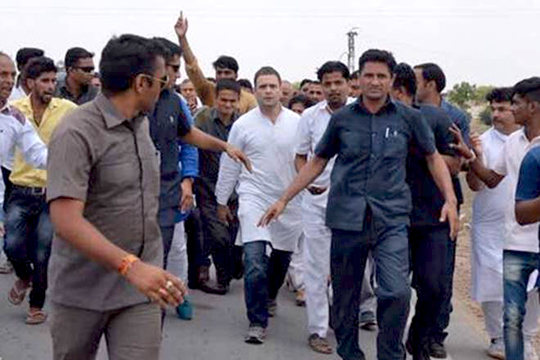
Rahul 2

"As long as the farmers are in distress or in any kind of trouble we will stand with the farmers- If that is politics then we are playing it. Unfortunately, from the past three years, the most neglected lot of the country is the farmers; they never get their price for their due nor revision of the Minimum Support Price (MSP) or loan waiver," said PC Chacko

Further supporting Rahul Gandhi who met with the kin of farmers in Mandsaur, Chacko asserted that when farmers are in trouble, it is his responsibility too to be there and that?s what he did.

"Rahul Gandhi has said that big business houses are given lakh and crore from the bank to start business so why is this government not giving the loan waiver to its farmers who totally deserve it."

"Rahul ji's visit to Mandsaur means, when farmers are in trouble, is his responsibility to be there and if BJP says that Congress is playing politics then they don't understand the agony for the farmers," said Chacko.

Taking a jibe at Prime Minister Narendra Modi, another Congress leader Tom Vadakkan said Modi ji has no time not one tweet from his side regretting on the death of farmers.

"It is an established fact that Prime Minister Narendra Modi is well familiar with the rich and famous, and that he he has no time for the farmers not one tweet from his side regretting on the death of farmers has come... At this time, when farmers need compensation- bullets are being fired. Instead of helping the farmers at the needed hour- bullets are fired and blood is floored. There must be a course correction for this government as the situation is completing reeling out of control," said Vadakkan .

Mandsaur District Collector Om Prakash Srivastava yesterday assured that the curfew would be relaxed for longer hours tomorrow in the violence-hit district.

"Curfew would be relaxed for longer hours tomorrow. ATMs will be opened, milk, petrol and diesel availability will also be ensured," Srivastava said.

Collector said that the police are registering an FIR's against the accused who vandalised the public property and created ruckus.

"We are registering the FIR on those who vandalised the public property in this incident and created ruckus," he said.

Curfew was relaxed for a few hours on Thursday evening.

Madhya Pradesh Chief Minister Shivraj Singh Chouhan has ordered a judicial enquiry into the deaths of five farmers during the recent agitation.

He said he has announced a compensation of Rs. 1 crore to the kin of those killed and Rs. 5 lakh for those injured in the violence.

Internet services in Mandsaur, Ratlam and Ujjain remain suspended following the farmers' protests, and a curfew has also been imposed.

The Mandsaur district of Madhya Pradesh has been facing a tense situation with farmers protesting over their demands for remunerative prices for their produce and a farm loan waiver not being met.

This unfortunately took an ugly turn on Tuesday when five farmers were killed and eight others were injured in police firing.

Internet services in Mandsaur, Ratlam and Ujjain were also suspended following the farmers' protests and a curfew was reportedly imposed.

Comments

Add new comment

  • Coastaldigest.com reserves the right to delete or block any comments.
  • Coastaldigset.com is not responsible for its readers’ comments.
  • Comments that are abusive, incendiary or irrelevant are strictly prohibited.
  • Please use a genuine email ID and provide your name to avoid reject.
News Network
January 31,2020

New Delhi, Jan 31: Substantial competition and low tariff rates by telecom operators since 2016 have led to a financial stress in the sector, the Economic Survey said on Friday.

The data price in the country came down by over 99 per cent during 2016-2019, making it among the lowest tariff in the world, according to the survey.

"Since 2016, the sector has witnessed substantial competition and price cutting by the telecom service providers (TSPs), creating financial stress in the sector. As a result, the sector is experiencing consolidation. While some operators have filed for bankruptcy, others have merged, in their quest to improve viability," the survey report said.

In April-June 2019, the price of data was Rs 7.7 per gigabyte (GB) as compared to Rs 200 per GB in June 2016, it added.

"The Average Revenue Per User (ARPU) for GSM based mobile services has also gone down substantially from Rs 126 in June 2016 to Rs 74.30 in June 2019," the survey said.

The tariff war started in the market with entry of new telecom operator Reliance Jio in September 2016.

"BSNL and MTNL are also affected by the tariff war that has impacted their cash flow resulting in mounting losses," the survey said.

The financial health of the public sector telecom firms plummeted to a level where they have been finding hard to pay employees salaries in time.

The government has drawn up a plan to revive these PSUs which is still in works.

The revival plan consists of several measures, including reduction of staff cost through voluntary retirement scheme, allotment of spectrum for 4G services, monetisation of land and building, tower and fibre assets of BSNL and MTNL, debt restructuring through sovereign guarantee bonds and ''in-principle'' approval for merger of BSNL and MTNL.

The survey said that the wireless telephony now constitutes 98.27 per cent of all subscriptions whereas share of landline telephones now stands at only 1.73 per cent where market share is dominated by private sector players.

"The overall tele-density in India stands at 90.45 per cent, the rural tele-density being 57.35 per cent and urban teledensity being 160.71 per cent at the end of September 2019. The private sector dominates with a share of 88.81 per cent (106.06 crore connections) at the end of September, 2019 while the share of public sector was 11.19 per cent (13.36 crore connections)," the survey said.

The lower price of data has also lead in surge of broadband connections and average consumption of the internet.

Total broadband connections increased by about ten times, from 6.1 crore in 2014 to 59.46 crore in June 2019, the survey said.

The number of internet subscribers (both broadband and narrowband put together) stood at 66.53 crore at the end of June 2019 as compared to 25.16 crore in 2014.

The number of mobile internet subscribers was 64.36 lakh at the end of June 2019 while the number of wireline internet subscribers was 2.17 crore.

"India is now the global leader in monthly data consumption, with average consumption per subscriber per month increasing 157 times from 62 MB in 2014 to 9.8 GB in June 2019. The cost of data has also reduced substantially, enabling affordable internet access for millions of citizens," the survey said.

Comments

Add new comment

  • Coastaldigest.com reserves the right to delete or block any comments.
  • Coastaldigset.com is not responsible for its readers’ comments.
  • Comments that are abusive, incendiary or irrelevant are strictly prohibited.
  • Please use a genuine email ID and provide your name to avoid reject.
News Network
January 9,2020

New Delhi, Jan 9: Amazon founder and CEO Jeff Bezos will be visiting India next week and is likely to meet Prime Minister Narendra Modi and officials, besides industry leaders, according to sources.

The top executive will also attend SMBhav – an event focussing on small and medium businesses in India - that is slated for January 15-16 in the capital city.

When contacted, Amazon declined to comment.

Amazon, which has seen significant growth in its business in India, has also witnessed protest from a section of traders in the country who claim that e-commerce giants including Amazon and Walmart-owned Flipkart offer deep discounts and engage in unfair business practices.

Last year, the government had tightened rules for e-commerce marketplaces with foreign investment. These rules barred such platforms from offering products of sellers in which they hold a stake and banned exclusive marketing arrangements among other clauses. Following this, Amazon restructured its joint ventures to ensure compliance.

Bezos is likely to discuss regulatory issues in his meeting with the government officials.

He is also slated to engage with SMBs during the SMBhav event. The event - which will focus on discussions around how technology adoption can enable SMBs in India - is slated to see participation from industry experts, policymakers, solution providers and Amazon leadership.

Comments

Add new comment

  • Coastaldigest.com reserves the right to delete or block any comments.
  • Coastaldigset.com is not responsible for its readers’ comments.
  • Comments that are abusive, incendiary or irrelevant are strictly prohibited.
  • Please use a genuine email ID and provide your name to avoid reject.
News Network
April 24,2020

New Delhi, Apr 24: The trajectory of COVID-19 cases could have plateaued and might even fall for some weeks after the lockdown is lifted but India is likely to see a second wave in late July or August with a surge in the number of cases during the monsoon, say scientists.

The timing of the peak will depend on how India is able to control physical distancing and on the level of infection spreads after restrictions are relaxed, they said.

It looks apparent that the trajectory of daily new cases has reached a plateau and eventually it will take a downward fall, maybe for some weeks or even months, Samit Bhattacharya, associate professor at the Department of Mathematics, Shiv Nadar University, said.

Still, we may get a surge of new cases of the same coronavirus and this will be considered a second wave, Bhattacharya explained.

The second epidemic may come back in late July or August in the monsoon, although the peak timing will depend on how we control social distancing during that time, he said.

Rajesh Sundaresan, professor at Bengaluru's Indian Institute of Science (IISc), agreed.

“Once we return to normal activity levels, there is a chance that infection may begin to rise again. China is seeing this to some extent post easing of some restrictions on travel,” Sundaresan, corresponding author of a working paper by researchers at IISc and the Tata Institute of Fundamental Research (TIFR) in Mumbai, said.

On March 25, when the number of coronavirus cases was 618 with 13 deaths, the government announced a nationwide lockdown that was later extended to May 3.

On Friday, the death toll due to COVID-19 rose to 718 and the number of cases to 23,077, according to the Union Health Ministry.

In good news, officials said this week that the doubling rate of cases has slowed down in the period, going from 3.4 days before lockdown to 7.5 days, with 18 states doing better than the national average. The recovery rate has also almost doubled in the last 10 days.

"Looking at the new cases in the past few days, it seems the growth of new daily infection is much slower than earlier. This apparently indicates that we might have reached at the plateau of the growth curve, Bhattacharya said.

He noted that recent studies in China and Europe observed that the infection might relapse in those people who have already recovered from earlier phases.

So, there is no evidence that the earlier infection may help acquire immunity against the second infection. And in that way, the entire population may be vulnerable to the second wave to some extent, said the scientist.

In their study unveiled this week, IISc and TIFR researchers analysed the impact of strategies such as case isolation, home quarantine, social distancing and various post-lockdown restrictions on COVID-19 that might remain in force for some time.

The study modelled on Bengaluru and Mumbai suggests the infection is likely to have a second wave and the public health threat will remain, unless steps are taken to aggressively trace, localise, isolate the cases, and prevent influx of new infections.

The new levels and the peaking times for healthcare demand depend on the levels of infection spreads in each city at the time of relaxation of restrictions, they said.

The lockdown is currently upon us. It has given us valuable time. Let us test, trace, quarantine, isolate, practice better hygiene, search for a vaccine, etc. We should do these anyway, and these are being done. When and how to lift the lockdown is going to be a difficult decision to make, said Sundaresan.

It's clear that it's going to be phased. What our team is focusing on is to come up with tools to help the decision makers assess the public health impact of various choices, he said.

According to the experts, infectious diseases spread via contact between infectious and susceptible people. In the absence of any control measures, an outbreak will grow as long as the average number of people infected by each infectious person is more than one.

Once enough people are immune there will be fewer people susceptible to the infection and the outbreak will die.

However, when an outbreak is brought under control by social distancing and other interventions, it is possible only a small proportion of the population will have been infected and gained immunity, they said.

This means enough susceptible people may remain to fuel a second wave if controls are relaxed and infection is reintroduced.

Until the vaccine comes on the market, we have to remain alert Once sporadic cases occur here and there in the country, we immediately need to implement quarantine or social distancing locally for the people in that region, and also need to perform tests to identify positive cases irrespective of showing symptoms, Bhattacharya explained.

Note that these monsoon months are also flu season in many places of India. So, we should not ignore the early signs of the flu symptoms. Irrespective of symptoms, we need to increase tests in the hotspots to identify people and contain the surge, he said.

Sundaresan added that the timeline for a second wave will depend on a lot of circumstances which may change as the time passes.

Significant testing may have been underway, there may be behavioural changes with people becoming more careful about their hygiene, wearing masks may become more common, etc. All these responses may help restrict the second wave, he said.

A study published in The Lancet journal earlier this month modelled the potential adverse consequences of premature relaxation of interventions, and found it might lead to a second wave of infections.

The finding is critical to governments globally, because it warns against premature relaxation of strict interventions, the researchers said.

While interventions to control the spread of SARS-CoV-2 are in place, countries will need to work toward returning to normalcy; thus, knowledge of the effect of each intervention is urgently required, they said in the study.

According to a recent analysis by the Harvard Chan School of Public Health, the best strategy to ease the critical care burden and loss of life from COVID-19 might be on-again, off-again social distancing.

In the absence of such interventions, surveillance and intermittent distancing may need to be maintained into 2022, which would present a substantial social and economic burden, the researchers wrote.p

Comments

Add new comment

  • Coastaldigest.com reserves the right to delete or block any comments.
  • Coastaldigset.com is not responsible for its readers’ comments.
  • Comments that are abusive, incendiary or irrelevant are strictly prohibited.
  • Please use a genuine email ID and provide your name to avoid reject.