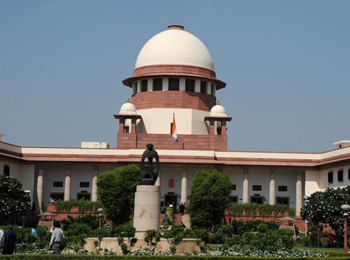
Why not a CBI probe into DySP's suicide, SC asks Karnataka

January 6, 2017

New Delhi, Jan 6: The Supreme Court on Thursday asked the Karnataka government to explain why a CBI probe should not be ordered into the suicide of deputy superintendent of police M K Ganapathy on July 7 last year.

scA bench of Justices Adarsh Kumar Goel and U U Lalit issued notice to the state government seeking their response within six weeks on a petition filed by M K Kushalappa, father of the deceased.

Senior advocate Jayant Bhushan, appearing for the petitioner, contended that the officer, posted at the office of Inspector General of Police, Madikeri, was being hounded by then Minister K J George and other senior officers.

The court agreed to consider the plea by asking the petitioner to delete the name of the minister and other senior police officers from the list of respondents in the special leave petition.

The petitioner has challenged the Karnataka High Court's order of October 19, declining a plea for a CBI probe.

“We are of the opinion that transferring of investigation must be in rare and exceptional circumstances only. All steps were taken for ensuring a fair investigation. Superior officers other than two accused police officers were appointed by the investigating agency and the DGP oversaw the investigation throughout,” a division bench headed by high court Chief Justice S K Mukherjee had said.

The court had also noted that then minister George had resigned to facilitate proper investigation at the relevant time. The high court had also declined to look into the closure report filed by the CID in the case.

Comments

abdullah
 - 
Saturday, 7 Jan 2017

Why SC rejected CBI Probe into Jayalalitha's sudden illness & death.
All are under the influence of Chaddees.

Add new comment

  • Coastaldigest.com reserves the right to delete or block any comments.
  • Coastaldigset.com is not responsible for its readers’ comments.
  • Comments that are abusive, incendiary or irrelevant are strictly prohibited.
  • Please use a genuine email ID and provide your name to avoid reject.
Agencies
February 20,2020

India ranked 77th on a sustainability index that takes into account per capita carbon emissions and ability of children in a nation to live healthy lives and secures 131st spot on a flourishing ranking that measures the best chance at survival and well-being for children, according to a UN-backed report.

The report was released on Wednesday by a commission of over 40 child and adolescent health experts from around the world. It was commissioned by the World Health Organization (WHO), UN Children's Fund (UNICEF) and The Lancet medical journal.

In the report assessing the capacity of 180 countries to ensure that their youngsters can survive and thrive, India ranks 77th on the Sustainability Index and 131 on the Flourishing Index, it said.

Flourishing is the geometric mean of Surviving and Thriving. For Surviving, the authors selected maternal survival, survival in children younger than 5 years old, suicide, access to maternal and child health services, basic hygiene and sanitation, and lack of extreme poverty.

For Thriving, the domains were educational achievement, growth and nutrition, reproductive freedom, and protection from violence.

Under the Sustainability Index, the authors noted that promoting today's national conditions for children to survive and thrive must not come at the cost of eroding future global conditions for children's ability to flourish.

The Sustainability Index ranks countries on excess carbon emissions compared with the 2030 target. This provides a convenient and available proxy for a country's contribution to sustainability in future.

The report noted that under realistic assumptions about possible trajectories towards sustainable greenhouse gas emissions, models predict that global carbon emissions need to be reduced from 39·7 giga­ tonnes to 22·8 gigatonnes per year by 2030 to maintain even a 66 per cent chance of keeping global warming below 1·5°C.

It said that the world's survival depended on children being able to flourish, but no country is doing enough to give them a sustainable future.

"No country in the world is currently providing the conditions we need to support every child to grow up and have a healthy future," said Anthony Costello, Professor of Global Health and Sustainability at University College London, one of the lead authors of the report.

"Especially, they're under immediate threat from climate change and from commercial marketing, which has grown hugely in the last decade," said Costello – former WHO Director of Mother, Child and Adolescent health.

Norway leads the table for survival, health, education and nutrition rates - followed by South Korea and the Netherlands. Central African Republic, Chad and Somalia come at the bottom.

However, when taking into account per capita CO2 emissions, these top countries trail behind, with Norway 156th, the Republic of Korea 166th and the Netherlands 160th.

Each of the three emits 210 per cent more CO2 per capita than their 2030 target, the data shows, while the US, Australia, and Saudi Arabia are among the 10 worst emitters. The lowest emitters are Burundi, Chad and Somalia.

According to the report, the only countries on track to beat CO2 emission per capita targets by 2030, while also performing fairly – within the top 70 – on child flourishing measures are: Albania, Armenia, Grenada, Jordan, Moldova, Sri Lanka, Tunisia, Uruguay and Vietnam.

"More than 2 billion people live in countries where development is hampered by humanitarian crises, conflicts, and natural disasters, problems increasingly linked with climate change," said Minister Awa Coll-Seck from Senegal, Co-Chair of the commission.

The report also highlights the distinct threat posed to children from harmful marketing.

Evidence suggests that children in some countries see as many as 30,000 advertisements on television alone in a single year, while youth exposure to vaping (e-cigarettes) advertisements increased by more than 250 per cent in the US over two years, reaching more than 24 million young people.

Studies in Australia, Canada, Mexico, New Zealand and the US – among many others – have shown that self-regulation has not hampered commercial ability to advertise to children.

Children's exposure to commercial marketing of junk food and sugary beverages is associated with purchase of unhealthy foods and overweight and obesity, linking predatory marketing to the alarming rise in childhood obesity, it said.

The number of obese children and adolescents increased from 11 million in 1975 to 124 million in 2016 – an 11-fold increase, with dire individual and societal costs, the report said.

To protect children, the authors call for a new global movement driven by and for children.

Specific recommendations include stopping CO2 emissions with the utmost urgency, to ensure children have a future on this planet; placing children and adolescents at the centre of global efforts to achieve sustainable development, the report said.

New policies and investment in all sectors to work towards child health and rights; incorporating children's voices into policy decisions and tightening national regulation of harmful commercial marketing, supported by a new Optional Protocol to the UN Convention on the Rights of the Child, it said.


Comments

Add new comment

  • Coastaldigest.com reserves the right to delete or block any comments.
  • Coastaldigset.com is not responsible for its readers’ comments.
  • Comments that are abusive, incendiary or irrelevant are strictly prohibited.
  • Please use a genuine email ID and provide your name to avoid reject.
News Network
June 26,2020

Bengaluru, Jun 26: All efforts would be made to control the spread of coronavirus in the city and there will be no fresh lockdown, Karnataka Chief Minister B S Yediyurappa on Friday said, asserting that improving economic situation of the state is also equally important.

Though the state capital was considered a model for the entire country in COVID management and has seen a spike in cases during the last few days, the pandemic can be controlled if everyone cooperated, he said.

His remarks come a day after Revenue Minister R Ashoka said Bengaluru is still 'safe' compared to the COVID-19 situation in other cities and states and had ruled out a fresh lockdown for now, putting to rest speculations that it was planning such a move in view of spike in cases.

As of Thursday evening, a total of 1,791 COVID-19 cases, including 78 deaths and 505 discharges, had been reported in the city while the state's tally stood at 10,560 compared to just 3,408 cases as on June 1. The state capital has the highest number of cases among the districts.

"There is no question of imposing lockdown for any reason. In some areas (with high case load) we have already implemented lockdown, other than those places there is no question of it being implemented in other places," Yediyurappa told reporters here.

Improving the economic situation of the state was also equally important, he said ahead of his meeting with Ministers, MLAs and MPs of all parties from Bengaluru to discuss measures to control COVID-19.

"I will discuss with all MLAs including those from opposition and Ministers from Bengaluru and come to some decision. With their cooperation we will make all honest efforts to control the pandemic in Bengaluru," he added.

Earlier, there had been intense speculation after some ministers said the government may have to consider re-imposing the lockdown, eased in phases from the middle of last month, in view of continuing spike in new cases in the past several days. Bengaluru was a "model" to the entire country in COVID management, but in recent days cases have increased, Yediyurappa said, adding to control it cooperation from everyone was necessary.

"I have confidence that if everyone (MLAs) pays special attention in their respective assembly constituency, COVID can be controlled," he said. Meanwhile, official sources said the Chief Minister has given Revenue Minister Ashoka the charge of overseeing the COVID management in the city.

Comments

Add new comment

  • Coastaldigest.com reserves the right to delete or block any comments.
  • Coastaldigset.com is not responsible for its readers’ comments.
  • Comments that are abusive, incendiary or irrelevant are strictly prohibited.
  • Please use a genuine email ID and provide your name to avoid reject.
News Network
June 20,2020

Bengaluru,  Jun 19: Following the coronavirus outbreak, Bengaluru's Kempegowda International Airport has introduced ultraviolet treatment while scanning outbound baggage apart from other measures to enhance passenger and staff safety.

"Two custom-designed UV tunnels have been created to disinfect trolleys after every use. Two custom-designed UV tunnels have been created to disinfect trolleys after every use. These Tunnels are located at a cordoned-off area of the Terminal," according to a statement by the Bangalore International Airport Limited (BIAL).

The airport plans to use an ultra-low volume (ULV) spray treatment for check-in bags: all outbound passenger baggage is sanitised before dispatch to the aircraft

Authorities also plan to minimise use of additional trays for footwear by introducing specially designed trays; the trays that are in use are UV treated and sanitised manually after every use.

Officials are currently in the process of implementing silver nano-coating for frequently used touchpoints for self disinfection like check-in counters, Immigration counters, ATRS trays, etc. Currently, sanitisation of high-traffic areas and frequently touched surfaces continues to be done every thirty minutes manually without disrupting the flow of passengers.

All high-traffic areas are sanitised once every three hours by using ULV machines - eight times in 24 hours.

Washrooms across the Airport premises are sanitised on a regular basis with dedicated manpower, irrespective of the frequency of use. 456 units of tabletop hand sanitiser and 107 units of sensor-based hand sanitisers have been placed across the Terminal.

120 biowaste bins located across the Airport campus enable passengers and staff to dispose of their masks, gloves and other PPE conveniently and safely. This bio-waste is managed by a dedicated team and handed over to a Pollution Control Board-approved vendor and taken away for incineration.

The Airport said that the passenger feedback for the contactless process has been positive. "The objective of the process is to minimise physical contact and enhance passenger throughput," it said.

These sanitisation measures come in light of the highly infectious COVID-19 pandemic which spreads through person-to-person contact. Small droplets from the nose or mouth can spread the virus when they land on objects and surfaces around the person.

Comments

Add new comment

  • Coastaldigest.com reserves the right to delete or block any comments.
  • Coastaldigset.com is not responsible for its readers’ comments.
  • Comments that are abusive, incendiary or irrelevant are strictly prohibited.
  • Please use a genuine email ID and provide your name to avoid reject.