Will bury alive those who raise slogans against Modi and Yogi: UP Minister

Agencies
January 14, 2020

Aligarh, Jan 14: Uttar Pradesh Minister Raghuraj Singh has courted a major controversy after he said that people who raise slogans against Prime Minster Narendra Modi and Uttar Pradesh Chief Minister Yogi Adityanath "would be buried alive".

The minister said this on Sunday while addressing a rally in Aligarh to muster support for the Citizenship Amendment Act (CAA) 2019.

"If you raise slogans against Prime Minister Narendra Modi or Chief Minister Yogi Adityanath, I will bury you alive," he threatened.

He was apparently referring to protests held by students of Aligarh Muslim University against the CAA during which they allegedly raised slogans against the Prime Minister and the chief minister.

The minister further said: "These one per cent people are opposing the CAA. They stay in India, eat up our taxes and then raise 'murdabad' slogans against the leaders. This country belongs to people of all faiths, but slogan shouting against the Prime Minister or chief minister is unacceptable."

He also launched an attack on India's first Prime Minister Jawaharlal Nehru. "What was Nehru's caste? He did not have a 'khaandan'," he claimed.

Raghuraj Singh is minister of state in the labour ministry in Uttar Pradesh.

Comments

Sharief
 - 
Wednesday, 15 Jan 2020

All will be burried alive including you.

Oh coward, do not bark with your majority stupids and illeterates.

Face 1 to 1.


You will know the result

Add new comment

  • Coastaldigest.com reserves the right to delete or block any comments.
  • Coastaldigset.com is not responsible for its readers’ comments.
  • Comments that are abusive, incendiary or irrelevant are strictly prohibited.
  • Please use a genuine email ID and provide your name to avoid reject.
Agencies
August 3,2020

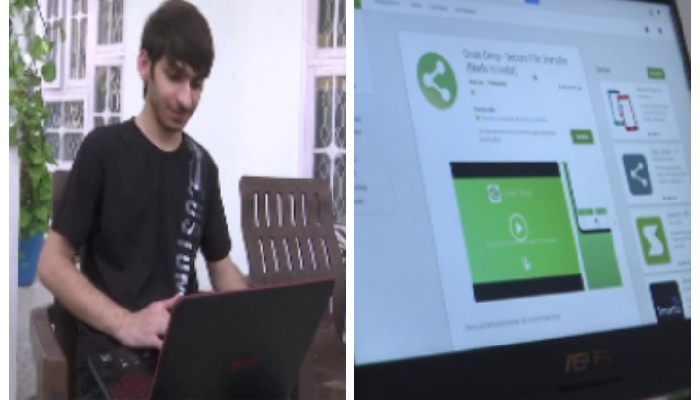
Rajouri, Aug 3: Ashfaq Mehmood Choudhary, a 17-year-old boy from Chattyear of Jammu and Kashmir's Rajouri district, has developed a file-sharing app 'Dodo Drop' which would enable users to share audios, videos, images, and texts between two devices without Internet access.

While speaking to media persons, Ashfaq Mehmood said that the 'Dodo Drop' application is an alternative to the Chinese 'SHAREit' app. "The Indian government has banned several Chinese apps due to data breaching, and among those apps was SHAREit which was used for sharing files.

Users faced a lot of problems due to the ban, and so I decided to make this file-sharing app. With 'Dodo Drop', users can share audios, videos, images, and even texts," he said.

Ashfaq said that it took him four weeks to develop the application, and it was launched on August 1 this year. The 'Dodo Drop' application has a transfer rate of up to 480 mbps, which is faster than the SHAREit app and is "quite easy" to use.

"Users can transfer data comprising photos, videos, audios, apps, texts, etc. between two devices with no Internet access. The transfers are fully encrypted and secure," he added.

"Our Prime Minister has always asserted the need for decreasing the dependency on foreign products and apps and to focus on the development of India-based apps. I tried to be part of the initiative of 'Aatmanirbhar Bharat' by developing an India-based file-sharing app. I want to develop global-standard apps for India," he added.

"We support and cooperate with him. He generates his own income by working on some projects and utilises it. We will continue to support him," said Parvez Ahmed Choudhary, Ashfaq's father.

In July, the Ministry of Electronics and Information Technology (MEITY) banned 47 apps, which were variants and cloned copies of the 59 apps banned earlier in June. These banned clones included SHAREit Lite, Tiktok Lite, Helo Lite, BIGO LIVE Lite, and VFY Lite.

The 59 apps had been banned by the Centre in June in view of the information available that they were engaged in activities which were "prejudicial to sovereignty and integrity and defence" of the country.

Almost all the apps banned had some preferential Chinese interest and the majority had parent Chinese companies.

The ban came amid border tensions with China in the Eastern Ladakh region.

Comments

Add new comment

  • Coastaldigest.com reserves the right to delete or block any comments.
  • Coastaldigset.com is not responsible for its readers’ comments.
  • Comments that are abusive, incendiary or irrelevant are strictly prohibited.
  • Please use a genuine email ID and provide your name to avoid reject.
News Network
May 14,2020

May 14: The UN’s children agency has warned that an additional 6,000 children could die daily from preventable causes over the next six months as the COVID-19 pandemic weakens the health systems and disrupts routine services, the first time that the number of children dying before their fifth birthday could increase worldwide in decades.

As the coronavirus outbreak enters its fifth month, the UN Children’s Fund (UNICEF) requested USD 1.6 billion to support its humanitarian response for children impacted by the pandemic.

The health crisis is “quickly becoming a child rights crisis. And without urgent action, a further 6,000 under-fives could die each day,” it said.

With a dramatic increase in the costs of supplies, shipment and care, the agency appeal is up from a USD 651.6 million request made in late March – reflecting the devastating socioeconomic consequences of the disease and families’ rising needs.

"Schools are closed, parents are out of work and families are under strain," UNICEF Executive Director Henrietta Fore said on Tuesday.

 “As we reimagine what a post-COVID world would look like, these funds will help us respond to the crisis, recover from its aftermath, and protect children from its knock-on effects.”

The estimate of the 6,000 additional deaths from preventable causes over the next six months is based on an analysis by researchers from the Johns Hopkins Bloomberg School of Public Health, published on Wednesday in the Lancet Global Health Journal.

UNICEF said it was based on the worst of three scenarios analysing 118 low and middle-income countries, estimating that an additional 1.2 million deaths could occur in just the next six months, due to reductions in routine health coverage, and an increase in so-called child wasting.

Around 56,700 more maternal deaths could also occur in just six months, in addition to the 144,000 likely deaths across the same group of countries. The worst case scenario, of children dying before their fifth birthdays, would represent an increase "for the first time in decades,” Fore said.

"We must not let mothers and children become collateral damage in the fight against the virus. And we must not let decades of progress on reducing preventable child and maternal deaths, be lost,” she said.

Access to essential services, like routine immunisation, has already been compromised for hundreds of millions of children and threatens a significant increase in child mortality.

According to a UNICEF analysis, some 77 per cent of children under the age of 18 worldwide are living in one of 132 countries with COVID-19 movement restrictions.

The UN agency also spotlighted that the mental health and psychosocial impact of restricted movement, school closures and subsequent isolation are likely to intensify already high levels of stress, especially for vulnerable youth.

At the same time, they maintained that children living under restricted movement and socio-economic decline are in greater jeopardy of violence and neglect. Girls and women are at increased risk of sexual and gender-based violence.

The UNICEF pointed out that in many cases, refugee, migrant and internally displaced children are experiencing reduced access to protection and services while being increasingly exposed to xenophobia and discrimination.

“We have seen what the pandemic is doing to countries with developed health systems and we are concerned about what it would do to countries with weaker systems and fewer available resources,” Fore said.

In countries suffering from humanitarian crises, UNICEF is working to prevent transmission and mitigate the collateral impacts on children, women and vulnerable populations – with a special focus on access to health, nutrition, water and sanitation, education and protection.

To date, the UN agency said it has received USD 215 million to support its pandemic response, and additional funding will help build upon already-achieved results.

Within its response, UNICEF has reached more than 1.67 billion people with COVID-19 prevention messaging around hand washing and cough and sneeze hygiene; over 12 million with critical water, sanitation and hygiene supplies; and nearly 80 million children with distance or home-based learning.

The UN agency has also shipped to 52 countries, more than 6.6 million gloves, 1.3 million surgical masks, 428,000 N95 respirators and 34,500 COVID-19 diagnostic tests, among other items.


Comments

Add new comment

  • Coastaldigest.com reserves the right to delete or block any comments.
  • Coastaldigset.com is not responsible for its readers’ comments.
  • Comments that are abusive, incendiary or irrelevant are strictly prohibited.
  • Please use a genuine email ID and provide your name to avoid reject.
News Network
June 27,2020

New Delhi, Jun 27: Delhi Environment Minister Gopal Rai on Saturday called an emergency meeting here to discuss the situation following a locust attack in neighbouring Gurugram.

The minister also directed the administration to be alert, an official said.

"After the emergency meeting, an advisory will be issued on steps to be taken to deal with the situation," Rai told PTI.

He asked the officials of the Agriculture department to make field visits to areas close to Gurugram.

The development secretary, divisional commissioner, director, Agriculture department, and the district magistrates of South Delhi and West Delhi will attend the meeting, the official said.

Earlier in the day, the skies over many parts of Gurugram turned dark as swarms of locusts descended on the town.

However, the migratory pests are likely to spare the national capital for now, officials said.

The swarms of locusts, spread across two kilometres, moved from west to east. They entered Gurugram around 11.30 am, K L Gurjar of the Locust Warning Organisation, Ministry of Agriculture, told PTI.

The pests, he said, were headed towards Faridabad and Palwal in Haryana.

Alarmed at the invasion of the locusts, which settled on trees, rooftops and plants, many residents of Gurugram shared videos from their high-rise perches.

In May, India battled a devastating desert locust outbreak. The crop-destroying swarms first attacked Rajasthan and then spread to Punjab, Gujarat, Maharashtra and Madhya Pradesh.

According to experts, broadly four species of locusts are found in India – desert locust, migratory locust, Bombay locust and tree locust. The desert locust is considered the most destructive.

It multiplies very rapidly and is capable of covering 150 kilometers in a day.

This insect, a type of a grasshopper, can eat more than its body weight. A one square kilometer of locust swarm containing around 40 million locusts can in a day eat as much food as 35,000 people.

Experts blame the growing menace of desert locusts on climate change. They say breeding of locusts is directly related to soil moisture and food availability.

Comments

Add new comment

  • Coastaldigest.com reserves the right to delete or block any comments.
  • Coastaldigset.com is not responsible for its readers’ comments.
  • Comments that are abusive, incendiary or irrelevant are strictly prohibited.
  • Please use a genuine email ID and provide your name to avoid reject.