Will bury alive those who raise slogans against Modi and Yogi: UP Minister

Agencies
January 14, 2020

Aligarh, Jan 14: Uttar Pradesh Minister Raghuraj Singh has courted a major controversy after he said that people who raise slogans against Prime Minster Narendra Modi and Uttar Pradesh Chief Minister Yogi Adityanath "would be buried alive".

The minister said this on Sunday while addressing a rally in Aligarh to muster support for the Citizenship Amendment Act (CAA) 2019.

"If you raise slogans against Prime Minister Narendra Modi or Chief Minister Yogi Adityanath, I will bury you alive," he threatened.

He was apparently referring to protests held by students of Aligarh Muslim University against the CAA during which they allegedly raised slogans against the Prime Minister and the chief minister.

The minister further said: "These one per cent people are opposing the CAA. They stay in India, eat up our taxes and then raise 'murdabad' slogans against the leaders. This country belongs to people of all faiths, but slogan shouting against the Prime Minister or chief minister is unacceptable."

He also launched an attack on India's first Prime Minister Jawaharlal Nehru. "What was Nehru's caste? He did not have a 'khaandan'," he claimed.

Raghuraj Singh is minister of state in the labour ministry in Uttar Pradesh.

Comments

Sharief
 - 
Wednesday, 15 Jan 2020

All will be burried alive including you.

Oh coward, do not bark with your majority stupids and illeterates.

Face 1 to 1.


You will know the result

Add new comment

  • Coastaldigest.com reserves the right to delete or block any comments.
  • Coastaldigset.com is not responsible for its readers’ comments.
  • Comments that are abusive, incendiary or irrelevant are strictly prohibited.
  • Please use a genuine email ID and provide your name to avoid reject.
Agencies
August 3,2020

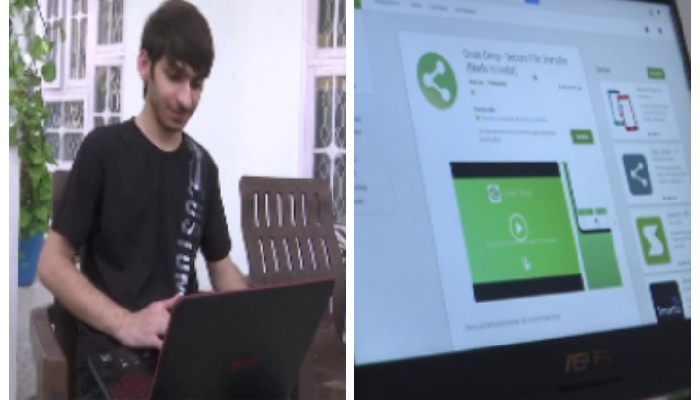
Rajouri, Aug 3: Ashfaq Mehmood Choudhary, a 17-year-old boy from Chattyear of Jammu and Kashmir's Rajouri district, has developed a file-sharing app 'Dodo Drop' which would enable users to share audios, videos, images, and texts between two devices without Internet access.

While speaking to media persons, Ashfaq Mehmood said that the 'Dodo Drop' application is an alternative to the Chinese 'SHAREit' app. "The Indian government has banned several Chinese apps due to data breaching, and among those apps was SHAREit which was used for sharing files.

Users faced a lot of problems due to the ban, and so I decided to make this file-sharing app. With 'Dodo Drop', users can share audios, videos, images, and even texts," he said.

Ashfaq said that it took him four weeks to develop the application, and it was launched on August 1 this year. The 'Dodo Drop' application has a transfer rate of up to 480 mbps, which is faster than the SHAREit app and is "quite easy" to use.

"Users can transfer data comprising photos, videos, audios, apps, texts, etc. between two devices with no Internet access. The transfers are fully encrypted and secure," he added.

"Our Prime Minister has always asserted the need for decreasing the dependency on foreign products and apps and to focus on the development of India-based apps. I tried to be part of the initiative of 'Aatmanirbhar Bharat' by developing an India-based file-sharing app. I want to develop global-standard apps for India," he added.

"We support and cooperate with him. He generates his own income by working on some projects and utilises it. We will continue to support him," said Parvez Ahmed Choudhary, Ashfaq's father.

In July, the Ministry of Electronics and Information Technology (MEITY) banned 47 apps, which were variants and cloned copies of the 59 apps banned earlier in June. These banned clones included SHAREit Lite, Tiktok Lite, Helo Lite, BIGO LIVE Lite, and VFY Lite.

The 59 apps had been banned by the Centre in June in view of the information available that they were engaged in activities which were "prejudicial to sovereignty and integrity and defence" of the country.

Almost all the apps banned had some preferential Chinese interest and the majority had parent Chinese companies.

The ban came amid border tensions with China in the Eastern Ladakh region.

Comments

Add new comment

  • Coastaldigest.com reserves the right to delete or block any comments.
  • Coastaldigset.com is not responsible for its readers’ comments.
  • Comments that are abusive, incendiary or irrelevant are strictly prohibited.
  • Please use a genuine email ID and provide your name to avoid reject.
News Network
July 18,2020

New Delhi, Jul 18: With 34,884 people testing positive for coronavirus in the last 24 hours, India's Covid-19 caseload surged to 10,38,716 while 6,53,750 patients have recovered from the disease so far, according to data by the Union Health Ministry.

The death toll due to Covid-19 rose to 26,273 with 671 fatalities reported in a day, the data updated at 8 am on Saturday showed.

At present, there are 3,58,692 active cases in the country, while 6,53,750 people have recovered so far and one has migrated.

"Around 62.94 per cent of patients have recovered so far," an official said.

The total number of confirmed cases includes foreigners.

This is the third consecutive day when the number of Covid-19 cases increased by more than 30,000.

According to the Indian Council of Medical Research (ICMR), a cumulative total of 1,34,33,742 samples have been tested for COVID-19 up to July 17 with 3,61,024 samples being tested on Friday.

Of the 671 deaths reported in the last 24 hours, 258 are from Maharashtra, 115 from Karnataka, 79 from Tamil Nadu, 42 from Andhra Pradesh, 38 from Uttar Pradesh, 26 each from West Bengal and Delhi, 17 from Gujarat, nine each from Jammu and Kashmir and Punjab, and eight each from Madhya Pradesh and Rajasthan.

Telangana has reported seven fatalities followed by Haryana with five deaths, Jharkhand, Bihar and Odisha reported four each, Assam and Puducherry have registered three each, Chhattisgarh and Goa reported two each while Kerala and Uttarakhand have registered a fatality each.

Of the total 26,273 deaths reported so far, Maharashtra accounted for the highest 11,452 fatalities followed by Delhi with 3,571 deaths, Tamil Nadu 2,315, Gujarat 2,106, Karnataka 1,147, Uttar Pradesh 1,084, West Bengal 1,049, Madhya Pradesh 697 and Rajasthan 546.

So far 534 people have died of COVID-19 in Andhra Pradesh, 403 in Telangana, 327 in Haryana, 239 in Punjab, 231 in Jammu and Kashmir, 201 in Bihar, 83 in Odisha, 51 in Uttarakhand and Assam each, 46 in Jharkhand and 38 in Kerala.

Puducherry has registered 25 deaths, Chhattisgarh 23, Goa 21, Himachal Pradesh and Chandigarh 11 each, Arunachal Pradesh and Tripura three each, Meghalaya and Dadra and Nagar Haveli and Daman and Diu two each while Ladakh has reported one fatality.

The Health Ministry stressed that more than 70 per cent of the deaths occurred due to comorbidities.

Maharashtra has reported the highest number of cases at 2,92,589 followed by Tamil Nadu at 1,60,907, Delhi at 1,20,107, Karnataka at 55,115, Gujarat at 46,430, Uttar Pradesh at 45,163 and Telangana at 42,496.

The number of Covid-19 cases has gone up to 40,646 in Andhra Pradesh, 38,011 in West Bengal, 27,789 in Rajasthan, 24,797 in Haryana, 23,589 in Bihar and 21,081 in Madhya Pradesh.

Assam has instances of 20,646 infections, Odisha 16,110 and Jammu and Kashmir 12,757 cases. Kerala has reported 11,066 novel coronavirus infections so far, while Punjab has 9,442 cases.

A total of 4,964 have been infected by the virus in Chhattisgarh, 4,921 in Jharkhand, 4,102 in Uttarakhand, 3,304 in Goa, 2,366 in Tripura, 1,832 in Puducherry, 1,800 in Manipur, 1,417 in Himachal Pradesh and 1,151 in Ladakh.

Nagaland has recorded 956 Covid-19 cases, Chandigarh 660, Arunachal Pradesh 609 and Dadra and Nagar Haveli and Daman and Diu together have reported 585 cases.

Meghalaya has reported 403 cases, Mizoram 282, Sikkim has registered 266 infections so far, while Andaman and Nicobar Islands has recorded 194 cases.

"Our figures are being reconciled with the ICMR," the ministry said, adding that 163 cases are being reassigned to states.

State-wise distribution is subject to further verification and reconciliation, it added.

Comments

Add new comment

  • Coastaldigest.com reserves the right to delete or block any comments.
  • Coastaldigset.com is not responsible for its readers’ comments.
  • Comments that are abusive, incendiary or irrelevant are strictly prohibited.
  • Please use a genuine email ID and provide your name to avoid reject.
News Network
January 13,2020

Jan 13: For the first time in years, the government of India’s Prime Minister Narendra Modi is playing defense. Protests have sprung up across the country against an amendment to India’s laws — which came into effect on Friday — that makes it easier for members of some religions to become citizens of India. The government claims this is simply an attempt to protect religious minorities in the Muslim-majority countries that border India; but protesters see it as the first step toward a formal repudiation of India’s constitutionally guaranteed secularism — and one that must be resisted.

Modi was re-elected prime minister last year with an enhanced majority; his hold over the country’s politics is absolute. The formal opposition is weak, discredited and disorganized. Yet, somehow, the anti-Citizenship Act protests have taken hold. No political party is behind them; they are generally arranged by student unions, neighborhood associations and the like.

Yet this aspect of their character is precisely what will worry Modi and his right-hand man, Home Minister Amit Shah. They know how to mock and delegitimize opposition parties with ruthless efficiency. Yet creating a narrative that paints large, flag-waving crowds as traitors is not quite that easy.

For that is how these protests look: large groups of young people, many carrying witty signs and the national flag. They meet and read the preamble to India’s Constitution, into which the promise of secularism was written in the 1970’s.

They carry photographs of the Constitution’s drafter, the Columbia University-trained economist and lawyer B. R. Ambedkar. These are not the mobs the government wanted. They hoped for angry Muslims rampaging through the streets of India’s cities, whom they could point to and say: “See? We must protect you from them.” But, in spite of sometimes brutal repression, the protests have largely been nonviolent.

One, in Shaheen Bagh in a Muslim-dominated sector of New Delhi, began simply as a set of local women in a square, armed with hot tea and blankets against the chill Delhi winter. It has now become the focal point of a very different sort of resistance than what the government expected. Nothing could cure the delusions of India’s Hindu middle class, trained to see India’s Muslims as dangerous threats, as effectively as a group of otherwise clearly apolitical women sipping sweet tea and sharing their fears and food with anyone who will listen.

Modi was re-elected less than a year ago; what could have changed in India since then? Not much, I suspect, in most places that voted for him and his party — particularly the vast rural hinterland of northern India. But urban India was also possibly never quite as content as electoral results suggested. India’s growth dipped below 5% in recent quarters; demand has crashed, and uncertainty about the future is widespread. Worse, the government’s response to the protests was clearly ill-judged. University campuses were attacked, in one case by the police and later by masked men almost certainly connected to the ruling party.

Protesters were harassed and detained with little cause. The courts seemed uninterested. And, slowly, anger began to grow on social media — not just on Twitter, but also on Instagram, previously the preserve of pretty bowls of salad. Instagram is the one social medium over which Modi’s party does not have a stranglehold; and it is where these protests, with their photogenic signs and flags, have found a natural home. As a result, people across urban India who would never previously have gone to a demonstration or a political rally have been slowly politicized.

India is, in fact, becoming more like a normal democracy. “Normal,” that is, for the 2020’s. Liberal democracies across the world are politically divided, often between more liberal urban centers and coasts, and angrier, “left-behind” hinterlands. Modi’s political secret was that he was that rare populist who could unite both the hopeful cities and the resentful countryside. Yet this once magic formula seems to have become ineffective. Five of India’s six largest cities are not ruled by Modi’s Bharatiya Janata Party in any case — the financial hub of Mumbai changed hands recently. The BJP has set its sights on winning state elections in Delhi in a few weeks. Which way the capital’s voters will go is uncertain. But that itself is revealing — last year, Modi swept all seven parliamentary seats in Delhi.

In the end, the Citizenship Amendment Act is now law, the BJP might manage to win Delhi, and the protests might die down as the days get unmanageably hot and state repression increases. But urban India has put Modi on notice. His days of being India’s unifier are over: From now on, like all the other populists, he will have to keep one eye on the streets of his country’s cities.

Comments

Add new comment

  • Coastaldigest.com reserves the right to delete or block any comments.
  • Coastaldigset.com is not responsible for its readers’ comments.
  • Comments that are abusive, incendiary or irrelevant are strictly prohibited.
  • Please use a genuine email ID and provide your name to avoid reject.