



Will have to take military way if India doesn't listen, warns China

Agencies
July 4, 2017

Beijing, Jul 4: China would be forced to use a "military way" to end the standoff in the Sikkim sector if India "refuses to listen" to it, a Chinese expert has warned.
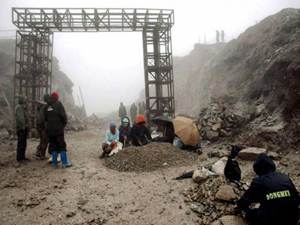
china copy copyAs the standoff at the Doklam area continued for the third week, the longest between the two countries, the official media and the think-tanks here have said that "war is possible if the conflict between India and China is not handled properly".

"China is trying its best to use historical lessons to reason with India and show sincerity in peacefully solving the problem, but if India refuses to listen, then China would have no other choice than to use a military way of solving the problem," Hu Zhiyong, a research fellow at the Shanghai Academy of Social Sciences, told the state-run Global Times.

Hu claimed that India is provoking China because it wanted to prove to the US that it could contain China while Prime Minister Narendra Modi was in the US.

But Hu said Trump was not like his predecessor Barack Obama.

"Obama believes India is important only because they share the same values, but Trump is very pragmatic, and he doesn't treat India as a valuable ally because New Delhi is too weak to confront Beijing," Hu opined.

Although India always treats China as its biggest rival, China does not think so as India lags far behind China, Song Zhongping, a Beijing-based military expert, was quoted as saying by the daily.

"Experts also scoffed at India's military threat after Indian Defense Minister Arun Jaitely asserted on Friday that the India of 2017 is different from what it was in 1962," said the report in the daily, known for its nationalist stance.

"The gap between the militaries of China and India today is even bigger than in 1962, and I hope India can keep calm for its own good," Hu said.

Since the standoff on June 6, when the People's Liberation Army (PLA) destroyed bunkers of the India Army claiming the area belonged to China, Chinese media have carried several pieces warning India for escalating border tension and "reminding" the Indian Army about the 1962 war.

Of the 3,488-km-long India-China border from Jammu and Kashmir to Arunachal Pradesh, a 220-km section falls in Sikkim.

Comments

Salman sheikh
 - 
Friday, 7 Jul 2017

There is a name of the film in tulu which have been released recently which suites them \AREYMARLER\"
This bloody goon is disturbing peace in DK ...only becoz of him innocent ppl has to lose their lives.."

Add new comment

  • Coastaldigest.com reserves the right to delete or block any comments.
  • Coastaldigset.com is not responsible for its readers’ comments.
  • Comments that are abusive, incendiary or irrelevant are strictly prohibited.
  • Please use a genuine email ID and provide your name to avoid reject.
News Network
June 11,2020

Beijing, Jun 11: Floods and mudslides in south China have uprooted hundreds of thousands of people and left dozens dead or missing, state media reported Thursday.

The bad weather has wreaked havoc on popular tourist areas that had already been battered by months of travel restrictions during the coronavirus outbreak.

Torrential downpours unleashed floods and mudslides that caused nearly 230,000 people to be relocated and destroyed more than 1,300 houses, official state news agency Xinhua reported, citing the Ministry of Emergency Management.

In southern Guangxi Zhuang Autonomous Region, six people were reported dead and one missing, Xinhua said.

Streets were waterlogged in popular tourist destination Yangshuo, forcing residents and visitors to evacuate on bamboo rafts.

The local government said more than 1,000 hotels had been flooded and more than 30 tourist sites damaged.

One owner of a family-run hotel told Xinhua that the guest rooms were submerged in one metre (three feet) of rainwater.

The extreme weather has dealt a hefty blow to the region's tourism sector, which is still reeling from the COVID-19 epidemic.

The emergency management ministry said there were direct economic losses of over 4 billion yuan (more than $550 million) from the flooding, Xinhua reported.

In Hunan Province, at least 13 people were killed in rain-triggered disasters, and another eight people are missing or killed in southwestern Guizhou province, according to the local emergency response departments, Xinhua said.

The heavy downpours began at the beginning of June and have led to "dangerously high water levels" in 110 rivers, Xinhua reported.

Further rainstorms are expected in the next few days across the south.

Comments

Add new comment

  • Coastaldigest.com reserves the right to delete or block any comments.
  • Coastaldigset.com is not responsible for its readers’ comments.
  • Comments that are abusive, incendiary or irrelevant are strictly prohibited.
  • Please use a genuine email ID and provide your name to avoid reject.
Agencies
January 11,2020

Washington, Jan 11: US President Donald Trump has signed an executive order imposing another set of crippling sanctions against Iran, targeting several of its top leaders, military commanders, and its infrastructure industry, according to a statement from the White House on Friday.

Trump said the executive order authorises the imposition of sanctions against any individual or entity operating in the construction, manufacturing, textiles, or mining sectors of the Iranian economy or anyone assisting those who engage in this sanctioned business.

The sanctions are the latest in a series of retaliatory measures between the two nations.

Iran's powerful military commander Qasem Soleimani was killed last Friday in US drone strikes, ordered by President Trump, bringing the entire Gulf region close to a full-blown conflict.

Regional tensions remained high after Iran on Wednesday fired missiles at two bases in Iraq used by US forces.

"Today, I am holding the Iranian regime responsible for attacks against United States personnel and interests by denying it substantial revenue that may be used to fund and support its nuclear program, missile development, terrorism and terrorist proxy networks, and malign regional influence," said Trump on Friday, after signing the executive order.

"This order will have a major impact on the Iranian economy, authorising powerful secondary sanctions on foreign financial institutions.

"The Iranian regime has threatened United States military service members, diplomats, and civilians, as well as the citizens and interests of our allies and partners, through military force and proxy groups. The United States will continue to counter the Iranian regime's destructive and destabilising behaviour," the president said.

Trump said the economic sanctions will remain till the Iranian regime changes its behaviour.

Earlier at a White House news conference, Treasury Secretary Steven Mnuchin, along with cabinet colleague Secretary of State Mike Pompeo, said the US will continue its economic and diplomatic sanctions on Iran till Tehran announces it will not pursue the nuclear weapons program and stop its destabilising behaviour in the region.

The eight senior Iranian regime officials against whom sanctions have been issued include Ali Shamkhani, the Secretary of Iran's Supreme National Security Council, Mohammad Reza Ashtiani, the Deputy Chief of Staff of Iranian armed forces, and Gholamreza Soleimani, the head of the Basij militia of the Islamic Revolutionary Guards Corps (IRGC).

The sanction on the Iranian officials would mean denial of visa to the US and seizure of assets, among others.

In addition, the treasury designated 17 Iranian metals producers and mining companies, a network of three China-and Seychelles-based entities, and a vessel involved in the purchase, sale, and transfer of Iranian metals products, as well as in the provision of critical metals production components to Iranian metal producers.

"The United States is targeting senior Iranian officials for their involvement and complicity in Tuesday's ballistic missile strikes," Mnuchin said.

"We are also designating Iran's largest metals manufacturers, and imposing sanctions on new sectors of the Iranian economy including construction, manufacturing, and mining. These sanctions will continue until the regime stops the funding of global terrorism and commits to never having nuclear weapons," he added.

Pompeo told reporters that Iran was planning "broad, large-scale attacks" against American interests in the Middle East, including embassies.

The latest round of sanctions are aimed at striking at the heart of Iran's internal security apparatus, he said.

"The president has been very clear: we will continue to apply economic sanctions until Iran stops its terrorist activities and commits that it will never have nuclear weapons," Mnuchin said.

Comments

Add new comment

  • Coastaldigest.com reserves the right to delete or block any comments.
  • Coastaldigset.com is not responsible for its readers’ comments.
  • Comments that are abusive, incendiary or irrelevant are strictly prohibited.
  • Please use a genuine email ID and provide your name to avoid reject.
News Network
March 5,2020

Washington, Feb 5: Experts warned a US government panel last night that India's Muslims face risks of expulsion and persecution under the country’s new Citizenship Amendment Act (CAA) which has triggered major protests.

The hearing held inside Congress was called by the US Commission on International Freedom, which has been denounced by the Indian government as biased.

Ashutosh Varshney, a prominent scholar of sectarian violence in India, told the panel that the law championed by prime minister Narendra Modi's government amounted to a move to narrow the democracy's historically inclusive and secular definition of citizenship.

"The threat is serious, and the implications quite horrendous," said Varshney, a professor at Brown University.

"Something deeply injurious to the Muslim minority can happen once their citizenship rights are taken away," he said.

Varshney warned that the law could ultimately lead to expulsion or detention -- but, even if not, contributes to marginalization.

"It creates an enabling atmosphere for violence once you say that a particular community is not fully Indian or its Indianness in grave doubt," he said.

India's parliament in December passed a law that fast-tracks citizenship for persecuted non-Muslim minorities from neighboring countries.

Responding to criticism at the time from the US commission, which advises but does not set policy, India's External Affairs Ministry said the law does not strip anyone's citizenship and "should be welcomed, not criticized, by those who are genuinely committed to religious freedom."

Fears are particularly acute in Assam, where a citizens' register finalized last year left 1.9 million people, many of them Muslims, facing possible statelessness.

Aman Wadud, a human rights lawyer from Assam who traveled to Washington for the hearing, said that many Indians lacked birth certificates or other documentation to prove citizenship and were only seeking "a dignified life."

The hearing did not exclusively focus on India, with commissioners and witnesses voicing grave concern over Myanmar's refusal to grant citizenship to the Rohingya, the mostly Muslim minority that has faced widespread violence.

Gayle Manchin, the vice chair of the commission, also voiced concern over Bahrain's stripping of citizenship from activists of the Shiite majority as well as a new digital ID system in Kenya that she said risks excluding minorities.

More than 40 people were killed last week in New Delhi in sectarian violence sparked by the citizenship law.

India on Tuesday lodged another protest after the UN human rights chief, Michele Bachelet, sought to join a lawsuit in India that challenges the citizenship law's constitutionality.

Comments

Add new comment

  • Coastaldigest.com reserves the right to delete or block any comments.
  • Coastaldigset.com is not responsible for its readers’ comments.
  • Comments that are abusive, incendiary or irrelevant are strictly prohibited.
  • Please use a genuine email ID and provide your name to avoid reject.