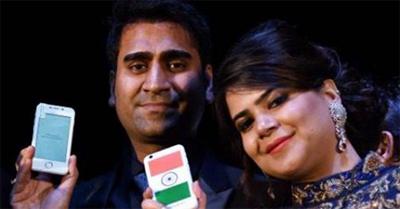
Will make profit of Rs 31 on each Rs 251 Smartphone: Mohit Goel

February 22, 2016

New Delhi, Feb 22: Since he announced the launch of a mobile phone for Rs 251, Mohit Goel has faced widespread scepticism, along with visits by police and income tax officials at his rented two-storey office in Noida. However, the Amity University graduate insists that he will not only deliver the phones at the stunning price he has quoted, but also make a profit of Rs 31 on each handset sold.
mohith1"Why am I being hounded? What wrong have I done?" Goel asked in the course of an exclusive interview with TOI. The director of Ringing Bells insists that his new venture is not a fly-by-night operation and will begin customer deliveries from April 15. "Has there ever been a case of income-tax evasion against me or my company, or has there been an FIR filed against me in any police station? Why am I being called a 'bhagora' (who'll run away with the money)? I intend to do a valid business, just like any other startup, and I have a business plan ready."

The company claims it has received over 7 crore registrations on its website since it started accepting applications on February 18. "We are taking online bookings for only 25 lakh units in the first batch due to limited supplies, while giving another 25 lakh through offline distributors. I will deliver the handsets before June 30. All the money that we receive from customers through the payment gateway will be kept in an escrow account and we will touch it only when we deliver the devices." The company has an account with ICICI Bank.

Goel, and his much-older confidant Ashok Chadha, who is the president of the company, insists that there have not been any infringements on design and other matters. "Some of the devices had the Adcom branding as we sourced panel (screen) from them. However, the final device will have our branding and the phone will have the same features and design that we had showcased."

The dual SIM Freedom 251 device carries a 4-inch display, 1 GB RAM, 8GB internal memory with a 1.3 GHZ quad-core processor, dual cameras and comes with a charger, headphone and one-year warranty.

The duo say that they have a carefully laid-out business model to manage the disruptive price for the device "The price that works out per device is roughly around Rs 1,500," Chadha says. insists, though significantly lowering it down from the Rs 2,500 he had announced on the day of the unveiling of the device. "We will source the devices from a supplier in Noida, who will be assembling the units for us after getting components from Taiwan." And while we do this, we also start the work to identify land and suppliers for setting up our manufacturing locations. For this, we have identified Noida while also looking at locations in Uttarakhand, West Bengal, Bihar and Punjab," Chadha says.

And just how does he bring down the cost to Rs 251, and also earn a profit? "Economies of scale gets it down to around Rs 1,200, and thereafter an online sales model cuts down marketing and sales expenses, giving us further savings," he says. And to this we will add marketing piggybacks from companies whose applications we load on the devices. We will save around Rs 300 per device more through this," Chadha says.

The unveiling of the phone on February 17 had created quite a flutter among existing handset suppliers, prompting industry body Indian Cellular Association to file a complaint with the government. (ICA) - which has members such as Samsung, Apple, Sony, Lava, Micromax, Karbonn, Motorola and HTC - ICA president Pankaj Mohindroo wrote a letter to telecom minister Ravi Shankar Prasad, expressing doubts about the intentions of Ringing Bells, saying it is not possible to supply a phone for Rs 251. Also, there were allegations that the company had ripped off the design of the prototype from American phone major Apple's iPhone, while also giving out devices sourced from a local electronics importer Adcom.

The company is also talking to large e-commerce companies, such as travel website Goibibo, to get their apps on the devices. "We will also monetize from the heavy traffic on our website and will make it into a marketplace for other brands to hop on. This will also help us to bring down the cost."

Comments

rampa
 - 
Monday, 22 Feb 2016

I think battery only original.

Add new comment

  • Coastaldigest.com reserves the right to delete or block any comments.
  • Coastaldigset.com is not responsible for its readers’ comments.
  • Comments that are abusive, incendiary or irrelevant are strictly prohibited.
  • Please use a genuine email ID and provide your name to avoid reject.
News Network
January 28,2020

Bengaluru, Jan 28: Brace for hefty traffic penalties as the state government is all set to reverse a notification on revised fines which came into effect last September following pushback from road users and opposition parties.

The Karnataka government will implement traffic penalties as stipulated in the amended Motor Vehicles Act, 2019, in a phased manner following a diktat from the Centre. The government did not specify the timeline for it.

“At a recent meeting of transport ministers from various states, the Union government explained why it wanted to implement these huge fines. We found it convincing and will implement it in its original form,” said transport minister Laxman Savadi on Monday.

Savadi said India’s image globally has taken a beating due to the high number of road deaths and the Centre wants to change it at any cost. However, he said the entire set of hefty fines would not be reintroduced all at once.

BJP govt revised rates in Sept

The BJP government last September had revised fines on compoundable offences and those which are fined on the spot by traffic cops by 50%- 80%, barring drunken driving and racing.

As per the revised rates, helmetless riding attracted a penalty of Rs 500 against Rs 1,000 notified by the Centre. Driving without a licence attracted a fine of Rs 1,000 for

two- and three-wheelers and Rs 2,000 for light motor vehicles as against the earlier Rs 5,000 for all types of vehicles.

The central government recently told states and Union Territories they should enforce fines as per the amended Act and they cannot be rolled back. The road transport and highways ministry said fines cannot be reduced below the minimum amount fixed by law, unless the President gives his assent.

Comments

Add new comment

  • Coastaldigest.com reserves the right to delete or block any comments.
  • Coastaldigset.com is not responsible for its readers’ comments.
  • Comments that are abusive, incendiary or irrelevant are strictly prohibited.
  • Please use a genuine email ID and provide your name to avoid reject.
coastaldigest.com news network
August 2,2020

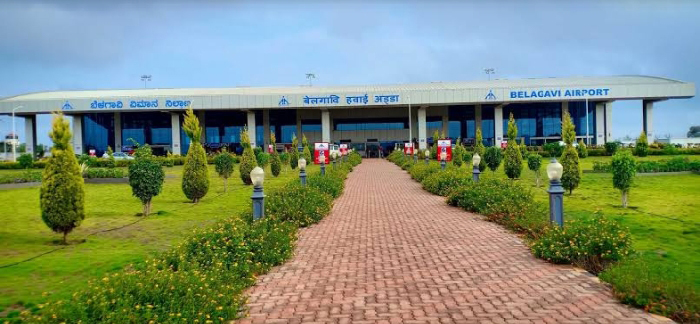
Bengaluru, Aug 2: All the seven Airports in Karnataka have seen poor traffic even after the restoration of domestic flight services post covid-19 lockdown. Interestingly, Mangaluru International Airport, the second biggest in the state, has slipped to third position in number of number of passengers and flights. 

Of all the seven airports in State-- Bengaluru, Mangaluru, Hubballi, Belagavi, Mysuru, Kalaburagi and Vijaynagara (Hosapete)-- it was the Sambra (Belagavi) airport which saw the highest number of passengers and flights after Bengaluru. 

According to Airports Authority of India report released on their website recently, the Sambra airport outperformed the Managluru international airport in June. 

As many 10,224 passengers travelled to or from Belagavi airport in June, whereas Mangaluru airport saw a footfall of only 8,608 passengers including 3,726 international and 4,882 domestic passengers. Belagavi airport handled 391 flights whereas Mangaluru airport handled 190 flights.

Even the Bengaluru international airport saw a decline in the number of passengers and flights in June. Only 3.69 lakh domestic and 10,654 international passengers arrived or departed from Kempegowda International Airport, Bengaluru in June as against 27.59 lakh total passengers in June 2019. 

Between April-June 2020 the Bengaluru airport saw only 4.54 lakh total passengers (domestic and international) as against 84.11 lakh total passenger during the same period last year. The number of flights to and from Bengaluru also saw a huge dip in June with only 731 international (2,582 in June 2019) and 4290 domestic (16,216 in June 2019) flights.

Though the Mysuru domestic airport handled a higher number of flights compared to last June, the number of passengers either arriving or departing saw a decline. Last year June 4,775 passengers travelled in 96 flights, whereas in June 2020 the airport handled 3,158 passengers and 330 flights.

Hubballi airport saw the least number of passengers or flights among the seven airports in Karnataka in June. It saw only 55 passengers either arriving or departing from the city's airport in 14 flights in the month of June. In the same month last year, Hubballi airport, which was third busiest before the pandemic, had facilitated 45,973 passengers and handled 604 flights.

Since April 2020 to June, the Hubballi airport has handled only 18 flights (as against 1,958 during the same period last year) and 122 passengers (1,50,416 between April-June 2019).

Comments

Add new comment

  • Coastaldigest.com reserves the right to delete or block any comments.
  • Coastaldigset.com is not responsible for its readers’ comments.
  • Comments that are abusive, incendiary or irrelevant are strictly prohibited.
  • Please use a genuine email ID and provide your name to avoid reject.
News Network
March 3,2020

Dubai, Mar 3: Abu Dhabi-based Indian retail tycoon MA Yusuff Ali has become the first Indian to receive Saudi Arabia's premium residency, his office said in a statement on Monday.

Yusuff Ali, 64, is the chairman of the LuLu Group, who was ranked the richest expat in the UAE by the Forbes magazine last year.

The permit, informally known as Saudi Green Card, grants expatriates the right to live, work and own business and property in the Kingdom without need for a sponsor, the LULU group said in a statement.

The introduction of the Premium Residency comes as a part of Saudi Arabia's Vision 2030 reform plan, which was announced by Crown Prince Mohammed bin Salman to boost the Saudi economy, the statement said.

Yusuff Ali said "obviously a very proud and humbling moment in my life. This is a great honour not only for me but for the entire Indian expat community and I sincerely thank the HM the King Salman, HRH Crown Prince Mohamed bin Salman and the government of Saudi Arabia."

"@Yusuffali_MA , an investor from India, after obtaining Premium Residency in Saudi Arabia: ''The Kingdom became an attractive investment destination due to the remarkable growth in economy," Premium Residency tweeted on Monday.

Yusuff Ali said he was sure that this new permanent residency initiative will further boost Saudi Arabia's image as one of the key investments and business hubs of the region as well as attract and retain new investors.

This initiative is targeting key investors and prominent personalities from various fields, including sports, arts & culture, who have played a defining role in the nation building process.

The Lulu Group owns and operates more than 35 hypermarkets and supermarkets in Saudi Arabia, which includes ARAMCO Commissaries and National Guards super stores.

Comments

Add new comment

  • Coastaldigest.com reserves the right to delete or block any comments.
  • Coastaldigset.com is not responsible for its readers’ comments.
  • Comments that are abusive, incendiary or irrelevant are strictly prohibited.
  • Please use a genuine email ID and provide your name to avoid reject.