


Will make profit of Rs 31 on each Rs 251 Smartphone: Mohit Goel

February 22, 2016

New Delhi, Feb 22: Since he announced the launch of a mobile phone for Rs 251, Mohit Goel has faced widespread scepticism, along with visits by police and income tax officials at his rented two-storey office in Noida. However, the Amity University graduate insists that he will not only deliver the phones at the stunning price he has quoted, but also make a profit of Rs 31 on each handset sold.
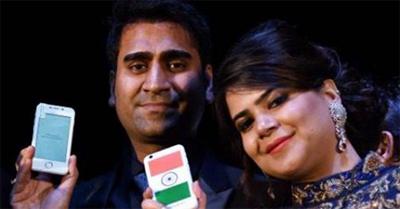
mohith1"Why am I being hounded? What wrong have I done?" Goel asked in the course of an exclusive interview with TOI. The director of Ringing Bells insists that his new venture is not a fly-by-night operation and will begin customer deliveries from April 15. "Has there ever been a case of income-tax evasion against me or my company, or has there been an FIR filed against me in any police station? Why am I being called a 'bhagora' (who'll run away with the money)? I intend to do a valid business, just like any other startup, and I have a business plan ready."

The company claims it has received over 7 crore registrations on its website since it started accepting applications on February 18. "We are taking online bookings for only 25 lakh units in the first batch due to limited supplies, while giving another 25 lakh through offline distributors. I will deliver the handsets before June 30. All the money that we receive from customers through the payment gateway will be kept in an escrow account and we will touch it only when we deliver the devices." The company has an account with ICICI Bank.

Goel, and his much-older confidant Ashok Chadha, who is the president of the company, insists that there have not been any infringements on design and other matters. "Some of the devices had the Adcom branding as we sourced panel (screen) from them. However, the final device will have our branding and the phone will have the same features and design that we had showcased."

The dual SIM Freedom 251 device carries a 4-inch display, 1 GB RAM, 8GB internal memory with a 1.3 GHZ quad-core processor, dual cameras and comes with a charger, headphone and one-year warranty.

The duo say that they have a carefully laid-out business model to manage the disruptive price for the device "The price that works out per device is roughly around Rs 1,500," Chadha says. insists, though significantly lowering it down from the Rs 2,500 he had announced on the day of the unveiling of the device. "We will source the devices from a supplier in Noida, who will be assembling the units for us after getting components from Taiwan." And while we do this, we also start the work to identify land and suppliers for setting up our manufacturing locations. For this, we have identified Noida while also looking at locations in Uttarakhand, West Bengal, Bihar and Punjab," Chadha says.

And just how does he bring down the cost to Rs 251, and also earn a profit? "Economies of scale gets it down to around Rs 1,200, and thereafter an online sales model cuts down marketing and sales expenses, giving us further savings," he says. And to this we will add marketing piggybacks from companies whose applications we load on the devices. We will save around Rs 300 per device more through this," Chadha says.

The unveiling of the phone on February 17 had created quite a flutter among existing handset suppliers, prompting industry body Indian Cellular Association to file a complaint with the government. (ICA) - which has members such as Samsung, Apple, Sony, Lava, Micromax, Karbonn, Motorola and HTC - ICA president Pankaj Mohindroo wrote a letter to telecom minister Ravi Shankar Prasad, expressing doubts about the intentions of Ringing Bells, saying it is not possible to supply a phone for Rs 251. Also, there were allegations that the company had ripped off the design of the prototype from American phone major Apple's iPhone, while also giving out devices sourced from a local electronics importer Adcom.

The company is also talking to large e-commerce companies, such as travel website Goibibo, to get their apps on the devices. "We will also monetize from the heavy traffic on our website and will make it into a marketplace for other brands to hop on. This will also help us to bring down the cost."

Comments

rampa
 - 
Monday, 22 Feb 2016

I think battery only original.

Add new comment

  • Coastaldigest.com reserves the right to delete or block any comments.
  • Coastaldigset.com is not responsible for its readers’ comments.
  • Comments that are abusive, incendiary or irrelevant are strictly prohibited.
  • Please use a genuine email ID and provide your name to avoid reject.
News Network
March 14,2020

Hyderabad, Mar 14: Telangana Public Health Director Dr Srinivas on Friday said that 34 people, who came in contact with the 76-year-old Karnataka man who died of coronavirus, have been identified in the state.

"So far, 34 people who came in contact with him have been traced and are kept under strict home isolation by the Telangana health authorities. As of now, all the contacts are stable and under active surveillance by the health teams of the Telangana government," Srinivas said.

He added that the rapid response team of the state is further searching for the persons who might have come in contact with the person who died of COVID-19.

"Telangana health authorities were alerted by the Karnataka government after the 76-year-old man's samples tested positive for coronavirus after his death. The man has visited two hospitals in Hyderabad before he died in Karnataka," Srinivas further said.

The Karnataka man, who had died a few days ago, was confirmed to have tested positive for COVID-19.

Meanwhile, Telangana Health Minister's office said that the lone coronavirus patient from the state has recovered and is going to be discharged from the hospital soon.

The development comes after 82 confirmed cases of coronavirus and two deaths related to the lethal infection have been reported in the country.

Comments

Add new comment

  • Coastaldigest.com reserves the right to delete or block any comments.
  • Coastaldigset.com is not responsible for its readers’ comments.
  • Comments that are abusive, incendiary or irrelevant are strictly prohibited.
  • Please use a genuine email ID and provide your name to avoid reject.
Ram Puniyani
March 14,2020

In the wake of Citizenship Amendment Act (CAA) UN High Commissioner, Michele Bachelet, has filed an intervention in the Supreme Court petition challenging the constitutionality of the Citizenship Amendment Act, as she is critical of CAA. Responding to her, India’s Foreign Minister S. Jai Shanker strongly rebutted her criticism, saying that the body (UNHCR) has been wrong and is blind to the problem of cross border terrorism. The issue on hand is the possibility of scores of people, mainly Muslims, being declared as stateless. The problem at hand is the massive exercise of going through the responses/documents from over 120 crore of Indian population and screening documents, which as seen in Assam, yield result which are far from truthful or necessary.

The issue of CAA has been extensively debated and despite heavy critique of the same by large number of groups and despite the biggest mass opposition ever to any move in Independent India, the Government is determined on going ahead with an exercise which is reminiscent of the dreaded regimes which are sectarian and heartless to its citizens, which have indulged in extinction of large mass of people on grounds of citizenship, race etc. The Foreign minister’s assertion is that it is a matter internal to India, where India’s sovereignty is all that matters! As far as sovereignty is concerned we should be clear that in current times any sovereign power has to consider the need to uphold the citizenship as per the principle of non-discrimination which is stipulated in Art.26 of the International Covenant on Civil and Political (ICCPR) rights.

Can such policies, which affect large number of people and are likely to affect their citizenship be purely regarded as ‘internal’? With the World turning into a global village, some global norms have been formulated during last few decades. The norms relate to Human rights and migrations have been codified. India is also signatory to many such covenants in including ICCPR, which deals with the norms for dealing with refugees from other countries. One is not talking of Chicago speech of Swami Vivekanand, which said that India’s greatness has been in giving shelter to people from different parts of the World; one is also not talking of the Tattariaya Upanishad’s ‘Atithi Devovhav’ or ‘Vasudhaiva Kutumbkam’ from Mahaupanishad today.

What are being talked about are the values and opinions of organizations which want to ensure to preserve of Human rights of all people Worldwide. In this matter India is calling United Nations body as ‘foreign party’; having no locus standi in the case as it pertains to India’s sovereignty. The truth is that since various countries are signatories to UN covenants, UN bodies have been monitoring the moves of different states and intervening at legal level as Amicus (Friend of the Court) to the courts in different countries and different global bodies. Just to mention some of these, UN and High Commissioner for Human Rights has often submitted amicus briefs in different judicial platforms. Some examples are their intervention in US Supreme Court, European Court of Human Rights, International Criminal Court, and the Inter-American Court of Human Rights. These are meant to help the Courts in areas where UN bodies have expertise.

 Expertise on this has been jointly formulated by various nations. These interventions also remind the nations as to what global norms have been evolved and what are the obligations of individual states to the values which have evolved over a period of time. Arvind Narrain draws our attention to the fact that, “commission has intervened in the European Court of Human Rights in cases involving Spain and Italy to underscore the principle of non-refoulement, which bars compulsory expulsion of illegal migrants… Similarly, the UN has intervened in the International Criminal Court in a case against the Central African Republic to explicate on the international jurisprudence on rape as a war crime.”

From time to time organizations like Amnesty International and Human Rights Watch have been monitoring the status of Human rights of different countries. This puts those countries in uncomfortable situation and is not welcome by those establishments. How should this contradiction between ‘internal matter’, ‘sovereignty’ and the norms for Human rights be resolved? This is a tough question at the time when the freedom indices and democratic ethos are sliding downwards all over the world. In India too has slid down on the scale of these norms.

In India we can look at the intervention of UN body from the angle of equality and non discrimination. Democratic spirit should encourage us to have a rethink on the matters which have been decided by the state. In the face of the greatest mass movement of Shaheen bagh, the state does need to look inwards and give a thought to international morality, the spirit of global family to state the least.

The popular perception is that when Christians were being persecuted in Kandhmal the global Christian community’s voice was not strong enough. Currently in the face of Delhi carnage many a Muslim majority countries have spoken. While Mr. Modi claims that his good relations with Muslim countries are a matter of heartburn to the parties like Congress, he needs to relook at his self gloating. Currently Iran, Malaysia, Indonesia and many Muslim majority countries have spoken against what Modi regime is unleashing in India. Bangladesh, our neighbor, has also seen various protests against the plight of Muslims in India. More than the ‘internal matter’ etc. what needs to be thought out is the moral aspect of the whole issue. We pride ourselves in treading the path of morality. What does that say in present context when while large section of local media is servile to the state, section of global media has strongly brought forward what is happening to minorities in India.   

The hope is that Indian Government wakes up to its International obligations, to the worsening of India’s image in the World due to CAA and the horrific violence witnessed in Delhi.

Comments

Add new comment

  • Coastaldigest.com reserves the right to delete or block any comments.
  • Coastaldigset.com is not responsible for its readers’ comments.
  • Comments that are abusive, incendiary or irrelevant are strictly prohibited.
  • Please use a genuine email ID and provide your name to avoid reject.
News Network
January 16,2020

Bengaluru, Jan 16: It was necessary to revise rates under the ECHS, CGHS and GIPSA schemes for private hospitals to be able to sustain, doctors from private hospitals have opined.

Under the banner of the Association of Healthcare Providers of India (AHPI), doctors from top private hospitals in the city spoke about the dues pending from the union government schemes. They said they could not give a deadline as to when they would stop offering the scheme.

In a press release issued here on Thursday association said, which had previously told the government that they would not treat patients under the scheme owing to dues, mellowed down after the government released Rs 250 crore out of the Rs 1,000 crore dues.

Comments

Add new comment

  • Coastaldigest.com reserves the right to delete or block any comments.
  • Coastaldigset.com is not responsible for its readers’ comments.
  • Comments that are abusive, incendiary or irrelevant are strictly prohibited.
  • Please use a genuine email ID and provide your name to avoid reject.