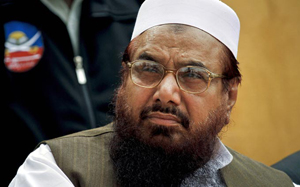
Will not allow Hindu temples in Pakistan to be destroyed: Hafiz Saeed

May 3, 2016

Islamabad May 3: Chief of Pakistan's banned JuD, Hafiz Saeed, has said his organisation will not allow destruction of Hindu temples and other holy places of non- Muslims in the country.hafiz-saeed

It was Muslims' responsibility to safeguard holy places of their Hindus brethren, he said while addressing a meeting in Matli town of Sindh province yesterday.

“We will not allow destruction of temples and other holy places of non-Muslims in the country,” he warned.

The Jamaat-ud-Dawa (JuD) chief rejected allegations that his organisation is promoting extremism in Thar area of Sindh, which borders India, by opening seminaries in the poverty- stricken arid region.

Saeed also pledged support for Kashmiri Muslims, according to a Dawn report.

He said the law enforcement agencies were sincerely trying to fight against anti-state actors and RAW agents but the Nawaz Sharif government remained silent over it.

Comments

KhasaiKhaane
 - 
Wednesday, 4 May 2016

Hafiz Saeed - The Yogi Atidyanath of Pakistan? I think the latter is much worse since this statement from the former.

Satyameva jayate
 - 
Tuesday, 3 May 2016

@sumesh....
Yaar we all know your holy books all about war between famalies and gods for women.... Come on .. You dont know what other relegions teach... At least study your own real books.. Not story books...
Hafiz saeed is a useless goon lik

Add new comment

  • Coastaldigest.com reserves the right to delete or block any comments.
  • Coastaldigset.com is not responsible for its readers’ comments.
  • Comments that are abusive, incendiary or irrelevant are strictly prohibited.
  • Please use a genuine email ID and provide your name to avoid reject.
Agencies
May 8,2020

Washington D.C., May 8: The prime time for brain development in a child's life is the first year, where the infant spends most of the time asleep. It is the time when neural connections form and sensory memories are encoded.

However, when sleep is disrupted, as occurs more often among children with autism, brain development may be affected, too.

New research led by the University of Washington finds that sleep problems in a baby's first 12 months may not only precede an autism diagnosis but also may be associated with altered growth trajectory in a key part of the brain, the hippocampus.

The study, which was published in the American Journal of Psychiatry, researchers report that in a sample of more than 400 taken of 6- to 12-month-old infants, those who were later diagnosed with autism were more likely to have had difficulty falling asleep.

It also states that this sleep difficulty was associated with altered growth trajectories in the hippocampus.

"The hippocampus is critical for learning and memory, and changes in the size of the hippocampus have been associated with poor sleep in adults and older children.

As many as 80 per cent of the children with autism spectrum disorder have sleep problems," said Annette Estes, director of the UW Autism Center and senior author of the study.

"In our clinical experience, parents have a lot of concerns about their children's sleep, and in our work on early autism intervention, we observed that sleep problems were holding children and families back," added Estes, who is also a UW professor of speech and hearing sciences.

"It could be that altered sleep is part-and-parcel of autism for some children. One clue is that behavioural interventions to improve sleep don't work for all children with autism, even when their parents are doing everything just right. This suggests that there may be a biological component to sleep problems for some children with autism," said Estes.

To consider links among sleep, brain development, and autism, researchers at the IBIS Network looked at MRI scans of 432 infants, surveyed parents about sleep patterns, and measured cognitive functioning using a standardized assessment.

At the outset of the study, infants were classified according to their risk for developing autism: Those who were at higher risk of developing autism -- about two-thirds of the study sample -- had an older sibling who had already been diagnosed.

Infant siblings of children with autism have a 20 per cent chance of developing autism spectrum disorder -- a much higher risk than children in the general population.

In the current study, 127 of the 432 infants were identified as "low risk" at the time the MRI scans were taken because they had no family history of autism.

They later evaluated all the participants at 24 months of age to determine whether they had developed autism. Of the roughly 300 children originally considered "high familial risk," 71 were diagnosed with autism spectrum disorder at that age.

Problems with sleep were more common among the infants later diagnosed with an autism spectrum disorder, as were larger hippocampi. No other subcortical brain structures were affected, including the amygdala, which is responsible for certain emotions and aspects of memory, or the thalamus, a signal transmitter from the spinal cord to the cerebral cortex.

The authors note that while parents reported more sleep difficulties among infants who developed autism compared to those who did not, the differences were very subtle and only observed when looking at group averages across hundreds of infants.

Sleep patterns in the first years of life change rapidly as infants transition from sleeping around the clock to a more adult-like sleep/wake cycle. Until further research is completed, Estes said, it is not possible to interpret challenges with sleep as an early sign of increased risk for autism.


Comments

Add new comment

  • Coastaldigest.com reserves the right to delete or block any comments.
  • Coastaldigset.com is not responsible for its readers’ comments.
  • Comments that are abusive, incendiary or irrelevant are strictly prohibited.
  • Please use a genuine email ID and provide your name to avoid reject.
News Network
June 28,2020

Bengaluru, Jun 28: Novel coronavirus has claimed another police officer's life here, official sources said on Sunday.

According to official sources, the deceased police officer attached to station in Whitefield division had collapsed in his home on Saturday.

The 57-year-old Police officer, working as an Assistant Sub-Inspector (ASI) who was diagnosed with COVID-19 infection, also reportedly suffered from breathing related problems, the sources said.

Comments

Add new comment

  • Coastaldigest.com reserves the right to delete or block any comments.
  • Coastaldigset.com is not responsible for its readers’ comments.
  • Comments that are abusive, incendiary or irrelevant are strictly prohibited.
  • Please use a genuine email ID and provide your name to avoid reject.
News Network
May 5,2020

Bengaluru, May 5: Life is limping back to a new normalcy in most parts of Karnataka with easing of Covid-19 induced restrictions yesterday as the State headed into the third phase of lockdown started since March 24.

According to the guidelines issued by the Centre, industrial activities, construction works, essential, non-essential shops, delivery of essential goods through e- commerce, courier and postal services, banking and agriculture activities, plying of four-wheelers and two-wheelers and inter-state movement of goods vehicles is permitted in all the zones, whereas buses are allowed to ply only in green and orange zone districts.

This apart, sale of liquor was also allowed at the designated shops. Police said vehicular movement is allowed only from 7am to 7pm for ordinary citizens.

Clarifying about the movement of people, Bengaluru police commissioner Bhaskar Rao tweeted, "From Monday you don't need a pass to move in Bengaluru between 7am and 7pm. After 7 pm and up to 7am the following morning, even if you have a pass you are not allowed to move except medical and essential service. Checkpoints will remain and your ID may be asked. Please be responsible." After the restrictions were lifted, heavy vehicular movement was witnessed in parts of Bengaluru leading to traffic jam in some areas.

Chikpet, which is the main trade area in Bengaluru, saw some activities.

With restrictions on public transport continuing, this unusually crowded place had very less footfall. "Movement of public is limited due to ban on public transport, such as city buses and Metro Rail.

"The trade activities are taking place between retailers," trade activist and joint secretary of Jain International Trade Organisation Sajjanraj Mehta said .

Select liquor shops in the city and other parts of the state pulled up shutters after being closed for about six weeks due to the lockdown with tipplers thronging them in huge numbers at many places.

Some traders in the city complained that they received notices regarding the Tax Deduction at Source for the month of April "thought here were no trading activities."

Meanwhile, Chief minister B S Yediyurappa announced on Monday that free bus service for migrant labourers, which is operating smoothly, has been extended till Thursday.

Comments

Add new comment

  • Coastaldigest.com reserves the right to delete or block any comments.
  • Coastaldigset.com is not responsible for its readers’ comments.
  • Comments that are abusive, incendiary or irrelevant are strictly prohibited.
  • Please use a genuine email ID and provide your name to avoid reject.