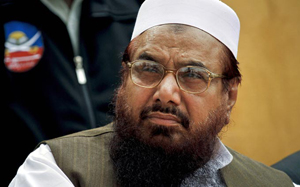
Will not allow Hindu temples in Pakistan to be destroyed: Hafiz Saeed

May 3, 2016

Islamabad May 3: Chief of Pakistan's banned JuD, Hafiz Saeed, has said his organisation will not allow destruction of Hindu temples and other holy places of non- Muslims in the country.hafiz-saeed

It was Muslims' responsibility to safeguard holy places of their Hindus brethren, he said while addressing a meeting in Matli town of Sindh province yesterday.

“We will not allow destruction of temples and other holy places of non-Muslims in the country,” he warned.

The Jamaat-ud-Dawa (JuD) chief rejected allegations that his organisation is promoting extremism in Thar area of Sindh, which borders India, by opening seminaries in the poverty- stricken arid region.

Saeed also pledged support for Kashmiri Muslims, according to a Dawn report.

He said the law enforcement agencies were sincerely trying to fight against anti-state actors and RAW agents but the Nawaz Sharif government remained silent over it.

Comments

KhasaiKhaane
 - 
Wednesday, 4 May 2016

Hafiz Saeed - The Yogi Atidyanath of Pakistan? I think the latter is much worse since this statement from the former.

Satyameva jayate
 - 
Tuesday, 3 May 2016

@sumesh....
Yaar we all know your holy books all about war between famalies and gods for women.... Come on .. You dont know what other relegions teach... At least study your own real books.. Not story books...
Hafiz saeed is a useless goon lik

Add new comment

  • Coastaldigest.com reserves the right to delete or block any comments.
  • Coastaldigset.com is not responsible for its readers’ comments.
  • Comments that are abusive, incendiary or irrelevant are strictly prohibited.
  • Please use a genuine email ID and provide your name to avoid reject.
News Network
April 29,2020

New Delhi, Apr 29: Karnataka is likely to withdraw the case filed against a CRPF commando who was arrested by state police officials for alleged assault on them during COVID-19 lockdown duty in Belgaum, a charge contested by the paramilitary Central Reserve Police Force.

In a bid to diffuse the ongoing tussle between CRPF and Karnataka police, the official communication sent to CRPF headquarters on Tuesday, with the details of bail granted to CRPF jawan Sunil Sachin Sawant, stated that the issue was discussed with the DGP Karnataka and other senior state authorities with a request to withdraw the case.

According to official communication, Karnataka Director General of Police has assured top CRPF officers that the "case registered against CRPF CoBRA commando is likely to be withdrawn by the state authorities".

The communication also states that "they assured that the criminal case registered against constable of 207 CoBRA BN is likely to be withdrawn by the state authority."

A CRPF CoBRA commando was thrashed and dragged to police station barefoot by police on April 23 for allegedly violating lockdown norms and assaulting/deterring public servant from discharging his duty in Belgavi district of Karnataka. A case was also registered against him.

This is not the first time when the state is showing efforts to solve the matter amicably.

Karnataka culture and tourism minister CT Ravi had also tweeted on April 27 claiming that he had a word with two ministers including state deputy chief minister who 'confirmed that the issue will be resolved amicably'

"Unfortunate that this incident happened with a CRPF Commando and the police. I have spoken with Industries Minister @JagadishShettar and Transport Minister @LaxmanSavadi. Both have confirmed that the issue will be resolved amicably," CT Ravi had tweeted.

CRPF Additional Director General (ADG) Sanjay Arora had also written to DG showing his displeasure over the ill-treatment done by Karnataka police with CRPF jawan and had said that "Keeping in view the gravity of the incident and its impact on the relationship between the two police forces, I am desired by the Director-General CRPF to request you to kindly get the matter inquired and provide justice. We would be thankful if you could inform us of the outcome."

Arora, in his letter, had also said that Karnataka police should have informed the force before registering a case.

The CRPF CbBRA commando was on extended leave and cleaning his motorcycle in front of his house in Examba city when he was allegedly manhandled and ill-treated in front of his family members and paraded to the police station barefoot, where he was kept in chains and handcuff.

The commando was granted bail by a court on Tuesday in the matter.

Sunil Sachin Sawant has been involved in various anti-Naxals operations and is a part of the CRPF elite CoBRA force, which is famous for doing anti-Naxals operations and has eliminated hundreds of Naxals in the past few years.

Comments

Add new comment

  • Coastaldigest.com reserves the right to delete or block any comments.
  • Coastaldigset.com is not responsible for its readers’ comments.
  • Comments that are abusive, incendiary or irrelevant are strictly prohibited.
  • Please use a genuine email ID and provide your name to avoid reject.
News Network
May 15,2020

Kalaburagi, May 15: Former Karnataka Minister Dr Sharanprakash Patil and 22 others, including several local Congress leaders, have been booked for violating lockdown guidelines by conducting a meeting at a convention hall in Sulpeth town on May 13.

The FIR was registered on Thursday against 23 persons, including the former MLA and 21 local Congress leaders, under Section 188 (disobedience to order duly promulgated by a public servant) of the Indian Penal Code (IPC).

Congress leader Patil and his followers had conducted a meeting at a convention hall in Sulpeth town on May 13, following which sectoral magistrate Muneer Ahmed lodged a complaint.

This comes as the country of under lockdown and the Centre and states have issued strict social distancing and other norms to be followed to prevent the spread of coronavirus.

Comments

Add new comment

  • Coastaldigest.com reserves the right to delete or block any comments.
  • Coastaldigset.com is not responsible for its readers’ comments.
  • Comments that are abusive, incendiary or irrelevant are strictly prohibited.
  • Please use a genuine email ID and provide your name to avoid reject.
Media Release
February 14,2020

Veteran journalist P. Sainath has said that the nation is in a crisis. And this crisis is not limited to just the rural area. It has become a national crisis at various areas such as agriculture, education, economy, job creation etc.

He was delivering the endowment lecture on the topic ‘Indian democracy at the post-liberalization and post-truth era’ at Media Manthan 2020 organized by the PG department of journalism and mass communication at St Aloysius College (Autonomous). 

Mr Sainath said that the many policies adopted in the 90s led to India becoming unusually unequal. Referring to the speech Ambedkar had made at the Constituent Assembly while handing over the draft of the Constitution, Mr Sainath said, “Ambedkar had warned about the weakness of Indian democracy that liberty without equality allows the supremacy of a few over the multitude. Liberty, equality and fraternity must be kept together as we cannot have one without the other.” 

Mr Sainath stated that the agrarian crisis was no longer about the loss of productivity, employment or about farmer suicide; it was a societal, civilizational crisis. Commenting on the lopsided policies such as cow-slaughter ban, he explained how cow slaughter ban had adversely affected many industries due to their interdependency. While Muslims who slaughtered cows were rendered helpless, the cattle traders who were mostly OBCs lost their earnings as the cattle prices crashed. An important industry like Kolhapur sandals industry in Maharashtra went bankrupt as a result of the cow slaughter ban in Maharashtra. He said the policymakers had no idea how the rural industries were interconnected. Demonetisation too devastated the rural economy as 98 percent of rural transactions happen through cash. 

Mr Sainath also spoke about the crisis of inequality which affects the Dalits and the Adivasis far more than anyone else as 90 percent of the rural households take home less than Rs 10,000/- per month. “Women are yet another group whose labour is never counted in the gross domestic product. Women and girls globally do unpaid work which amounts to about 12.5 billion working hours per year. Monetarily speaking, this is worth 10.8 trillion dollars,” Mr Sainath added. 

Speaking about the crisis of jobs Mr Sainath said that major companies were laying off employees just to create more profits for the investors and the adoption of artificial intelligence in the industry would further destroy millions of jobs.

Rector of St Aloysius College Institutions Fr Dionysius Vaz SJ, Principal Dr (Fr) Praveen Martis SJ, HOD of Journalism and Mass Communication department Dr (Fr) Melwyn Pinto SJ were present.

‘Veerappan and Vijay Mallya’s business models are interesting!’

Addressing the gathering during his endowment lecture on Friday, Mr Sainath made an interesting comment on the so called ‘revenue model’. “Whenever I visit IIMs and IITs for lectures on my PARI project, the students there ask me what my revenue model for my project is. I tell them that I do not have a revenue model. In fact, journalism does not begin with a revenue model. Gandhiji, Ambedkar, Bhagat Singh were all great journalists. But they did not have a revenue model,” Mr Sainath said.

On a lighter note, he said that the best revenue model that he liked was that of forest brigand Veerappan and liquor baron Vijay Mallya. “Veerappan ruled the forest for forty years and from the top ministers to the villagers he could dictate terms and liver royally. Similarly, Mallya’s revenue model was to steal the banks and run away abroad and live like a king,” Mr Sainath added.

Journalism is not and can never be a business. It is a calling, he opined. While newspaper can be a business, television can be a business, journalism per se cannot be reduced to a business. “Unfortunately today, journalists are recruited on a contract basis and they have no bargaining power; and there are no unions to fight for their cause. Hence, they are at the mercy of the corporate media houses for their survival and are made to write stories that cannot be called journalism,” Mr Sainath said.

Answering a question as to the pressures he faced as a journalist, he said that external pressures from the government or others could be very well handled. It is the internal pressures from once own media house that journalists find it difficult to manage.


 

Comments

Add new comment

  • Coastaldigest.com reserves the right to delete or block any comments.
  • Coastaldigset.com is not responsible for its readers’ comments.
  • Comments that are abusive, incendiary or irrelevant are strictly prohibited.
  • Please use a genuine email ID and provide your name to avoid reject.