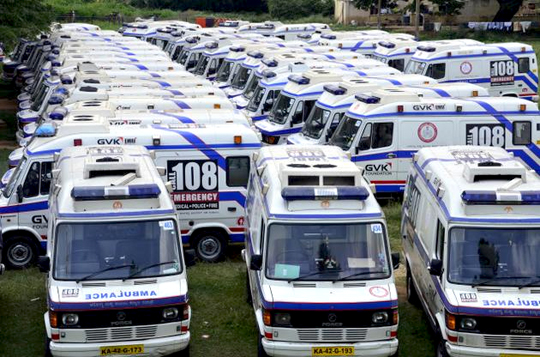
Will terminate pact if 108 failed to ensure better service: UT Khader

[email protected] (CD Network)
January 17, 2016

Bengaluru, Jan 17: UT Khader, minister for health and family welfare, has threatened to terminate agreement with GVK EMRI, a private agency, that runs the ‘108’ ambulance service if it failed to ensure quality and disciplined service.

108

At a press conference here Mr Khader warned that the staff of the ‘108’ ambulance had not been providing efficient service. “Taking patients to private hospitals, poor maintenance of vehicles, wearing dirty clothes, and parking ambulances outside hotels etc. are not good signs” from the view point of public, he said.

The ambulance staff have threatened to go on strike from next week seeking higher pay.

“We will run ambulance service, let them go on strike. Lack of discipline will not be tolerated. We will take action against GVK,” the Minister said, and threatened to terminate the contract with the private firm if the latter failed to provide quality service.

The Minister said an order was issued on January 14, 2016, for increasing the salary of emergency medical technicians and pilots for the ambulance service. The order would be kept in abeyance if the staff goes on strike next week.

The increased salary costs the State exchequer Rs. 6.64 crore a year, he said.

The Minister said a group with the ‘108’ ambulance employees had been blackmailing the government and encouraging drivers to go on strike.

Comments

rikaz
 - 
Sunday, 17 Jan 2016

for government 6.64 crore is not a big deal....

Add new comment

  • Coastaldigest.com reserves the right to delete or block any comments.
  • Coastaldigset.com is not responsible for its readers’ comments.
  • Comments that are abusive, incendiary or irrelevant are strictly prohibited.
  • Please use a genuine email ID and provide your name to avoid reject.
News Network
June 5,2020

Bengaluru, Jun 5: A COVID-19 patient, who was admitted to Victoria hospital, has recovered from the disease after he was administered convalescent plasma therapy.

He is the second patient in the state who has recovered from COVID-19 after the therapy.

"I am happy to inform the second plasma therapy patient has recovered and shifted out of ICU. This middle-aged patient was admitted in Victoria hospital ICU with severe COVID-19 illness and was also diabetic with poor sugar control," Dr Vishal Rao, HCG Hospital Bengaluru said.

"The patient received convalescent plasma on May 27, since then there was steady improvement in patient's condition and was taken off high flow nasal oxygen on June 2, 2020, and is at present on a minimal oxygen, shifted toward yesterday. With the rapid recovery we hope to discharge the patient soon," he said.

Speaking further, Rao said: "This is a significant improvement and reassuring. We hope to see him recover completely and will closely monitor the condition going forward to send the patient from ward to home."

In Karnataka, 4,320 coronavirus cases have been reported including 1,610 cured/discharged/migrated and 57 deaths, according to the Ministry of Health and Family Welfare. 

Comments

Add new comment

  • Coastaldigest.com reserves the right to delete or block any comments.
  • Coastaldigset.com is not responsible for its readers’ comments.
  • Comments that are abusive, incendiary or irrelevant are strictly prohibited.
  • Please use a genuine email ID and provide your name to avoid reject.
News Network
January 9,2020

Mangaluru, Jan 9: A forest guard was arrested caught red-hand by Anti-Corruption Bureau (ACB) officials while accepting Rs 3,000 bribe from a person for granting permission to cut Mahogany trees for his personal use, a statement said on Thursday.

According to the statement, the arrested identified as N Sudheer sought bribe of Rs 15,000 from Gopalakrishna Herale, a resident of Beltangady.

Mr Herale, in a complaint, lodged on January 7 said that he had sought a permit from the forest department for cutting of Mahogany trees purchased by him.

Comments

Add new comment

  • Coastaldigest.com reserves the right to delete or block any comments.
  • Coastaldigset.com is not responsible for its readers’ comments.
  • Comments that are abusive, incendiary or irrelevant are strictly prohibited.
  • Please use a genuine email ID and provide your name to avoid reject.
Agencies
May 8,2020

Washington D.C., May 8: The prime time for brain development in a child's life is the first year, where the infant spends most of the time asleep. It is the time when neural connections form and sensory memories are encoded.

However, when sleep is disrupted, as occurs more often among children with autism, brain development may be affected, too.

New research led by the University of Washington finds that sleep problems in a baby's first 12 months may not only precede an autism diagnosis but also may be associated with altered growth trajectory in a key part of the brain, the hippocampus.

The study, which was published in the American Journal of Psychiatry, researchers report that in a sample of more than 400 taken of 6- to 12-month-old infants, those who were later diagnosed with autism were more likely to have had difficulty falling asleep.

It also states that this sleep difficulty was associated with altered growth trajectories in the hippocampus.

"The hippocampus is critical for learning and memory, and changes in the size of the hippocampus have been associated with poor sleep in adults and older children.

As many as 80 per cent of the children with autism spectrum disorder have sleep problems," said Annette Estes, director of the UW Autism Center and senior author of the study.

"In our clinical experience, parents have a lot of concerns about their children's sleep, and in our work on early autism intervention, we observed that sleep problems were holding children and families back," added Estes, who is also a UW professor of speech and hearing sciences.

"It could be that altered sleep is part-and-parcel of autism for some children. One clue is that behavioural interventions to improve sleep don't work for all children with autism, even when their parents are doing everything just right. This suggests that there may be a biological component to sleep problems for some children with autism," said Estes.

To consider links among sleep, brain development, and autism, researchers at the IBIS Network looked at MRI scans of 432 infants, surveyed parents about sleep patterns, and measured cognitive functioning using a standardized assessment.

At the outset of the study, infants were classified according to their risk for developing autism: Those who were at higher risk of developing autism -- about two-thirds of the study sample -- had an older sibling who had already been diagnosed.

Infant siblings of children with autism have a 20 per cent chance of developing autism spectrum disorder -- a much higher risk than children in the general population.

In the current study, 127 of the 432 infants were identified as "low risk" at the time the MRI scans were taken because they had no family history of autism.

They later evaluated all the participants at 24 months of age to determine whether they had developed autism. Of the roughly 300 children originally considered "high familial risk," 71 were diagnosed with autism spectrum disorder at that age.

Problems with sleep were more common among the infants later diagnosed with an autism spectrum disorder, as were larger hippocampi. No other subcortical brain structures were affected, including the amygdala, which is responsible for certain emotions and aspects of memory, or the thalamus, a signal transmitter from the spinal cord to the cerebral cortex.

The authors note that while parents reported more sleep difficulties among infants who developed autism compared to those who did not, the differences were very subtle and only observed when looking at group averages across hundreds of infants.

Sleep patterns in the first years of life change rapidly as infants transition from sleeping around the clock to a more adult-like sleep/wake cycle. Until further research is completed, Estes said, it is not possible to interpret challenges with sleep as an early sign of increased risk for autism.


Comments

Add new comment

  • Coastaldigest.com reserves the right to delete or block any comments.
  • Coastaldigset.com is not responsible for its readers’ comments.
  • Comments that are abusive, incendiary or irrelevant are strictly prohibited.
  • Please use a genuine email ID and provide your name to avoid reject.