


Will terminate pact if 108 failed to ensure better service: UT Khader

[email protected] (CD Network)
January 17, 2016

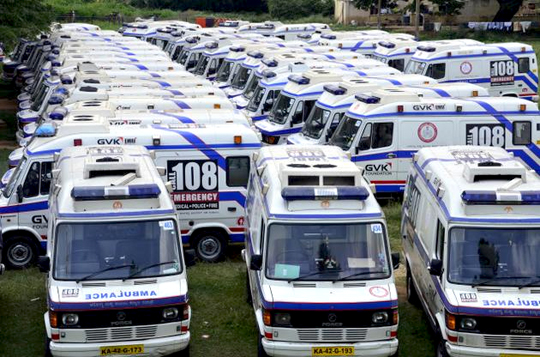
Bengaluru, Jan 17: UT Khader, minister for health and family welfare, has threatened to terminate agreement with GVK EMRI, a private agency, that runs the ‘108’ ambulance service if it failed to ensure quality and disciplined service.
108

At a press conference here Mr Khader warned that the staff of the ‘108’ ambulance had not been providing efficient service. “Taking patients to private hospitals, poor maintenance of vehicles, wearing dirty clothes, and parking ambulances outside hotels etc. are not good signs” from the view point of public, he said.

The ambulance staff have threatened to go on strike from next week seeking higher pay.

“We will run ambulance service, let them go on strike. Lack of discipline will not be tolerated. We will take action against GVK,” the Minister said, and threatened to terminate the contract with the private firm if the latter failed to provide quality service.

The Minister said an order was issued on January 14, 2016, for increasing the salary of emergency medical technicians and pilots for the ambulance service. The order would be kept in abeyance if the staff goes on strike next week.

The increased salary costs the State exchequer Rs. 6.64 crore a year, he said.

The Minister said a group with the ‘108’ ambulance employees had been blackmailing the government and encouraging drivers to go on strike.

Comments

rikaz
 - 
Sunday, 17 Jan 2016

for government 6.64 crore is not a big deal....

Add new comment

  • Coastaldigest.com reserves the right to delete or block any comments.
  • Coastaldigset.com is not responsible for its readers’ comments.
  • Comments that are abusive, incendiary or irrelevant are strictly prohibited.
  • Please use a genuine email ID and provide your name to avoid reject.
News Network
July 21,2020

Bengaluru, Jul 21: The total number of Covid-19 cases in Karnataka breached the 70,000 mark on Tuesday as the state reported 3,649 fresh infections, while 61 fatalities took the death toll to 1,464, the health department said.

The day also saw 1,664 patients getting discharged after recovery. Out of 3,649 fresh cases reported on Tuesday, a whopping 1,714 were from Bengaluru urban alone. As of July 21 evening, cumulatively 71,069 Covid-19 cases have been confirmed in Karnataka, which includes 1,464 deaths and 25,459 discharges, the health department said in its bulletin.

It said that out of the 44,140 active cases, 43,557 patients are in isolation at designated hospitals and are stable, while 583 are in Intensive Care Units.

Twenty-two out of 61 deaths reported on Tuesday are from Bengaluru urban, followed by five each from Dakshina Kannada, Mysuru and Dharwad, four each from Kolar and Belagavi, three each from Hassan, Tumakuru and Haveri, Bidar 2, and one each from Chikkaballapura, Chikkamagaluru, Chamarajanagara, Gadag and Vijayapura.

Most of the deceased either had a history of Severe Acute Respiratory Infection (SARI) or Influenza-like illness (ILI). Out of 3,649 cases tested positive on Tuesday, contacts of the large number of the cases are still under tracing.

Among the districts where new cases were reported, Bengaluru urban accounted for 1,714, Ballari 193, Dakshina Kannada 149, Mysuru 135, Yadgir 117, Uttara Kannada 109, Hassan 107, Kolar 103, followed by others.

Bengaluru urban district topped the list of positive cases, with 34,943 infections, followed by Dakshina Kannada 3,829 and Kalaburagi 2,966. Among discharges Bengaluru urban was on top with 7,476 discharges, followed by Kalabuagi 1,834 and Udupi 1,731.

A total of 10,64,734 samples were tested so far, out of which 43,904 were tested on Tuesday alone, the bulletin said. It said that 19,328 of the 43,904 samples tested today were rapid antigen tests.

Comments

Add new comment

  • Coastaldigest.com reserves the right to delete or block any comments.
  • Coastaldigset.com is not responsible for its readers’ comments.
  • Comments that are abusive, incendiary or irrelevant are strictly prohibited.
  • Please use a genuine email ID and provide your name to avoid reject.
News Network
June 18,2020

Bengaluru, Jun 18: Two employees at a plant of Toyota Kirloskar Motor in Karnataka's Bidadi have tested positive for COVID-19, the automobile company said in a statement on Wednesday.

According to the auto major, the two employees had attended work on June 7 and 16 respectively.

"As a first step and through appropriate contact tracing, TKM has started identifying all those employees who may have had primary or secondary contact with the infected employees for necessary treatment and quarantine wherever necessary and is in contact with the local government authorities," the statement said.

Toyota Kirloskar Motors had restarted operations after weeks of nationwide lockdown to prevent the spread of coronavirus on May 26. It said that all necessary precautions were to maintain social distancing and all Central and state government directives were being followed.

"However, despite all such measures, two employees at TKM's Bidadi plant tested positive for COVID-19 on June 16th, 2020. Operations at TKM plant has already been temporarily suspended so that required disinfection can be carried out at the plant," the statement said.

"TKM has extended all necessary support to the infected employees for medical treatment as well as quarantine procedures. The company is in touch with the families of the infected employees so as to support them to handle this situation carefully without further complications," it added.


Comments

Add new comment

  • Coastaldigest.com reserves the right to delete or block any comments.
  • Coastaldigset.com is not responsible for its readers’ comments.
  • Comments that are abusive, incendiary or irrelevant are strictly prohibited.
  • Please use a genuine email ID and provide your name to avoid reject.
Media Release
February 14,2020

Veteran journalist P. Sainath has said that the nation is in a crisis. And this crisis is not limited to just the rural area. It has become a national crisis at various areas such as agriculture, education, economy, job creation etc.

He was delivering the endowment lecture on the topic ‘Indian democracy at the post-liberalization and post-truth era’ at Media Manthan 2020 organized by the PG department of journalism and mass communication at St Aloysius College (Autonomous). 

Mr Sainath said that the many policies adopted in the 90s led to India becoming unusually unequal. Referring to the speech Ambedkar had made at the Constituent Assembly while handing over the draft of the Constitution, Mr Sainath said, “Ambedkar had warned about the weakness of Indian democracy that liberty without equality allows the supremacy of a few over the multitude. Liberty, equality and fraternity must be kept together as we cannot have one without the other.” 

Mr Sainath stated that the agrarian crisis was no longer about the loss of productivity, employment or about farmer suicide; it was a societal, civilizational crisis. Commenting on the lopsided policies such as cow-slaughter ban, he explained how cow slaughter ban had adversely affected many industries due to their interdependency. While Muslims who slaughtered cows were rendered helpless, the cattle traders who were mostly OBCs lost their earnings as the cattle prices crashed. An important industry like Kolhapur sandals industry in Maharashtra went bankrupt as a result of the cow slaughter ban in Maharashtra. He said the policymakers had no idea how the rural industries were interconnected. Demonetisation too devastated the rural economy as 98 percent of rural transactions happen through cash. 

Mr Sainath also spoke about the crisis of inequality which affects the Dalits and the Adivasis far more than anyone else as 90 percent of the rural households take home less than Rs 10,000/- per month. “Women are yet another group whose labour is never counted in the gross domestic product. Women and girls globally do unpaid work which amounts to about 12.5 billion working hours per year. Monetarily speaking, this is worth 10.8 trillion dollars,” Mr Sainath added. 

Speaking about the crisis of jobs Mr Sainath said that major companies were laying off employees just to create more profits for the investors and the adoption of artificial intelligence in the industry would further destroy millions of jobs.

Rector of St Aloysius College Institutions Fr Dionysius Vaz SJ, Principal Dr (Fr) Praveen Martis SJ, HOD of Journalism and Mass Communication department Dr (Fr) Melwyn Pinto SJ were present.

‘Veerappan and Vijay Mallya’s business models are interesting!’

Addressing the gathering during his endowment lecture on Friday, Mr Sainath made an interesting comment on the so called ‘revenue model’. “Whenever I visit IIMs and IITs for lectures on my PARI project, the students there ask me what my revenue model for my project is. I tell them that I do not have a revenue model. In fact, journalism does not begin with a revenue model. Gandhiji, Ambedkar, Bhagat Singh were all great journalists. But they did not have a revenue model,” Mr Sainath said.

On a lighter note, he said that the best revenue model that he liked was that of forest brigand Veerappan and liquor baron Vijay Mallya. “Veerappan ruled the forest for forty years and from the top ministers to the villagers he could dictate terms and liver royally. Similarly, Mallya’s revenue model was to steal the banks and run away abroad and live like a king,” Mr Sainath added.

Journalism is not and can never be a business. It is a calling, he opined. While newspaper can be a business, television can be a business, journalism per se cannot be reduced to a business. “Unfortunately today, journalists are recruited on a contract basis and they have no bargaining power; and there are no unions to fight for their cause. Hence, they are at the mercy of the corporate media houses for their survival and are made to write stories that cannot be called journalism,” Mr Sainath said.

Answering a question as to the pressures he faced as a journalist, he said that external pressures from the government or others could be very well handled. It is the internal pressures from once own media house that journalists find it difficult to manage.


Comments

Add new comment

  • Coastaldigest.com reserves the right to delete or block any comments.
  • Coastaldigset.com is not responsible for its readers’ comments.
  • Comments that are abusive, incendiary or irrelevant are strictly prohibited.
  • Please use a genuine email ID and provide your name to avoid reject.