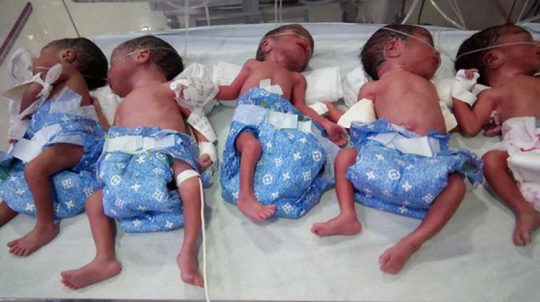
Woman gives birth to 5 baby girls in 6 months of pregnancy

April 3, 2016

Raipur, Apr 3: In what Chhattisgarh doctors claimed to be the first case in India, a woman gave birth to Quintuplets (five babies at once), that too in just six months of pregnancy.

Chhattisgarh

All the pre-mature baby girls who were born at district hospital in Ambikapur on Saturday morning have been kept in Neo-natal Intensive Care Unit (NICU) because of their low-birth weight.

The hospital staff called them "five star" babies and rightly so because they are probably the "most premature" quintuplets babies born in India so far. The proud parents, 25-year-old Manita Kumari and her husband Mahesh are happy to have five baby girls and are praying for each child to remain alive.

Manita is a house-wife and had lost her first pre-mature child after three months of her birth in 2014.

The babies born through normal delivery, around 10 am on Saturday, are so tiny that they could fit in single tray. Even being the pre-mature quintuplets, all the body parts of the new born are fully developed. For the record, a foetus's lungs, brain and eyes are hardly fully developed in the fifth month or the second trimester. The one with the lowest weight among the five is of 1 kg while the heaviest is of 1.5 kg.

"Our gynaecologist's observation says that the babies are premature and took birth in between six to seven months of pregnancy. They all have very low birth weight (LBW) and the survival of such LBW children in the best of hospitals is abysmally low," said Dr NP Pandey, chief superintendent of Ambikapur district hospital.

Comments

A. Mangalore
 - 
Monday, 4 Apr 2016

May Allah protect them and give them good health , so that they can be seen as a proud 5 star childrens of their creator.

Add new comment

  • Coastaldigest.com reserves the right to delete or block any comments.
  • Coastaldigset.com is not responsible for its readers’ comments.
  • Comments that are abusive, incendiary or irrelevant are strictly prohibited.
  • Please use a genuine email ID and provide your name to avoid reject.
News Network
May 21,2020

Bengaluru, May 21: With temples yet to open for devotees as coronavirus restrictions are in place, the Karnataka government is preparing for live streaming of sevas (service) and poojas offered to deities at temples that comes under the state's Hindu Religious Institutions and Charitable Endowment Department.

The government has also decided to develop an app and web-based software with an intention to provide information to devotees regarding temples, also to facilitate online donations and advance booking for various sevas offered there.

Regarding online live streaming, Commissioner of the Hindu Religious Institutions and Charitable Endowment Department has written to the Deputy Commissioners of all the districts and Executive Officers seeking a list of temples that comes under their jurisdiction where such facility can be provided.

"It has been intended to do online live streaming of sevas and pooja rituals at temples that come under the department in the backdrop of COVID-19 crisis. In this regard it is requested to provide a list of temples where online live facility can be provided to devotees, by abiding the traditions and practices of the temple," the letter said.

Though the temples are holding daily poojas and rituals, they are not open to public for now, with COVID-19 induced lockdown restrictions in place.

Officials had recently had stated that the department was planning to have a standard operating procedure (SOP) in place, that needs to be followed at temples in a post lockdown scenario, once they are opened for the public.

There are over 34,000 temples in the state that come under the department.

Meanwhile, in another letter to DCs of 15 districts, also Executive officers and administrators of 'A' grade temples, aimed at development of app and web-based software, the Commissioner has sought information regarding sevas offered at temples in their jurisdictions and those sevas for which option can be provided for devotees to do advance booking.

Comments

Add new comment

  • Coastaldigest.com reserves the right to delete or block any comments.
  • Coastaldigset.com is not responsible for its readers’ comments.
  • Comments that are abusive, incendiary or irrelevant are strictly prohibited.
  • Please use a genuine email ID and provide your name to avoid reject.
Agencies
May 8,2020

Washington D.C., May 8: The prime time for brain development in a child's life is the first year, where the infant spends most of the time asleep. It is the time when neural connections form and sensory memories are encoded.

However, when sleep is disrupted, as occurs more often among children with autism, brain development may be affected, too.

New research led by the University of Washington finds that sleep problems in a baby's first 12 months may not only precede an autism diagnosis but also may be associated with altered growth trajectory in a key part of the brain, the hippocampus.

The study, which was published in the American Journal of Psychiatry, researchers report that in a sample of more than 400 taken of 6- to 12-month-old infants, those who were later diagnosed with autism were more likely to have had difficulty falling asleep.

It also states that this sleep difficulty was associated with altered growth trajectories in the hippocampus.

"The hippocampus is critical for learning and memory, and changes in the size of the hippocampus have been associated with poor sleep in adults and older children.

As many as 80 per cent of the children with autism spectrum disorder have sleep problems," said Annette Estes, director of the UW Autism Center and senior author of the study.

"In our clinical experience, parents have a lot of concerns about their children's sleep, and in our work on early autism intervention, we observed that sleep problems were holding children and families back," added Estes, who is also a UW professor of speech and hearing sciences.

"It could be that altered sleep is part-and-parcel of autism for some children. One clue is that behavioural interventions to improve sleep don't work for all children with autism, even when their parents are doing everything just right. This suggests that there may be a biological component to sleep problems for some children with autism," said Estes.

To consider links among sleep, brain development, and autism, researchers at the IBIS Network looked at MRI scans of 432 infants, surveyed parents about sleep patterns, and measured cognitive functioning using a standardized assessment.

At the outset of the study, infants were classified according to their risk for developing autism: Those who were at higher risk of developing autism -- about two-thirds of the study sample -- had an older sibling who had already been diagnosed.

Infant siblings of children with autism have a 20 per cent chance of developing autism spectrum disorder -- a much higher risk than children in the general population.

In the current study, 127 of the 432 infants were identified as "low risk" at the time the MRI scans were taken because they had no family history of autism.

They later evaluated all the participants at 24 months of age to determine whether they had developed autism. Of the roughly 300 children originally considered "high familial risk," 71 were diagnosed with autism spectrum disorder at that age.

Problems with sleep were more common among the infants later diagnosed with an autism spectrum disorder, as were larger hippocampi. No other subcortical brain structures were affected, including the amygdala, which is responsible for certain emotions and aspects of memory, or the thalamus, a signal transmitter from the spinal cord to the cerebral cortex.

The authors note that while parents reported more sleep difficulties among infants who developed autism compared to those who did not, the differences were very subtle and only observed when looking at group averages across hundreds of infants.

Sleep patterns in the first years of life change rapidly as infants transition from sleeping around the clock to a more adult-like sleep/wake cycle. Until further research is completed, Estes said, it is not possible to interpret challenges with sleep as an early sign of increased risk for autism.


Comments

Add new comment

  • Coastaldigest.com reserves the right to delete or block any comments.
  • Coastaldigset.com is not responsible for its readers’ comments.
  • Comments that are abusive, incendiary or irrelevant are strictly prohibited.
  • Please use a genuine email ID and provide your name to avoid reject.
News Network
February 5,2020

Bengaluru, Feb 5: The Karnataka government on Tuesday launched the Janasevaka scheme in a few municipal corporation wards to ensure home delivery of various services like ration cards, senior citizen identity and health cards.

The scheme, which was launched by Chief Minister B S Yediyurappa, will pertain to 53 services involving 11 departments.

"Janasevaka under the Sakala scheme is a programme to avail the benefits of government schemes at the doorstep. Our objective is to make the lives of the citizens of Karnataka easy by launching this scheme," the Chief Minister said. Sakala aims to ensure in-time delivery of government services to citizens by practising innovative and efficient management systems through capacity building in government and empowering citizens to exercise their right to service.

Minister for Sakala and Primary and Secondary Education S Suresh Kumar said: "The scheme that was implemented in Dasarahalli area on a pilot basis will now be extended to Mahadevapura, Bommanahalli and Rajajinagar areas."

He added that it will benefit the senior citizens of the city.

If the scheme works well, it will be implemented across Bengaluru in all the 27 assembly segments, Kumar said, adding that based on the experiment in Bengaluru, it will be extended to Mysuru, Mangaluru and Hubballi-Dharwad.

Under the scheme, there will be one volunteer in each ward. These volunteers have been outsourced. A toll-free helpline has been set up for this scheme which will work from 8 am to 8 pm.

A sum of Rs 115 will be charged to provide the home delivery services.

In addition to it, the Karnataka government has also decided to seek information under the RTI Act easy by making it online.

People can apply from home by paying the fee online. This will make the process hassle-free, the Chief Minister said.

Comments

Add new comment

  • Coastaldigest.com reserves the right to delete or block any comments.
  • Coastaldigset.com is not responsible for its readers’ comments.
  • Comments that are abusive, incendiary or irrelevant are strictly prohibited.
  • Please use a genuine email ID and provide your name to avoid reject.