Women bending to pray at Dargah may show breasts: Haji Ali trustees

[email protected] (CD Network)
August 27, 2016

Mumbai, Aug 27: One of the arguments raised in the court by the Haji Ali Dargah Trust justifying its ban on women inside the inner sanctum, was that the female devotees wearing blouses with wide necks bend on the mazaar thus showing their breasts.

dargahajialiIn a significant judgement, the Bombay High Court on Friday lifted the ban imposed on women from entering the sanctum sanctorum of Haji Ali dargah. The ban was imposed somewhere between March and June 2012 by the Haji Ali Dargah Trust.

Safety and security of women is another prominent reason given by the Trust to justify the ban. It said that ensuring safety of women from sexual harassment was its responsibility.

The trust also cited complaints they had received from women, of belongings being stolen and of eve-teasing, and hence rationalised the ban.

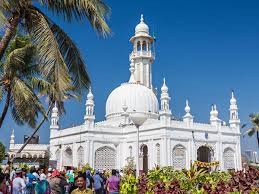
The Haji Ali Dargah is a mosque and dargah (tomb) located on an islet off the coast of Worli in the southern part of Mumbai. Near the heart of the city proper, the dargah is one of the most recognisable landmarks of Mumbai.

An exquisite example of Indo-Islamic Architecture, associated with legends about doomed lovers, the dargah contains the tomb of Sayed Peer Haji Ali Shah Bukhari.

The Haji Ali Dargah was constructed in 1431 in memory of a wealthy Muslim merchant, Sayyed Peer Haji Ali Shah Bukhari, who gave up all his worldly possessions before making a pilgrimage to Makkah. Hailing from Bukhara, in present-day Uzbekistan, Bukhari travelled around the world in the early to mid 15th century, and eventually settled in present-day Mumbai.

Also Read: HC allows women's entry in Haji Ali dargah, order stayed for 6 weeks

Comments

Muslim
 - 
Sunday, 28 Aug 2016

Please be a muslim and stop going to dargahs, it is prohibited in Islam, Dargahs nothing but a grave, don't expect any help from deceased, seek help from Allah only, real muslims will never go to Dargahs.

Ahmed
 - 
Sunday, 28 Aug 2016

Dear Non Muslim Brothers.
I was going through your comments.One thing i would like to clarify with you is that do not judge Islam by seeing other's rather try to learn later you can judge your own.Islam never entertain Darga or Darga Pooja it is the people who added in Islam for their benefits where as Allah almighty do not need any Mediator.Learn Islam before its too late.

Ahmed Ali K
 - 
Saturday, 27 Aug 2016

Question to the trustee
Who is watching breast of female visitors?

Ahmed K. C.
 - 
Saturday, 27 Aug 2016

Dargah is not meant for those who believe in \Tawheed\"."

abdul
 - 
Saturday, 27 Aug 2016

Still it is better than doing Shirq.!

Stop doing shirq & Nobody will show you anything.

Pray to Almighty Allah Only.

muslim ummah
 - 
Saturday, 27 Aug 2016

First of all true religious lady will not visit any dargah ( major shirk) which is haram in Islam.
Secondly how Muslim lady mingle with gents in any public or private place which is also haraam in Islam.
Thirdly looking at ghair mahrum is also haraam in Islam.
So all are eagerly awaiting to do haraam things in life!!! Shabbash...

Sensible
 - 
Saturday, 27 Aug 2016

@ Monu.. have you been to Haji Ali Darga.. go and see how many non-muslims come there and prostrate.. or else the Dargah should pass a rule for all.. to cover oneself with shawl or something to avoid such incidents

Mohammed
 - 
Saturday, 27 Aug 2016

Haraam it is Shirkh for Muslims to pray in Dargah or visit it.

aharkul
 - 
Saturday, 27 Aug 2016

Mr. L.K. Monu

They are referring to non-muslims women entering dargah.,

L K Monu
 - 
Saturday, 27 Aug 2016

Dear Reader.

In Islam women (compulsorily) should wear full covering cloth including all the parts of the body, leg and hand and except only face and 2 palm.

So where is the question of showing breast.

Note: Praying is normally include Rokooh and Sujood i.e. bend the body and Prostration and which is only for Almighty Allah not to Shrine of Bukhari who is buried there.

Now where is the question of Breast show up.

Add new comment

  • Coastaldigest.com reserves the right to delete or block any comments.
  • Coastaldigset.com is not responsible for its readers’ comments.
  • Comments that are abusive, incendiary or irrelevant are strictly prohibited.
  • Please use a genuine email ID and provide your name to avoid reject.
News Network
March 6,2020

Bengaluru, Mar 6: In the face of unprecedented economic difficulties, Chief Minister B S Yediyurappa has chosen to hike the prices of fuel and liquor to fund development in his 2020-21 Budget, which tries to offer something for everybody with the available resources.

Yediyurappa announced a 3% hike in the rate of tax on petrol and diesel. This will result in the prices of petrol going up by Rs 1.60 per litre and diesel by Rs 1.59 per litre. This is expected to fetch the government Rs 1,500 crore.

By hiking additional excise duty on Indian Made Liquor (IML) by 6%, the government hopes to mop up Rs 1,200 crore.

In essence, Yediyurappa, the finance minister, pointed fingers at the Centre for the state’s fiscal woes. He said Karnataka’s share in Central taxes has come down this fiscal by Rs 8,887 crore. Plus, Rs 3,000 crore GST compensation will also be reduced as collections from the GST cess are not on expected lines, he said in his Budget speech. 

“It has become difficult to reach the 2019-20 Budget targets due to these reasons. To manage this situation within the bounds of the Karnataka Fiscal Responsibility Act, it has become inevitable this year to cut down the expenditure of many departments,” he said.

Under the 15th Finance Commission, Karnataka will see a reduction of Rs 11,215 crore in the state’s share of central taxes in 2020-21, Yediyurappa said. He also pointed out that expenditure on salaries, pensions and loan interest payments had risen by Rs 10,000 crore. “Serious difficulties are being faced in resource mobilisation efforts of the state. The state never faced economic difficulties of this magnitude in the previous years,” he said.

But in an attempt to please all, Yediyurappa made announcements across sectors and communities. Instead of the usual department-wise announcements, the CM chose to divide the Budget into six sectors: agriculture & allied activities; welfare & inclusive growth; stimulating economic growth; Bengaluru development; culture, heritage & natural resources and administrative reforms & public service delivery.

Farmers will get additional incentives under PM-KISAN costing Rs 2,600 crore and a waiver of interest on loans they have borrowed from cooperative banks worth Rs 466 crore.

The CM has earmarked Rs 500 crore to start work on the Kalasa-Banduri canals under the Mahadayi project. Also, Yediyurappa has given Rs 1,500 crore to commission the Yettinahole drinking water project.

This project will cater to the districts of Hassan, Chikkamagaluru, Tumakuru, Bengaluru Rural, Ramanagara, Chikkaballapur and Kolar.

For Bengaluru, the CM has made an allocation of Rs 8,772 crore. This includes Rs 500 crore for the suburban rail project, an electric bike taxi project and bus priority lanes.

Significantly, Yediyurappa has not made any allocation to mutts. However, the government will spend Rs 100 crore on the Anubhava Mantapa at Basavakalyan, Rs 66 crore for a 100 ft Kempegowda statue in Bengaluru and Rs 20 crore on a 325 ft statue of Basavanna at the Murugha Mutt in Chitradurga.

The CM has given Rs 305 crore for the development of various communities — Christians (Rs 200 crore), Upparas (Rs 10 crore), Vishwakarma (Rs 25 crore), Ambigara Chaudaiah (Rs 50 crore), Arya Vysya (Rs 10 crore) and Kumbara (Rs 10 crore).

Also, nearly 22.5 lakh government employees and their dependents will get cashless treatment facility for surgical treatment procedures at an estimated annual cost of Rs 50 crore under the Jyothi Sanjini scheme, the CM said.

Comments

Add new comment

  • Coastaldigest.com reserves the right to delete or block any comments.
  • Coastaldigset.com is not responsible for its readers’ comments.
  • Comments that are abusive, incendiary or irrelevant are strictly prohibited.
  • Please use a genuine email ID and provide your name to avoid reject.
Agencies
January 1,2020

For many Indian tycoons, 2019 turned woeful as lenders -- empowered by the nation’s recent bankruptcy law and desperate to clean up soured debt from their books -- started seizing assets of delinquent firms or dragged them into insolvency.

Indian banks wrote off a record $39 billion of loans in the 18 months through September in a bid to repair their balance sheets as they battled the world’s worst bad debt pile. Making matters worse, a shadow banking crisis led to a funding squeeze, crushing debt-laden businesses that were critically dependent on rollover financing.

“Life has come a full circle for tycoons that had enjoyed debt-fueled growth,” said Nirmal Gangwal, founder of distress and debt restructuring advisory firm Brescon & Allied Partners LLP. “Many firms collapsed like a house of cards. The downfall was rather unprecedented.”
The government has also been cracking down on economic crime to assuage public anger over absconding businessmen. It’s even barred some from traveling overseas if they were deemed a flight risk.

Here are some of the country’s biggest and most-storied businessmen who saw their fortunes fade. Spokespersons for none of these tycoons, except Essar, immediately replied to emails and text messages seeking comments.

Anil Ambani

The chairman of Reliance Group, which makes movies to metro lines, had a close shave with jail time in March before his elder brother and Asia’s richest man, Mukesh Ambani, bailed him out at the last minute. The woes of the ex-billionaire came to the fore when India’s top court asked him to pay Ericsson AB’s India unit about $77 million of past dues or go to jail since Anil Ambani, 60, had given a personal guarantee. His telecom carrier slipped into insolvency this year, while unprofitable Reliance Naval & Engineering Ltd. faced a cash crunch. Reliance Capital Ltd. is selling assets to pare debt. Ambani is also fending off Chinese lenders in a London court.

Malvinder & Shivinder Singh

Karma caught up with ex-billionaires and brothers Malvinder Singh, 47, and Shivinder Singh, 44, and how. Scions of a prominent business family, they once helmed India’s top drug maker and second-largest hospital chain. In October, the two were arrested on charges of fraudulently diverting nearly $337 million from a lender they controlled. India’s market regulator found in 2018 that the brothers had defrauded their hospital company of about $56 million. The collapse of the $2 billion empire turned brother against brother, prompting their mother to broker a peace deal that was short-lived. In February, Malvinder accused Shivinder and their spiritual guru of fraud.

Shashikant & Ravikant Ruia

After a hard-fought battle to keep their flagship steel mill, the first-generation entrepreneurs finally saw the bankrupt Essar Steel India Ltd. pass on to ArcelorMittal last month. The $5.9 billion takeover was almost two years in the making with multiple legal wrangles. The group, controlled by Shashikant Ruia, 76, and Ravikant Ruia, 70, were also reprimanded by a U.K. judge in March this year for concealing documents. Started in 1969 as a construction firm, Essar Group diversified, investing about $18 billion between 2008 and 2012, and piled on debt. In 2017, the group had sold another prized asset, Essar Oil.

Selling an asset to pare a liability shouldn’t be seen as a “lost asset,” an Essar spokesman said, adding that the group remains a diversified conglomerate.

VG Siddhartha

Before jumping off a bridge into a river in July in an apparent suicide, the founder of India’s biggest coffee chain Cafe Coffee Day had penned a letter that spoke of pressure from lenders, a private equity firm and harassment by tax officials. He had spent much of the last two years pledging ever more of Coffee Day Enterprises Ltd. shares to refinance loans for ever shorter periods, at ever higher interest rates. “I would like to say I gave it my all,” V.G. Siddhartha, 60, wrote in the letter. “I fought for a long time but today I gave up.”

Naresh Goyal

The former ticketing agent who built India’s largest airline by value, stepped down as chairman of Jet Airways India Ltd. in March, caving in to pressure from banks who took over the company. Cut-throat price wars and surging costs pushed Jet deeper into loss. The airline stopped flying in April and went into bankruptcy two months later as lenders failed to find a buyer. In July, an Indian court barred Naresh Goyal from flying overseas after the government said it was investigating an alleged $2.6 billion fraud involving Jet Airways.

Rana Kapoor

The founder of Yes Bank Ltd., which became India’s fourth-largest non-state lender, tweeted in September 2018 that his shares were invaluable and requested his children never to sell them upon inheritance. But trouble was brewing. The nation’s banking regulator, which found the lender had repeatedly under-reported its bad loans, refused to extend his tenure as chief executive officer. This forced Rana Kapoor, 62, to step down by end-January. Kapoor, who has pledged some of his Yes Bank shares in July, sold almost his entire stake in the lender by October.

Subhash Chandra

The rice trader-turned-media mogul, 69, who brought cable television into Indian homes in the early 1990s with his ZEE TV, resigned as chairman of Zee Entertainment Enterprises Ltd. in November and lost control of his crown jewel. Subhash Chandra has been selling stake in Zee Entertainment in the past few months to repay group’s debt.

Gautam Thapar

A default by Gautam Thapar, founder of the paper mill-to-power transmission Avantha Group, on pledged shares made Yes Bank Ltd. the biggest shareholder in CG Power and Industrial Solutions Ltd. In August, the firm was hit by an accounting scandal forcing the board to remove Thapar, 59, from the chairman’s post. A month later, the market regulator ordered a forensic audit of the firm and barred Thapar from accessing securities market.


Comments

Add new comment

  • Coastaldigest.com reserves the right to delete or block any comments.
  • Coastaldigset.com is not responsible for its readers’ comments.
  • Comments that are abusive, incendiary or irrelevant are strictly prohibited.
  • Please use a genuine email ID and provide your name to avoid reject.
News Network
January 31,2020

Bengaluru, Jan 31: Senior IPS officer Praveen Sood is the new Head of Police Force in Karnataka as the current DG and IG Neelamani Raju today retired.

Praveen Sood, the DIG of CID’s Economic Offences Wing, introduced several reforms that sped up investigation processes. He introduced the Crime and Criminal Tracking Network System all over the state by networking all police stations in the country and ensuring data entry and retrieval of all information in police stations and higher police officers online.

Born in 1964, Sood graduated from IIT Delhi and joined the Indian Police Service in 1986. He kicked off his career as the Assistant Superintendent of Police in Mysuru in 1989. He has served as the SP of Ballari and Raichur before being posted as the Deputy Police Commissioner (Law and Order) of Bengaluru.

In 1999, he served as the police officer on foreign deputation as the police advisor to the Government of Mauritius for 3 years.  He was posted as Police Commissioner of Mysuru City between 2004 and 2007.

He took over as the Additional Commissioner of Police (Traffic) in Bengaluru in 2008 and continued in the post till 2011. He has won the Chief Minister’s Gold Medal for excellence in service in 1996, the Police Medal for Meritorious Service in 2002  and the President’s Police Medal in 2011.

During 2013-14 he took over as Managing Director of Karnataka State Police Housing Corporation. He later worked as the Principal Secretary to the Home  Department as the Additional Director General of Police (Karnataka State Reserve Police) and the ADGP of Administration.

In 2017, he was appointed the Bengaluru Police Commissioner. He was also instrumental in launching “Suraksha” App and “Pink Hoyasalas” managed by all-women police officers.

As the DIG of the CID, Economic offences and Special Units, he is credited for opening the Centre for Cyber-crime Investigation, Training and Research for training police officers, prosecutors and the judiciary in handling cyber crime cases.

Comments

Add new comment

  • Coastaldigest.com reserves the right to delete or block any comments.
  • Coastaldigset.com is not responsible for its readers’ comments.
  • Comments that are abusive, incendiary or irrelevant are strictly prohibited.
  • Please use a genuine email ID and provide your name to avoid reject.